creavoid – Where Innovation Meets the Future

Author: Greg Parnett

  • Boost Efficiency with Automation for Small Business

    Boost Efficiency with Automation for Small Business

    For any small business owner, the list of jobs to do is endless. You're the CEO, the marketer, the bookkeeper, and the customer service rep, all rolled into one. It’s exhausting, and some of those hats are getting seriously heavy.

    When people hear "automation," they often picture complex factory robots. But for you, the reality is much simpler—and frankly, more powerful. It's about using smart technology to take over the repetitive, manual tasks that drain your day, freeing you up to focus on what actually grows your business.

    Why Automation Is Now Essential for Your Business

    This isn't just about shaving a few minutes off your schedule. It’s a core strategy for survival and growth in a competitive world.

    Think about the consultant drowning in a sea of scheduling emails, or the e-commerce shop owner who spends hours manually tracking inventory and sending out shipping updates. These are the kinds of low-value, time-sucking tasks that kill productivity and prevent you from seeing the bigger picture.

    Moving from Busywork to High-Impact Work

    Automation takes care of the predictable stuff so you can handle the exceptional. It’s not meant to replace your human touch; it’s designed to amplify it. By offloading the administrative drag, you suddenly have the time and energy to connect with customers, innovate your products, and plan your next big move.

    By automating routine processes, you create the bandwidth to work on your business, not just in it. This shift is crucial for scaling beyond the limitations of your own daily hours.

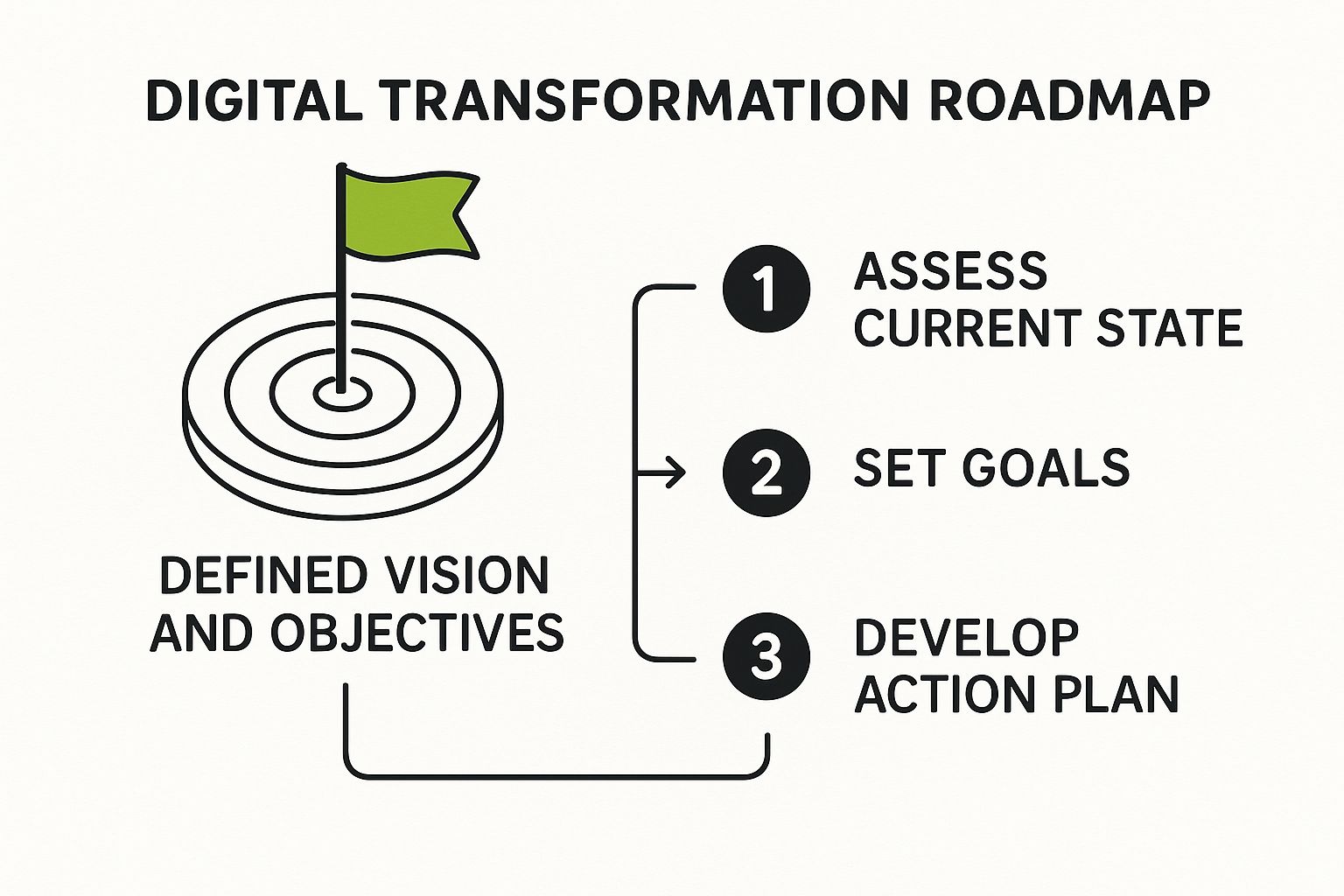
    The data backs this up. By 2025, artificial intelligence has become a vital tool for small businesses, with a staggering 89% using AI to automate repetitive tasks and improve efficiency. And it's not just a local trend—globally, 77% of small businesses have already woven these tools into at least one part of their operations. This strategic shift is a key part of building a modern, competitive company, and you can learn more by exploring a comprehensive digital transformation roadmap.

    Where Small Businesses Can Automate Today

    To get you started, here's a quick look at the business areas with the highest potential for automation and their immediate benefits.

    Business AreaExample Automation TaskPrimary Benefit
    MarketingSending personalized welcome emails to new subscribersBuilding customer relationships from day one
    SalesAutomatically assigning new leads to a sales repFaster response times and increased conversions
    Customer ServiceUsing a chatbot to answer common questions 24/7Happier customers and less support overhead
    FinanceSending automatic payment reminders for overdue invoicesImproved cash flow and less time chasing payments
    OperationsSyncing inventory levels between your store and websitePreventing stockouts and overselling

    These are just a few examples, but they show how powerful even simple automations can be.

    Competing on a Level Playing Field

    One of the biggest wins with automation is its ability to help you punch above your weight. It gives you the tools to offer a customer experience that can rival much larger companies, without needing a massive team or budget.

    Here’s how it looks in the real world:

    • Customer Service: Instantly respond to basic inquiries with an automated chatbot or a well-crafted email reply. This ensures no customer feels ignored, even if they reach out at 2 AM.
    • Marketing: Nurture potential customers with personalized email sequences triggered by their actions on your website. You can build relationships that lead to sales, all without constant manual follow-up.
    • Operations: Automatically generate invoices, send payment reminders, and manage project updates. This not only saves time but also creates a smooth, professional workflow that builds trust.

    By putting these systems in place, you’re not just saving time—you’re building a more resilient and scalable business from the ground up. The goal is simple: create a smarter, more efficient company that truly works for you, not the other way around.

    Finding Your First High-Impact Automation Wins

    Image

    Before you get lost in the sea of automation tools, you need to figure out what part of your ship is actually leaking. Trust me, jumping into new software without a clear target is a recipe for wasted time and a whole lot of frustration. The smart move? Start with a simple self-audit to find the biggest opportunities hiding in your daily grind.

    We're on the hunt for your first "quick win." This is a simple, high-impact automation that gives you an immediate payoff, proves the concept to you and your team, and builds the momentum you need to go after bigger challenges. Forget the abstract theories; the best place to start is with an honest look at where your time actually goes.

    For just one week, keep a time log. It doesn't have to be anything fancy—a notepad or a basic spreadsheet works perfectly. Every hour or so, just jot down what you worked on. By the end of the week, you'll have a surprisingly clear picture of your biggest time sinks.

    Identifying the Perfect Automation Candidates

    Once you can see where your hours are evaporating, you can filter those tasks through a simple framework. I've found that the best candidates for your first automation for small business are tasks that are Repetitive, Rule-Based, and Prone to Error (RRP).

    • Repetitive: Is this something you do every single day or week? Think about copying and pasting data between apps, sending the same follow-up email, or manually posting to social media.
    • Rule-Based: Does the task follow a clear, predictable logic? If you can write down the steps as a simple "if this happens, then do that" statement, it’s a golden opportunity.
    • Prone to Error: Is this a job where a tiny mistake—a typo in an email address or a missed decimal point—can create real problems? Automation is brilliant at taking human error out of these critical but tedious jobs.

    A local service business, for instance, might realize they spend hours each week calling or texting clients to confirm appointments. This is a classic RRP task. It's incredibly repetitive, follows a simple rule (send a reminder 24 hours before the appointment), and a missed confirmation can easily lead to a costly no-show.

    Your first automation shouldn't try to overhaul your entire company. It should solve one specific, nagging problem. The confidence you get from nailing that one thing is the fuel for everything that comes next.

    In another scenario, an online creator who offers a free downloadable guide might be manually sending a series of follow-up emails. This is a perfect automation opportunity. The trigger is obvious (a new download), and the action is predictable (send a pre-written email sequence). Automating this ensures every new lead gets a consistent, timely experience, which builds trust right from the start.

    Where to Look for Your First Win

    To get your own ideas flowing, here are some of the most common places small businesses find their first high-impact automation wins. See which of these rings a bell with your own daily frustrations.

    • Customer Onboarding: The whole sequence of events after a new customer signs up. This could be sending a welcome email, creating their project folder in your PM tool, or adding them to a specific mailing list.
    • Lead Nurturing: Following up with potential customers who've shown interest. An automated email sequence can keep your business top-of-mind without you having to manually track who needs what message and when.
    • Appointment & Meeting Scheduling: Finally ending the endless email chains to find a meeting time. Tools that show your real-time availability and let clients book directly are a massive time-saver for everyone.
    • Financial Admin: Automatically sending invoice reminders for overdue payments. This one simple automation can seriously improve your cash flow and save you from making those uncomfortable follow-up calls.

    Let's walk through a concrete example. A freelance consultant I know used to manually create a new folder in Google Drive, draft a welcome email from scratch, and send a scheduling link every single time a new client paid their initial invoice through Stripe. That whole multi-step process is a prime candidate for automation.

    The new workflow is a thing of beauty: When a new payment is confirmed in Stripe, then an automation tool automatically creates a new client folder in Google Drive, and then sends a templated welcome email that includes a link to their new folder and a scheduling link for the kickoff call. This single automation saves 15-20 minutes per client and, more importantly, ensures nothing ever falls through the cracks. Now that's a clear, measurable win.

    Choosing Your Automation Toolkit Without Overspending

    Image

    The software market is a crowded, noisy place. It's easy to get overwhelmed, and even easier to overspend. I've seen it happen countless times: a business owner gets excited about automation, signs up for a powerful, expensive tool, and then barely uses it.

    Let’s sidestep that common pitfall. The secret to smart automation for small business isn't about snagging the fanciest software. It's about finding the right tool for the job you need done right now, at a price that makes sense. You don’t need a huge budget to start seeing results.

    Specialized Apps Versus All-in-One Platforms

    One of the first forks in the road you'll hit is whether to go for individual "best-in-class" apps or a big, all-in-one platform that promises to do everything. Each has its pros and cons.

    • Specialized Apps: These are tools that do one thing and do it exceptionally well. Think of a dedicated email marketing service like Mailchimp or a social media scheduler like Buffer. They usually have deeper, more focused features.

    • All-in-One Platforms: These suites bundle CRM, email, project management, and more into a single ecosystem. The big appeal here is simplicity—everything is in one place, which can really clean up your workflow.

    My advice for most small businesses? Start with a few specialized apps. It's a more agile approach. You can solve specific pain points with targeted, often free, solutions. As your business grows and your needs get more complex, you can always integrate them or migrate to a unified platform.

    The Power of Freemium and Starting Small

    The "freemium" model is your best friend when you're just dipping your toes in. So many top-tier software companies offer generous free plans that are more than enough to test your automation ideas. This lets you see the value of a workflow firsthand before you ever pull out a credit card.

    Your goal should be to prove the ROI of an automation on a free plan first. Once the time you save or the revenue you generate justifies the cost, upgrading becomes an easy business decision, not a financial risk.

    For example, set up a welcome email sequence for your first 500 subscribers using a free plan. Or automate task notifications for your team with a free project management tool. This hands-on experience is far more valuable than reading endless reviews. If you're looking for ideas, you can explore various productivity automation tools that are perfect for getting started this way.

    Comparing Automation Tools for Your Business

    To help you visualize the options, here's a side-by-side look at different software categories. This should help you make an informed choice based on your specific needs and budget.

    Tool CategoryExample ToolsBest ForTypical Starting Price
    Workflow ConnectorsZapier, MakeConnecting different apps that don't have native integrations. The "glue" of your toolkit.Free, with paid plans from $20/month
    Email MarketingMailchimp, ConvertKitBuilding email lists, sending newsletters, and creating automated email sequences.Free, with paid plans from $10/month
    Project ManagementTrello, AsanaOrganizing tasks, automating team notifications, and managing project workflows.Free, with paid plans from $5/user/month
    All-in-One PlatformsHubSpot, Zoho OneBusinesses needing a single system for CRM, marketing, and sales.Free CRM, with paid suites from $30/user/month

    Choosing the right category first, before you even look at specific brands, will save you a ton of time and prevent you from buying a hammer when you really need a screwdriver.

    Your Non-Negotiable Tool Features

    No matter which tools you land on, a few features are absolutely critical for long-term success. Don't compromise on these, or you'll find yourself stuck down the road.

    1. Integration Capabilities: This is the big one. Your tools have to talk to each other. Look for native integrations with the other software you use, or at the very least, support for a connector platform like Zapier. This is what lets a new sale on your website automatically trigger an action in your email app.

    2. User-Friendly Interface: You're a business owner, not a software engineer. The tool should feel intuitive. A visual, drag-and-drop workflow builder that makes "if this, then that" logic easy to set up is a huge plus.

    3. Scalable Pricing: Find a provider with a clear and fair pricing ladder. You want to start small and only pay for more features or a higher contact limit as your business actually grows. Avoid tools that lock you into expensive annual plans from day one.

    Making the right choices here pays off. The impact on efficiency is real—over 90% of workers report a boost in productivity after implementing automation. The financial return is just as compelling, with companies seeing an average 22% reduction in operating costs. The ROI can be anywhere from 30% to 200% in the first year alone. You can find more on these stats over at thunderbit.com. Selecting the right tools is your first step toward getting these results for your own business.

    Alright, let's get down to business. Planning is one thing, but actually building your first workflow is where you'll see the magic happen. This is your hands-on guide to creating simple but powerful automations that deliver results right away.

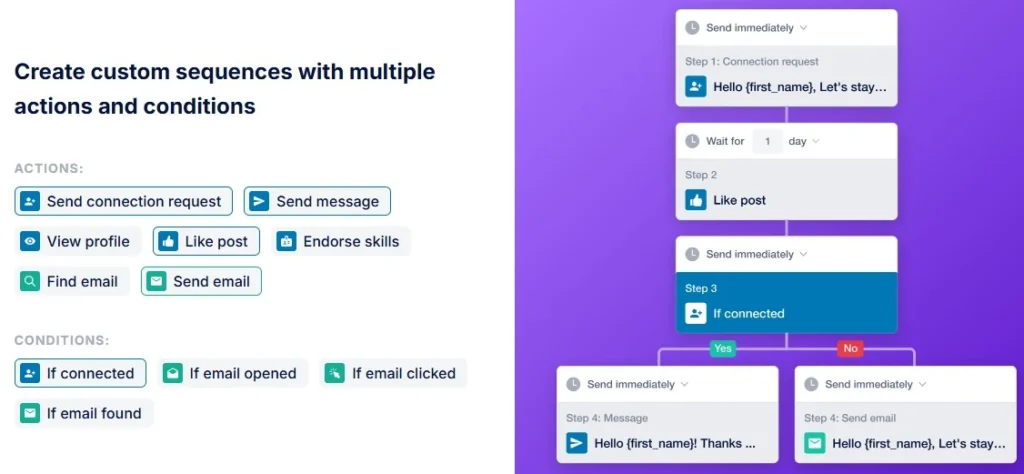
    The entire concept of automation boils down to a simple but powerful idea: "if this happens, then that happens." At its core, every automation you build will have a trigger (an event) that kicks off a specific action (a task). This is the secret to creating a process that runs on its own, freeing you up to focus on growing your business.

    Mastering the Logic of Automation

    Think of it like setting up a line of dominoes. When the first one falls (the trigger), it starts a chain reaction. For example, if a potential customer fills out a contact form on your site (the trigger), then a personalized welcome email automatically gets sent to them (the action). It's simple, predictable, and incredibly effective.

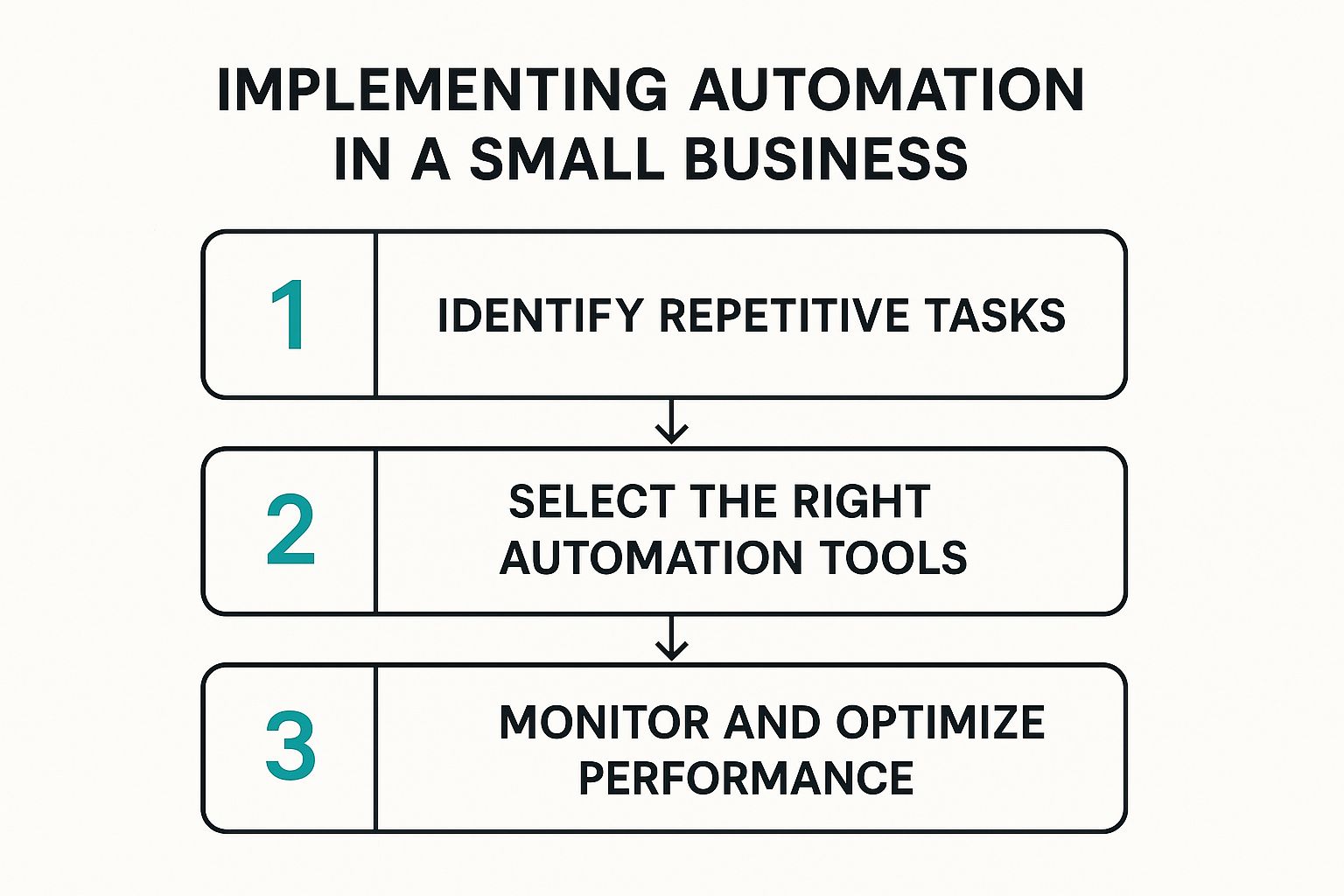
    This graphic really breaks down the whole process:
    Image

    As you can see, success isn't just about the initial setup. It's a continuous cycle of spotting opportunities, putting a solution in place, and then tweaking it based on what the results tell you.

    High-Value Automation Scenario 1: Lead Follow-Up

    One of the best places to start is with your new leads. A quick, personal follow-up can make a huge difference in your conversion rates, but trying to do it manually becomes impossible as you grow.

    Let’s say a visitor downloads a free guide from your website. Here’s a simple workflow to nurture that lead:

    • Trigger: A new contact submits the form on your guide's landing page.
    • Action 1: Instantly send an email with the download link and a warm welcome.
    • Action 2: Add a "wait" step of two days.
    • Action 3: Send a follow-up email with a related blog post or case study that provides more value.
    • Action 4: Add another "wait" step of three days, then send one last email checking if they have questions.

    This simple sequence makes sure every single lead gets a consistent, valuable experience. It builds trust from the get-go, all without you lifting a finger.

    Pro Tip: Keep your automated emails feeling human. Use personalization tags (like the person's first name) and write in your natural voice. The goal is efficiency, not sounding like a robot.

    Workflow automation has been a game-changer. A shocking 94% of companies still have people doing repetitive tasks, but that's changing fast. In fact, around 90% of knowledge workers say automation has made their jobs better, and 66% have seen real productivity boosts. You can dive deeper into these workflow automation trends to see the full picture.

    High-Value Automation Scenario 2: Client Onboarding

    A slick onboarding process makes a fantastic first impression. When you automate the admin side of things, you look organized and professional, and crucial steps never get missed.

    Imagine a new client just signed your proposal and paid their first invoice. Here's what can happen next, automatically:

    • Trigger: A payment is successfully processed in a tool like Stripe or PayPal.
    • Action 1: A new client folder is instantly created in your Google Drive or Dropbox.
    • Action 2: A "Welcome Aboard!" email zips out to the client with a link to their new folder, a link to book their kickoff call, and a quick rundown of what to expect.
    • Action 3: A new project pops up in your project management tool (like Trello or Asana), pre-filled with your standard onboarding checklist.
    • Action 4: Your team gets a notification about the new client in Slack or Microsoft Teams.

    What used to be a multi-step, error-prone manual task is now a flawless workflow that runs in the background.

    High-Value Automation Scenario 3: Social Media Content Scheduling

    Keeping up a consistent social media presence is a grind. It can feel like a full-time job. With the right tools, you can knock out a month's worth of content in a single afternoon.

    This one is less of a multi-step workflow and more about using a specialized tool to do the heavy lifting.

    • First, batch-create your posts. Write the copy, design the graphics, and get everything ready to go.
    • Next, upload all your content into a social media scheduling platform like Buffer or Later.
    • Finally, assign each post to the right platform (LinkedIn, Instagram, etc.) and schedule it for a specific date and time.

    The automation here is the "set it and forget it" power of scheduling. The tool takes care of the publishing, freeing you from the daily pressure of what to post. Many of these tools will even let you automatically re-share your most popular posts, getting you more bang for your buck from your best content.

    Measuring and Scaling Your Automation Strategy

    Image

    So you’ve flipped the switch on your new automation. That's a great first step, but the real magic happens next. The true power of automation for small business isn’t in a one-and-done setup; it’s in treating it like a living, breathing part of your strategy. That means you need to measure what’s working, what’s a dud, and where you should focus your energy next.

    Effective measurement is about so much more than vanity metrics like how many emails an automation sends. We're talking about tracking the Key Performance Indicators (KPIs) that have a real, tangible impact on your business—and your own sanity.

    KPIs That Truly Matter

    Let's cut through the noise. Instead of getting bogged down in abstract data, you should be tracking metrics you can actually feel. These are the numbers that directly translate to more efficiency and a healthier bottom line.

    Here are a few essential KPIs I always recommend tracking for any new automation:

    • Hours Saved Per Week: This one is my favorite because it's the most direct measure of your return on time. If an automation shaves 20 minutes off a task you do 15 times a week, you've just reclaimed five hours. That's half a workday you can now spend on sales, big-picture strategy, or just getting home to your family on time.
    • Reduction in Manual Errors: Keep an eye on the "oops" moments. Are you seeing fewer order mix-ups now that inventory updates are automated? Have you had fewer double-bookings since implementing an automated calendar system? A plummeting error rate means a happier customer and way less time spent putting out fires.
    • Customer Response Time: This is a big one for any customer-facing automation, like welcome emails or support ticket confirmations. Measure how fast customers get that first touchpoint. An instant, automated reply is a powerful way to show you’re on the ball, building trust from the very first interaction.
    • Conversion Rate Improvement: Time to connect your automation directly to sales. Did that automated lead nurturing sequence you built actually increase the percentage of leads who become paying customers? This KPI ties your automation efforts directly to revenue.

    Don’t just build automations; build a feedback loop. Regularly check your KPIs to see what’s delivering real value. This data is your roadmap for what to double down on and what to tweak.

    Calculating Your Return on Investment

    Calculating your Return on Investment (ROI) for automation doesn't require a finance degree. A simple formula can give you a crystal-clear picture of whether a tool or workflow is actually paying for itself.

    First, figure out the value of the time you saved. Let's say a $30/month tool saves you 10 hours per month, and you value your time at $50/hour.

    • Value of Time Saved: 10 hours x $50/hour = $500 per month
    • Cost of Tool: $30 per month
    • Net Gain: $500 – $30 = $470 per month

    This straightforward math makes it incredibly easy to justify your automation tools. It clearly shows the financial upside of investing in these systems. For anyone in e-commerce, tracking these kinds of metrics is absolutely crucial, and you can find a ton of great info on the best e-commerce tools and platforms to help you do just that.

    Knowing When and How to Scale

    As your business grows, your processes evolve. New bottlenecks will inevitably pop up. Your automation strategy needs to grow right alongside your business, which means regularly revisiting your workflows to make sure they're still doing their job.

    I suggest setting aside time once a quarter to ask a few key questions:

    • Is this workflow still solving the right problem?
    • Has a new, more frustrating task emerged as our biggest time-waster?
    • Can we add another step to an existing automation to make it even more useful?

    Scaling isn’t about trying to automate everything at once. It's about intelligently pinpointing the next most painful bottleneck and applying a focused, effective solution. By continuously measuring, refining, and expanding your efforts, you ensure your automations remain a powerful engine for your business's growth.

    Common Questions About Small Business Automation

    Taking the plunge into automation can feel like a pretty big step. It's totally normal to have a few questions buzzing around. After all, you’re not just buying a piece of software; you’re fundamentally changing how your business runs.

    Let’s walk through some of the most common worries I hear from business owners. My goal is to give you clear, straight-up answers so you can move forward feeling confident.

    Is Automation Too Expensive for a New Business?

    This is probably the biggest myth out there, and it holds so many people back. The short answer? No, it doesn't have to be. In fact, when done right, automation is one of the most cost-effective ways for a small business to grow.

    Many of the best tools on the market use a "freemium" model. They offer incredibly generous free plans that are perfect for solo operators or tiny teams just finding their feet. You can automate your welcome emails, schedule social media posts for the next month, or manage your team's tasks without spending a dime.

    The trick is to start small. Pick one specific, nagging problem and use a free tool to prove its value. The time you get back is an immediate return on your investment—even if that investment was just a few hours of setup. You don't need a massive, enterprise-level system; you just need a smart fix for a real pain point.

    Will Automation Make My Brand Feel Robotic?

    I get this question all the time, and it's a completely valid concern, especially for brands built on a personal touch. But here’s the interesting part: good automation actually makes you more human, not less.

    Think of it this way: automation is for the robots, relationships are for you. By handing off the repetitive, impersonal stuff—sending receipts, confirming appointments, chasing invoices—you free up your own time and mental energy.

    Automation handles the logistics so you can have more meaningful conversations. It executes the busywork flawlessly, giving you the space to focus on strategy, build genuine connections, and deliver exceptional personal service where it truly counts.

    And remember, you’re still in the driver's seat. You get to write the emails to sound warm, friendly, and perfectly on-brand. The "robot" is just your behind-the-scenes assistant, making sure every customer gets a prompt, professional experience while you do the important work of building real relationships.

    Do I Need to Be a Tech Expert to Set This Up?

    Not anymore. Maybe a decade ago that was true, but today’s automation platforms are designed for business owners, not hardcore developers. The user experience has come a long, long way.

    Most modern tools use visual, "drag-and-drop" interfaces. The logic is as simple as "if this happens, then do that." A real-world example would be: "When a new sale is made in Stripe, then send a welcome email from your email tool."

    Honestly, if you can sketch out a basic flowchart on a napkin, you have all the technical skills you need to build your first automation. Plus, the internet is overflowing with step-by-step video tutorials and pre-built templates for the most common workflows, making it easier than ever to get going.

    What Is the Best First Task to Automate?

    When you’re just starting, the goal isn’t to automate your entire business overnight. The goal is to get a quick, tangible win that shows you the power of this stuff and builds your confidence.

    My advice is always to start with a task that is highly repetitive and a major time-sink. For most small businesses, the best candidates fall into one of these buckets:

    • Marketing: A simple welcome email sequence for new newsletter subscribers. This is a classic "set it and forget it" workflow that engages every single new lead automatically.
    • Sales/Admin: Your appointment scheduling process. Using a tool that lets clients book time directly on your calendar eliminates the soul-crushing back-and-forth emails.
    • Operations: Automatically saving new form submissions from your website directly into a spreadsheet. This gets rid of manual data entry and cuts down on human error.

    Pick one small, specific process that drives you nuts. Get it automated, see the immediate benefit, and you'll have all the momentum you need to tackle bigger and more powerful workflows down the line.


    Ready to stop wasting time on repetitive tasks and start building a more efficient, scalable business? The expert team at creavoid specializes in AI-powered automation and digital transformation. We build the systems that let you focus on what you do best. Discover how we can transform your operations today.


  • The Ultimate Guide to Automated Customer Support in 2025

    The Ultimate Guide to Automated Customer Support in 2025

    You’ve probably heard the term “automatedsd customer support,” and maybe it conjures up images of clunky, unhelpful robots. Let’s clear the air on what it really is.

    Think of it less as a replacement for your team and more as an incredibly efficient digital assistant. It’s all about freeing up your best people from the repetitive, low-level tasks so they can focus on solving the complex problems that actually require a human touch.

    What Automated Customer Support Really Means

    a man standing next to a computer screen

    At its heart, automated customer support is a strategic partnership between technology and your human agents. It’s not about building a wall between you and your customers. Quite the opposite—it’s about intelligently delegating tasks to the right resource at the right time.

    Here’s a better way to think about it: imagine your support team is a group of world-class chefs. Right now, they might be spending half their day just chopping vegetables and washing dishes. It’s necessary work, but it doesn’t require their unique talent.

    Automation is like installing a professional-grade food processor and an industrial dishwasher in their kitchen. Suddenly, your chefs are free to do what they do best: create amazing, complex dishes that customers will rave about. This is exactly what automation does for your support team.

    Core Functions Prime for Automation

    So, what kind of “vegetable chopping” can you hand off to automation? The system shines when dealing with high-volume, low-complexity tasks that follow predictable patterns. This lets your skilled agents handle the nuanced “why” and “how” questions that build real customer loyalty.

    Some of the most common functions handed over to automation include:

    • Answering Frequent Questions: Instantly resolving common inquiries like “Where is my order?” or “What are your business hours?” using chatbots or interactive voice response (IVR).
    • Intelligent Ticket Routing: Automatically analyzing an incoming ticket to figure out what it’s about and who should handle it, sending it to the right agent or department without any manual sorting.
    • Self-Service Portals: Giving customers the power to find their own answers through comprehensive knowledge bases, FAQs, and community forums.
    • Proactive Status Updates: Sending automated emails or SMS messages about order confirmations, shipping notifications, or potential service disruptions before the customer even has to ask.

    By taking over these routine tasks, automated systems can slash service operational costs by up to 40%. This not only frees up budget but, more importantly, frees up your team to create genuinely positive customer experiences.

    A Partnership, Not a Replacement

    It’s easy to think the goal of automation is to eliminate human interaction, but that’s a common misconception. A well-designed automation strategy actually makes your human agents more valuable, not less.

    When customers know they can get instant help for simple issues 24/7, their frustration drops. Then, when they do need to speak with a person for a complex or emotional issue, they come into that conversation in a much better frame of mind.

    Better yet, the agent they speak with will be armed with all the context and history gathered by the automated system. This collaborative approach delivers efficiency without sacrificing the empathy and critical thinking that only a human can provide. It’s the foundation of a truly superior customer experience.

    The Core Technologies Driving Automation

    To really understand automated customer support, you have to pop the hood and look at the technologies that make it all tick. These aren’t just buzzwords; they’re the actual engines that power instant answers, smart routing, and personalized conversations. Think of this tech stack like a well-oiled pit crew—each member has a specific job, but they all work together to get the car back on the track in record time.

    The team captain is Artificial Intelligence (AI), which is the broad practice of creating smart systems that can do things normally requiring human brainpower. In our pit crew analogy, AI is the crew chief, calling the shots and making sure the entire operation runs smoothly. It’s what makes an automated system dynamic and responsive, rather than just a simple, static script.

    Working under the chief’s direction are the specialists: Machine Learning and Natural Language Processing. These are the sub-fields of AI that handle the really specific, hands-on tasks.

    Meet the Key Players on the Tech Team

    So, how do all these pieces come together to create an automated support experience that actually feels helpful? Let’s break down who does what.

    • Artificial Intelligence (AI): This is the big-picture technology. AI allows machines to learn from experience, reason through problems, and make decisions. It’s the overarching system that enables all the other automated actions to happen intelligently.
    • Machine Learning (ML): Think of ML as the crew member who gets smarter with every pit stop. It’s a type of AI where systems learn from data without needing to be reprogrammed. This is how a chatbot can improve its answers over time based on the thousands of customer interactions it handles.
    • Natural Language Processing (NLP): This is the team’s communication expert. NLP is the magic that allows technology to understand, interpret, and generate human language—both written and spoken. It’s what helps a bot understand the intent behind “Where’s my stuff?” instead of just seeing keywords.

    These technologies are rarely lone wolves; their real power comes from teamwork. For example, an AI-powered chatbot uses NLP to figure out what a customer is asking and ML to learn from that conversation, making its future responses even better. That’s the secret sauce that turns basic automation into something genuinely useful.

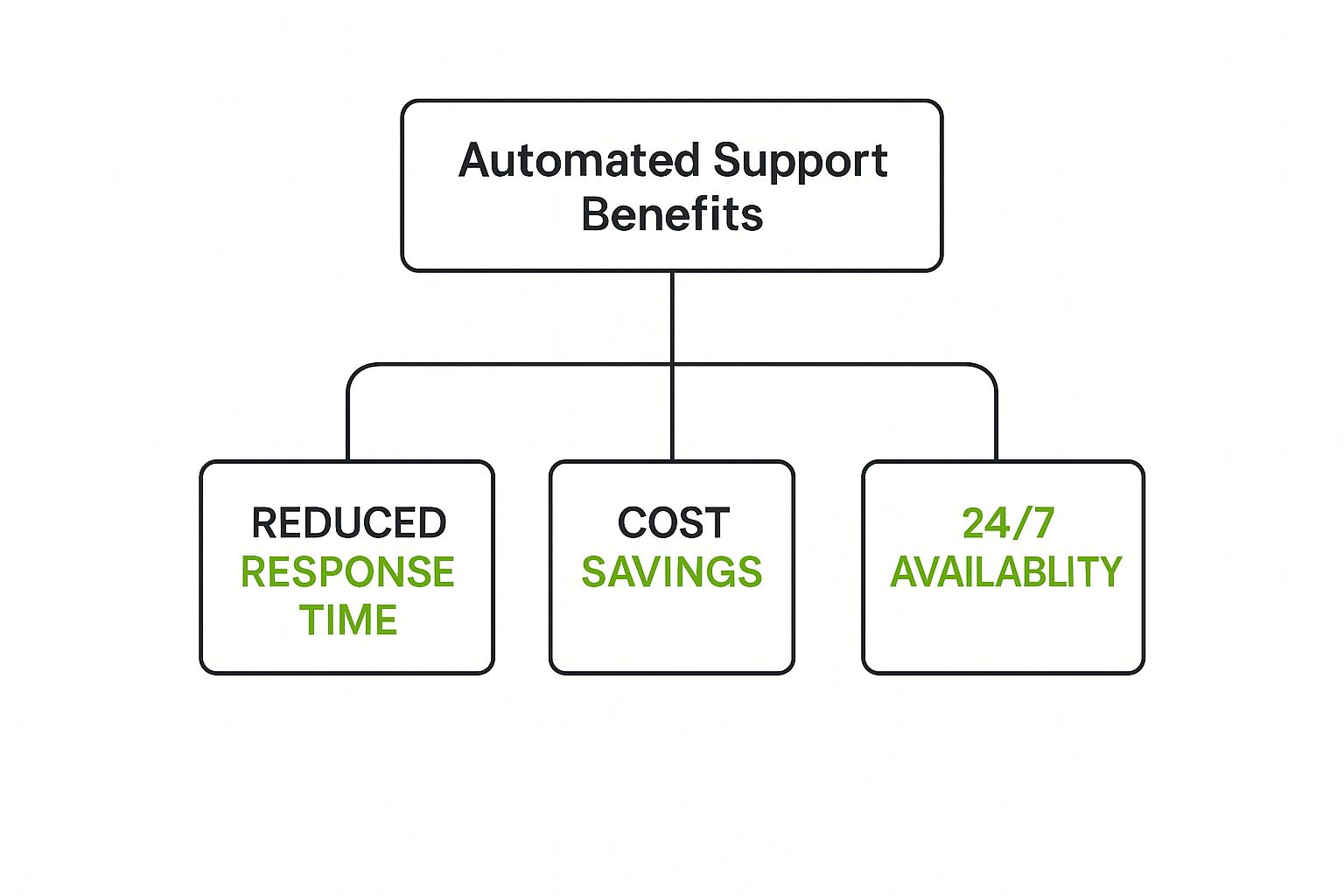
    We’re seeing a major push in how companies are using generative AI and automation, especially heading into 2025. The trend is crystal clear: businesses are deploying AI to offer 24/7 support, slash response times, and handle all the routine questions that used to tie up agents. This frees up the human team to tackle the really complex, high-touch issues, which is becoming a huge competitive advantage.

    From Technical Concepts to Real-World Tools

    So, what do you get when you mix all this tech together? The most common result is the chatbot, a program you’ve almost certainly interacted with, designed to simulate a conversation with a person.

    This image shows a pretty standard chatbot interface. The goal is always to make it feel simple and conversational.

    Image

    When the design is clean and the flow is logical, customers are much more willing to engage with an automated system to get the quick help they need.

    Key Automation Technologies Compared

    It’s important to remember that not all automation is built the same. The right tool for the job depends entirely on what you’re trying to accomplish. A simple, rule-based bot might be perfect for your FAQ page, but it will fall flat if a customer has a multi-part problem. For that, you need a more sophisticated AI assistant.

    Understanding the differences is the first step in building a support strategy that works. If you’re curious about how these ideas extend beyond support, our guide on productivity automation tools is a great next step.

    To help clear things up, here’s a quick rundown of the main technologies, what they do best, and where you’d typically see them in action.

    TechnologyPrimary FunctionBest ForExample Application
    Rule-Based ChatbotsFollow pre-defined conversational flows based on “if-then” logic.Answering simple, repetitive questions with predictable answers.A bot on a shipping company’s website that only provides order status based on a tracking number.
    AI-Powered ChatbotsUse NLP and ML to understand user intent and learn from conversations.Handling a wider range of queries and personalizing interactions.An e-commerce bot that can answer “Where’s my order?” and also recommend products based on chat history.
    Interactive Voice Response (IVR)Uses NLP to understand spoken commands and route callers.Efficiently directing phone calls and handling simple voice-based requests.A banking phone system that lets you say “check my balance” instead of pressing a number.
    AI Knowledge BaseUses AI to search and surface the most relevant help articles for customers or agents.Empowering self-service and speeding up agent-assisted support.A search bar in a help center that understands a complex query and provides the exact right paragraph from an article.

    At the end of the day, picking the right technology comes down to matching the complexity of the tool to the complexity of the customer’s problem. Get that right, and you’re well on your way to building an automation strategy that both your customers and your support team will love.

    Key Business Benefits of Support Automation

    Image
    While the technology behind automated support is cool, let’s be real—the true magic is what it does for your business. We can geek out about the tech all day, but what really matters are the tangible results. These aren’t just small tweaks; they’re fundamental shifts in how you operate, grow, and compete.

    Think about an e-commerce brand bracing for the Black Friday storm. In past years, their small support team was completely swamped. This meant long waits, angry customers, and abandoned carts. This year, they launch an AI chatbot. Instantly, it handles thousands of “Where is my order?” and “What’s your return policy?” tickets, keeping shoppers happy and sales flowing. This isn’t a hypothetical—it’s how automation directly protects your bottom line.

    Drive Down Operational Costs

    One of the first things you’ll notice is the impact on your operational budget. Every single routine question an AI chatbot or self-service portal answers is a ticket a human agent doesn’t have to touch. That adds up, fast.

    In fact, some businesses have slashed their operational service costs by as much as 40% by strategically using automation. This isn’t about replacing your team; it’s about empowering them to handle a much higher volume of inquiries without needing to constantly hire more people. The money you save can then be funneled back into growing other parts of the business.

    Empower Your Human Agents

    There’s a common misconception that automation will make human agents obsolete. The reality is the complete opposite. By taking over the dull, repetitive tasks, automation frees up your team to tackle the high-value work—the complex problems that require empathy, creativity, and critical thinking.

    This has a huge effect on agent productivity and morale. Instead of feeling like broken records answering the same five questions all day, agents evolve into true problem-solvers. Their roles become more engaging and fulfilling, which dramatically cuts down on agent burnout and turnover—a notoriously expensive issue for any support department.

    Automation transforms an agent’s role from a simple “answerer” of questions to a “solver” of complex problems. This elevation doesn’t just improve efficiency; it creates a more rewarding career path, helping you keep your best people.

    Scale Support Operations Seamlessly

    Your company’s growth should never be bottlenecked by your support team’s capacity. Automated customer support gives you the flexibility to scale up or down on a dime, without the logistical nightmare of hiring and training new staff.

    Just think about these advantages:

    • Handle Volume Spikes: Effortlessly manage sudden floods of support tickets during product launches, holiday sales, or seasonal rushes.
    • Expand into New Markets: Offer genuine 24/7 support across different time zones without needing to build a physical office in every location.
    • Maintain Service Quality: Guarantee that every single customer gets a fast, consistent response, whether you have 100 customers or 100,000.

    This ability to scale without friction is a cornerstone of any modern growth strategy. Weaving these automated systems into your operations is a key part of building a successful digital transformation roadmap, ensuring your support can keep up with your ambition.

    Enhance Customer Satisfaction and Loyalty

    At the end of the day, it always comes back to the customer. Modern consumers expect service that is fast, convenient, and effective. Automation nails all three. Giving customers instant answers through chatbots or a knowledge base gets rid of frustrating wait times.

    This is more than a “nice-to-have.” When 73% of customers expect to solve issues on any channel without having to repeat themselves, a connected, automated system becomes a basic expectation. This instant, always-on support leads directly to better customer satisfaction (CSAT) scores. Happier customers are far more likely to stick around, buy again, and tell their friends about you, creating a powerful engine for growth.

    How to Implement Your Automation Strategy

    Jumping into an automated customer support system can feel like a huge project, but it doesn’t have to be. If you break it down into smart, bite-sized steps, you can build a powerful system that helps your customers and gives your team a boost. Don’t think of it as flipping a giant switch—think of it as methodically laying the tracks for a brand-new high-speed train.

    Your starting point isn’t with cool tech, but with simple data. The best place to begin is by digging into your existing support tickets. This is where your customers are literally telling you, in their own words, what they need help with most often.

    Start by Identifying the Low-Hanging Fruit

    Before you even glance at a chatbot platform or sketch out a workflow, you need to spot the tasks that are begging to be automated. These are usually the high-volume, low-effort questions that eat up your agents’ day without needing their real problem-solving smarts.

    Take a look at your support ticket data from the last few months. What patterns pop up again and again? Are you constantly dealing with tickets about:

    • Order status updates (“Where’s my stuff?”)
    • Return policy questions
    • Password resets
    • Business hours or locations
    • Basic questions about product features

    These repeat offenders are your low-hanging fruit. They’re the perfect first targets for automation because the answers are straightforward and don’t require any emotional heavy lifting. Automating just one or two of these can instantly free up a surprising amount of your team’s time.

    Select the Right Tools for the Job

    Once you know what you want to automate, it’s time to figure out the how. The market is packed with tools, from simple rule-based bots to incredibly smart AI platforms. The right one for you comes down to your specific needs, budget, and what tech you’re already using.

    Think about these points when you’re weighing your options:

    • Business Size: A small startup might just need a simple chatbot for its website. A large enterprise, on the other hand, will likely need a solution that works across every channel and plugs right into its CRM.
    • Technical Complexity: Are you looking for a no-code builder that anyone can use, or do you have developers ready to build something more custom and powerful?
    • Integration Capabilities: This is a big one. Make sure the tool can connect smoothly with your helpdesk, CRM, and e-commerce platform. A connected experience is key.

    The shift to automation is happening, and it’s happening fast. Experts predict that by 2025, AI will handle a massive 95% of all customer interactions. This isn’t because AI is replacing humans, but because it’s so good at managing simple questions. This frees up human agents to focus on the more complex, tricky situations where they’re needed most.

    Build and Deploy Your Automated System

    With your tools picked out, it’s time to build. This is where your strategy starts to come to life. A good rollout is more than just turning on a bot; it takes careful design and a solid game plan.

    1. Design Conversational Flows: For chatbots, you need to map out the conversation. Start with a friendly hello, figure out what the user wants, and then guide them to an answer or a clear path to a human agent. Keep it simple and intuitive.
    2. Build a Robust Knowledge Base: Your automation is only as smart as the information it has access to. A detailed, well-organized knowledge base is the brain of your entire operation.
    3. Train Your Human Agents: Get your team ready for their new, more advanced roles. Teach them how to work with the automation, how to handle escalations seamlessly, and how to use their newfound time to create amazing customer experiences. If you’re wondering where to begin, our guide on how to build AI agents for beginners is a great starting point.

    Measure Success and Continuously Refine

    Launching your system isn’t the finish line—it’s just the start of a continuous cycle of improvement. To know if your strategy is actually working, you have to track the right numbers, or Key Performance Indicators (KPIs).

    Here are the essential metrics you should be watching:

    KPIWhat It MeasuresWhy It’s Important
    Ticket Deflection RateThe percentage of customer questions solved without needing a human.This is the clearest measure of your automation’s effectiveness and return on investment.
    First-Contact Resolution (FCR)The rate at which issues are solved in the very first interaction (bot or human).A high FCR means you have an efficient process and happy customers.
    Customer Satisfaction (CSAT)Feedback from customers on their support experience, usually from a quick survey.This tells you if your automation is making people happy or frustrating them.

    Check these metrics regularly to see what’s working and what isn’t. Use customer feedback to tweak your chatbot scripts, update your knowledge base, and make your workflows even better. This ongoing feedback loop is what ensures your automated support system grows with your business and keeps delivering real value.

    Common Automation Mistakes to Avoid

    Image

    Rolling out an automated customer support system can be a huge win, but it’s a path littered with potential missteps. If you’re not careful, you can end up frustrating customers and watching your big project go completely off the rails. The smartest way to get it right? Learn from the mistakes others have already made.

    One of the most common blunders is trying to automate everything. It’s tempting, I get it. But automation really shines with simple, repetitive tasks. Trying to make a bot handle complex, emotional issues is just asking for trouble and is guaranteed to leave your customers seeing red.

    Another classic mistake is making it nearly impossible for a customer to escape the bot and reach a person. Trapping someone in an endless “bot loop” is one of the fastest ways to lose their business for good. The goal is to be helpful and efficient, not to build an impenetrable digital fortress.

    Hiding the Human Escalation Path

    Picture this: a customer has a billing error that’s causing them real stress. They try your chatbot, but it’s only built for basic FAQs. After a few failed attempts to explain their problem, they start desperately searching for a “Talk to an Agent” button… but it’s nowhere to be found. Their frustration quickly boils over into anger. Just like that, a fixable problem has cost you a customer.

    This is exactly what happens with a poor escalation strategy. Your automated tools absolutely must have a clear, easy-to-find off-ramp to a human agent.

    • Solution: Make sure a one-click button like “Speak with an Agent” or “Get Human Help” is always visible in your chat interface.
    • Best Practice: Program your bot to proactively offer a handoff to a person after it fails to understand a customer’s request twice in a row.

    Launching Without a Solid Foundation

    Here’s a simple truth: your automated tools are only as smart as the information you give them. Launching a chatbot or an AI helper without a detailed, well-organized knowledge base is like hiring a librarian for a library with empty shelves. It’s pointless.

    Without a rich source of answers to draw from, your bot will constantly fail. This leads to miserable customer experiences and makes the entire system feel like a waste of time and money.

    A poorly planned automation strategy doesn’t just fail to help—it actively damages the customer relationship. The stakes are incredibly high. Poor service delivery costs U.S. companies an estimated $75 billion a year, often because technology was thrown at a problem without the right human-centric planning. You can dig into the financial impact in this detailed research on customer service effectiveness.

    Forgetting to Train Your Team

    The final, and often overlooked, mistake is failing to prepare your human agents for the change. Automation completely shifts their role. They’re no longer just answering basic questions; they’re becoming specialists who manage complex escalations and build real customer relationships.

    If you just “flip the switch” on automation without training your team on how to work alongside it, you’re creating chaos. Agents need to understand the new workflows, know how to seamlessly take over a conversation from a bot, and feel empowered in their new, more strategic position.

    Steer clear of these common pitfalls, and you’ll be on your way to building an automated support system that genuinely helps customers, empowers your team, and actually delivers a real return on your investment.

    The Future of Automated Customer Support

    If you think automated customer support has already reached its peak, you’re in for a surprise. The entire field is gearing up for a massive shift, moving away from simply reacting to customer problems and into a genuinely predictive, personalized, and seamless world of assistance. The next evolution isn’t just about answering questions faster; it’s about anticipating needs before a customer even realizes they have one.

    Think about this: you get a notification that your package is delayed, and it comes with an automatic refund for the shipping fee. You didn’t even have to check the tracking status. That’s the power of proactive support. AI systems are getting smart enough to analyze data, spot patterns that signal a potential hiccup, and step in to fix it ahead of time. It completely flips the traditional support model on its head.

    Instead of being a cost center that waits for complaints, support becomes a proactive engine for building loyalty.

    Deeper Personalization and Blurring Channels

    As AI continues to learn and evolve, its ability to craft truly individual experiences will explode. The next frontier is hyper-personalization, where automated systems tap into a customer’s entire journey—from their purchase history to their browsing habits—to customize every single interaction. This means conversations will feel less like you’re talking to a machine reading a script and more like you’re chatting with someone who actually gets you.

    The future of automated customer support is a collaborative ecosystem where the line between human and AI blurs, creating an intelligent, predictive, and highly effective experience.

    We’re also going to see the walls between communication channels completely dissolve. It’s already starting to happen. A customer might begin a conversation with a chatbot, then seamlessly transition to a voice or even a video call with a human agent, all within the same window. The context and history of the conversation travel with them, creating one fluid, continuous experience. The future isn’t just about automation; it’s about making technology feel more human and intuitive than ever before.

    Got Questions About Automation? We’ve Got Answers.

    As you start thinking about bringing automated customer support into your business, it’s only natural to have some questions. What’s this really going to cost? Will it replace my team? Where in the world do I even begin? Let’s tackle these common concerns head-on so you can move forward with confidence.

    What’s the Real Cost to Get Started?

    This is usually the first question on every business owner’s mind, and the honest answer is: it depends. The price tag for automation can swing wildly based on how big your business is and what you need it to do.

    • For Small Businesses: Getting started can be surprisingly affordable. A simple, rule-based chatbot for your website might only run a few hundred dollars a month with a subscription service.
    • For Mid-Sized Companies: When you need more muscle—like integrating with your CRM or using smarter AI—you’re looking at a range from the low thousands to several thousand dollars monthly.
    • For Large Enterprises: A fully custom AI solution that works across every channel and plugs into multiple systems is a serious investment. These projects often run into the tens of thousands of dollars or more.

    Will Automation Replace Our Human Support Agents?

    This is a big—and important—concern. But a well-designed automation strategy is all about collaboration, not replacement. Automation is brilliant at handling the high-volume, repetitive stuff that bogs your team down.

    This frees up your human agents to focus on what they do best: solving complex, high-stakes problems that need a real dose of empathy and critical thinking.

    Think of automation as a power-up for your team. By taking over the routine questions, it turns agents from simple question-answerers into expert problem-solvers. Their roles become more valuable, and honestly, a lot more engaging.

    I’m a Small Business. What’s the Best First Step?

    For any small business, my advice is always the same: start simple. Please don’t try to automate everything at once—that’s a recipe for disaster.

    A great first move is to put a basic chatbot on your website to handle your top 3-5 most frequently asked questions. This is a low-risk, high-reward way to dip your toes in the water and see an immediate return.

    How Do We Actually Measure the ROI of This Stuff?

    Knowing if your strategy is working is everything. To measure the return on your investment (ROI), you need to focus on a few key metrics that tell a clear story.

    Track your ticket deflection rate—that’s the percentage of issues your automation solves without needing a human. At the same time, keep a close eye on your Customer Satisfaction (CSAT) scores to make sure people are still happy. If your deflection rate is climbing while your CSAT scores hold steady or even improve, you’ve found the sweet spot. That’s a clear win.


    Ready to see how intelligent automation can slash your operational costs and help you scale support? The team at creavoid specializes in building and implementing AI solutions that help businesses like yours grow. Learn how we can transform your customer service today.

  • Top 3 Best VPN Services​ of 2025: Find Your Perfect Match

    Top 3 Best VPN Services​ of 2025: Find Your Perfect Match

    Navigating the crowded market for virtual private networks can be overwhelming. With dozens of providers all claiming to be the fastest, most secure, or best value, how do you determine which one truly fits your specific needs? This resource cuts through the marketing noise to provide a direct, in-depth analysis of what we consider the Top 3 best VPN services available today: NordVPN, ExpressVPN, and Surfshark. We move beyond generic feature lists and surface-level reviews to give you a clear, practical understanding of each platform.

    This guide is built for decisive action. Instead of just listing features, we explore real-world performance, specific use cases, and the practical implementation of each service. You’ll learn which VPN excels at unblocking streaming content, which offers the most robust security for public Wi-Fi, and which provides the best balance of price and performance for everyday use. We’ll present a detailed breakdown of their server infrastructure, privacy policies, and speed test results. Each profile includes an honest assessment of limitations, screenshots of the user interface, and direct links to help you make an informed choice quickly and confidently. Let’s find the right VPN for you.

    1. NordVPN Official Website

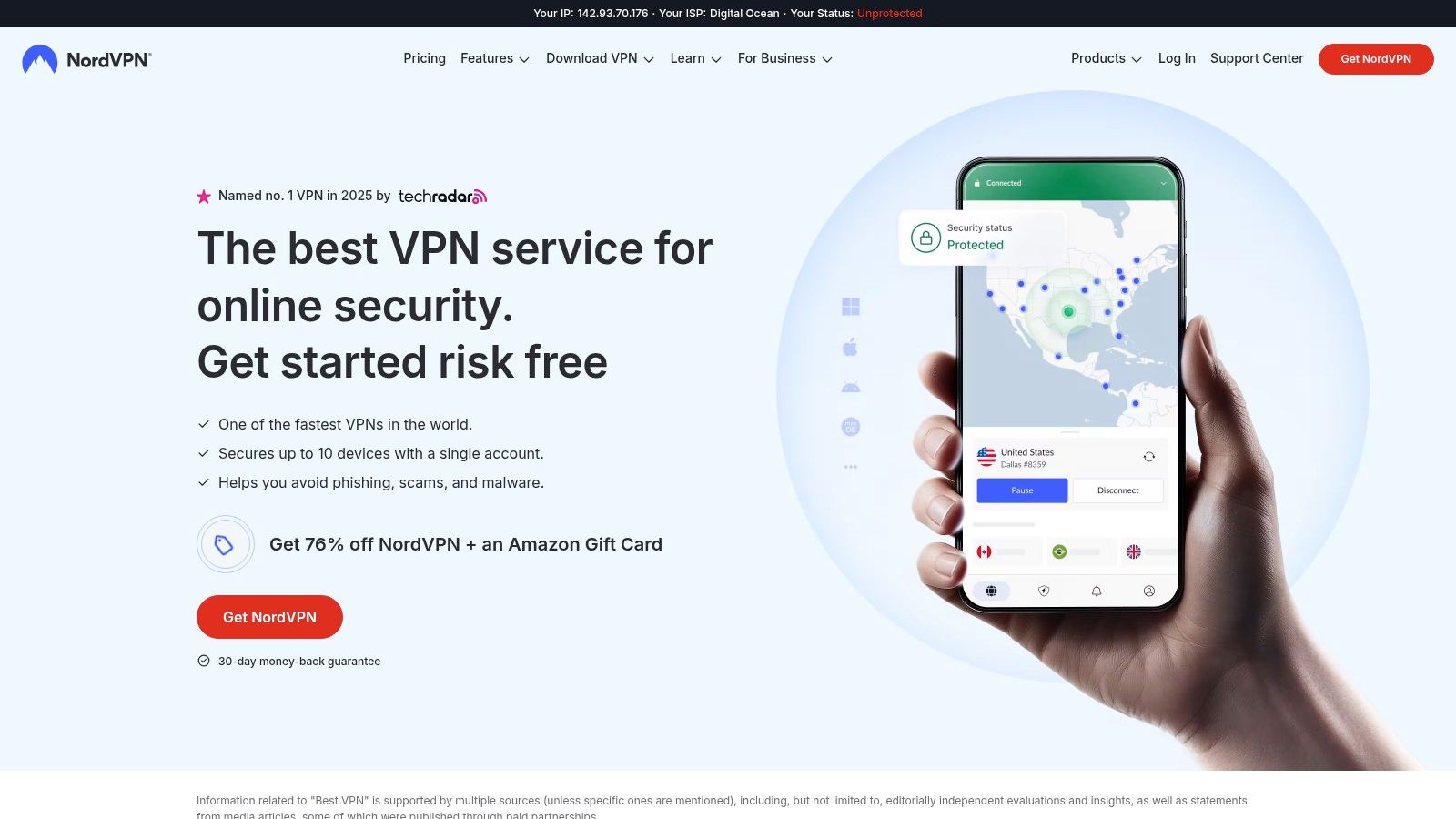
    NordVPN earns its spot as one of the top 3 best VPN services by offering a powerful blend of speed, security, and user-friendliness, all accessible through its streamlined official website. The platform is the central hub for potential and existing users, providing clear, detailed breakdowns of its features, transparent pricing, and direct access to its software. Unlike some competitors, the site avoids overly technical jargon, making it easy for both tech-savvy users and beginners to understand the value proposition. It effectively showcases NordVPN’s key differentiators, such as its proprietary NordLynx protocol for top-tier speeds and specialty servers for enhanced security needs.

    Best VPN Services of 2025 - NordVPN Official Website
    Best VPN Services of 2025 – NordVPN Official Website

    The website excels in user experience, offering a straightforward path to purchasing and setup. A key advantage over competitors like ExpressVPN and Surfshark is the visibility of its Threat Protection feature, a built-in tool that blocks malware, trackers, and intrusive ads even when not connected to a VPN server. While Surfshark offers CleanWeb and ExpressVPN has Threat Manager, NordVPN’s suite is arguably the most comprehensive. This positions NordVPN as more than just a VPN, but a holistic digital safety tool. Pricing is presented clearly, and while it’s more expensive than Surfshark, it’s generally more affordable than ExpressVPN, especially with long-term plans. All subscriptions come with a 30-day money-back guarantee, providing a risk-free trial period.

    Core Features & Comparison

    FeatureNordVPNExpressVPNSurfshark
    Simultaneous ConnectionsUp to 10Up to 8Unlimited
    Unique ProtocolNordLynxLightwayWireGuard
    Server Count~6,400+~3,000+~3,200+
    Price PointMid-to-HighHighLow

    Pros:

    • Exceptional speeds with NordLynx, ideal for 4K streaming and online gaming.
    • Robust security suite including Threat Protection and Onion Over VPN.
    • Independently audited strict no-logs policy.

    Cons:

    • Slightly higher price than budget-friendly options like Surfshark.
    • Fewer simultaneous connections than Surfshark offers.

    Website: https://nordvpn.com/

    2. Surfshark Official Website

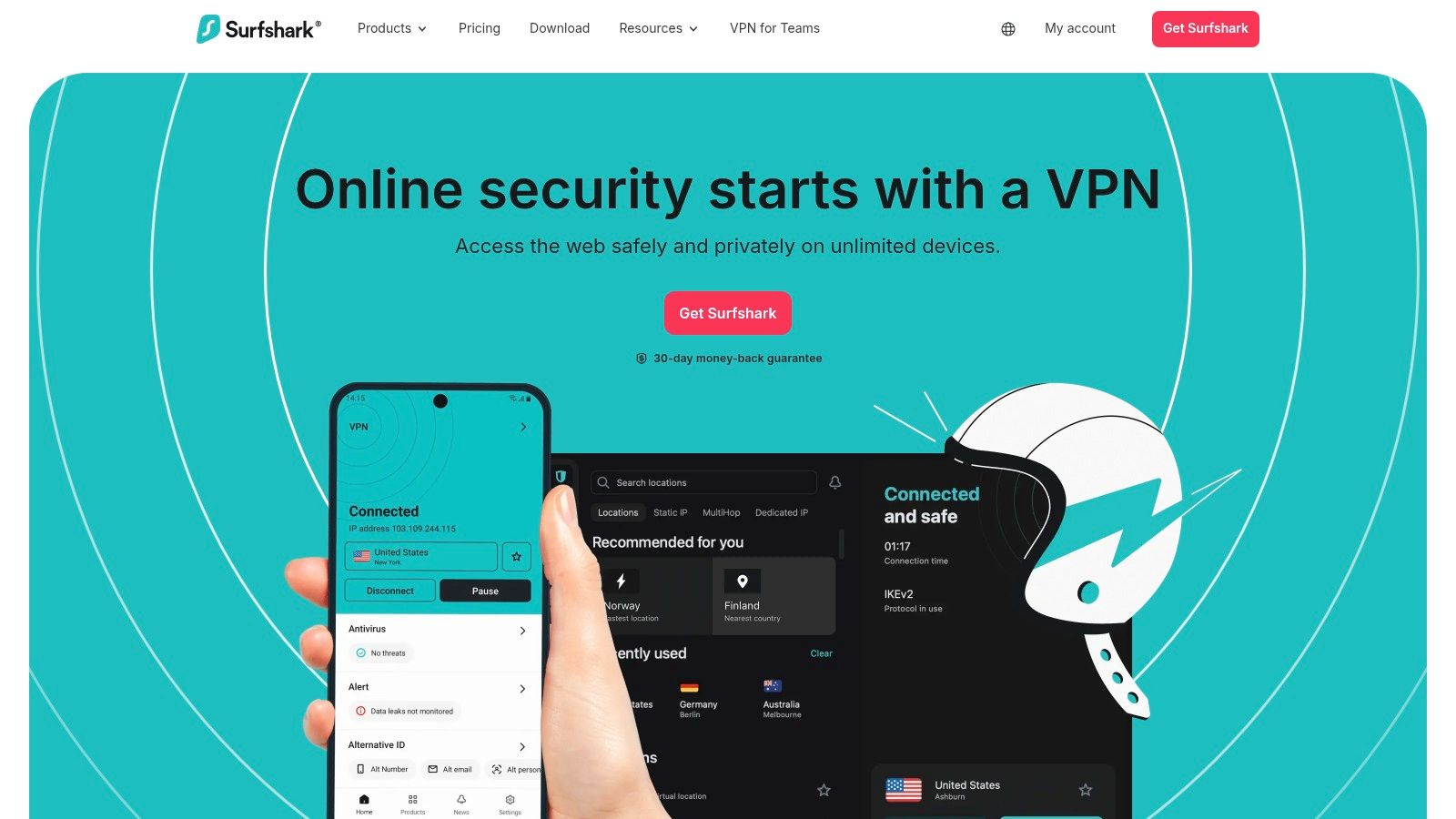
    Surfshark secures its place among the top 3 best VPN services by delivering exceptional value, centered around its standout offer of unlimited simultaneous connections. The official website serves as an accessible entry point, effectively communicating its core benefits without overwhelming visitors. Its clean design and straightforward navigation make it easy for users to explore features, compare plans, and sign up. The site clearly positions Surfshark as the go-to choice for families, individuals with numerous gadgets, or small businesses needing to protect all their devices without extra cost.

    Best VPN Services of 2025 - Surfshark Official Website
    Best VPN Services of 2025 – Surfshark Official Website

    The platform stands out for its affordability and user-friendliness, making it a strong contender against NordVPN and ExpressVPN for budget-conscious users, particularly with its unlimited device policy compared to NordVPN’s 10 and ExpressVPN’s 8. It offers transparent, competitive pricing that often undercuts both competitors on two-year plans, along with a 30-day money-back guarantee. Key features, such as CleanWeb for blocking ads and malware and MultiHop for enhanced security through dual server routing, provide significant value comparable to NordVPN’s Double VPN.

    Core Features & Comparison

    FeatureSurfsharkExpressVPNNordVPN
    Simultaneous ConnectionsUnlimitedUp to 8Up to 10
    Unique ProtocolWireGuardLightwayNordLynx
    Server Count~3,200+~3,000+~6,400+
    Price PointLowHighMid-to-High

    Pros:

    • Outstanding value with unlimited simultaneous device connections.
    • Highly affordable, especially with long-term subscription plans.
    • Strong unblocking capabilities for streaming platforms like Netflix and Hulu.

    Cons:

    • Fewer servers than industry leaders like NordVPN, which can lead to occasional congestion.
    • Lacks some of the advanced, niche features found in ExpressVPN or NordVPN.

    Website: https://surfshark.com/

    3. ExpressVPN Official Website

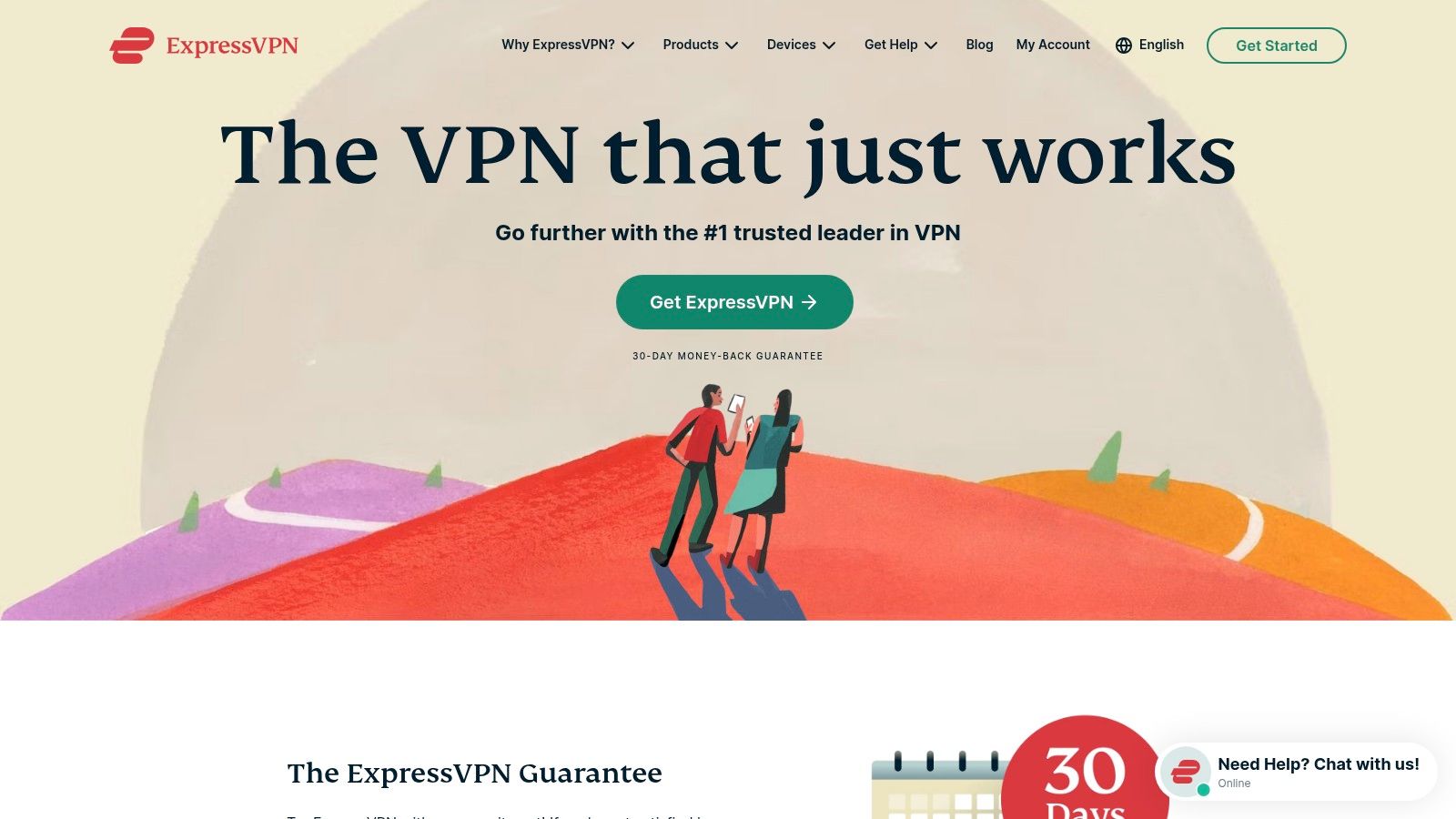
    ExpressVPN secures its position as one of the top 3 best VPN services through its focus on premium performance, user privacy, and exceptional ease of use, all managed through its well-designed official website. The site serves as the primary gateway for users, clearly articulating the service’s value with an emphasis on speed and security without overwhelming visitors with technical complexity. It effectively highlights ExpressVPN’s core strengths, such as its proprietary Lightway protocol engineered for rapid, reliable connections and its TrustedServer technology, which ensures server operations run exclusively on RAM.

    Best VPN Services of 2025 - ExpressVPN Official Website
    Best VPN Services of 2025 – ExpressVPN Official Website

    The website delivers a superb user experience, guiding visitors seamlessly from information gathering to purchase and installation. A key advantage over competitors is its renowned consistency and speed across its vast server network in 105 countries, making it a top choice for streaming geo-restricted content. While NordVPN and Surfshark also offer high speeds, ExpressVPN is often praised for its stability across a wider range of server locations. Its pricing is at a premium level, making it the most expensive of the top three, but all plans are backed by a 30-day money-back guarantee for a risk-free evaluation. For those looking to streamline their digital life, exploring how VPNs integrate with other productivity automation tools can offer even greater efficiency.

    Core Features & Comparison

    FeatureExpressVPNNordVPNSurfshark
    Simultaneous ConnectionsUp to 8Up to 10Unlimited
    Unique ProtocolLightwayNordLynxWireGuard
    Server Locations105 Countries111 Countries100 Countries
    Price PointHighMid-to-HighLow

    Pros:

    • Consistently fast and stable connections with the Lightway protocol.
    • Strong commitment to privacy with TrustedServer technology and audited no-logs policy.
    • Excellent 24/7 live chat customer support.

    Cons:

    • Higher price point than most other top-tier VPNs.
    • Fewer simultaneous connections than NordVPN and Surfshark.

    Website: https://www.expressvpn.com/

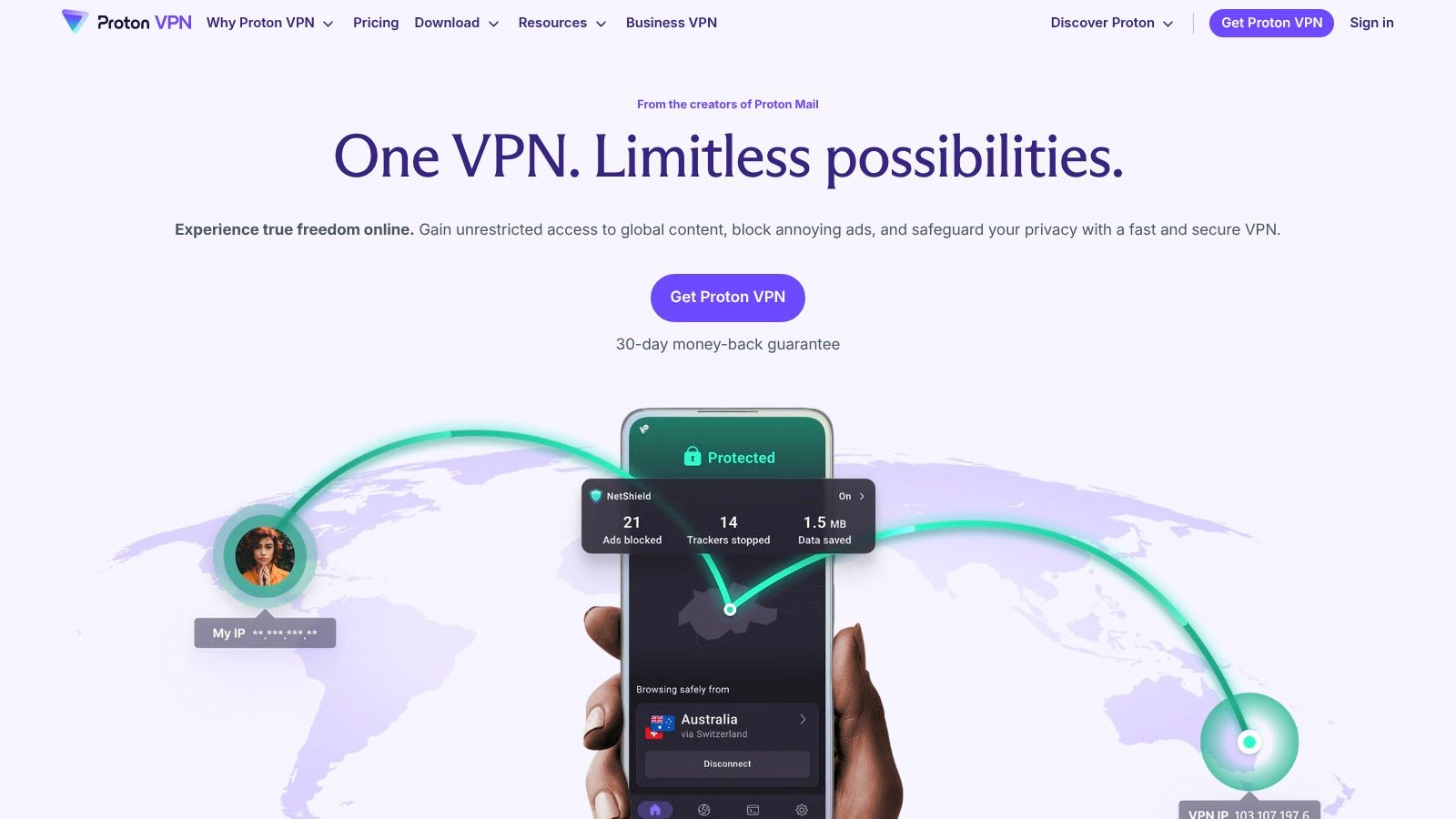
    4. Proton VPN Official Website

    Proton VPN secures its place on our list for its uncompromising commitment to privacy and security, making its official website a go-to resource for the most privacy-conscious users. The platform, backed by the same team behind the encrypted email service Proton Mail, clearly communicates its core mission: creating a more secure internet for everyone. The website effectively details its Secure Core architecture, a standout feature that routes user traffic through multiple hardened servers in privacy-friendly countries like Switzerland before it reaches its final destination, providing an exceptional layer of protection against sophisticated network surveillance. This focus on verifiable security is a key reason it’s considered among the top 3 best vpn services for privacy advocates.

    Proton VPN Official Website

    The website’s major differentiator is its generous and genuinely usable free tier, which offers unlimited data, a rarity in the industry. While competitors like NordVPN and ExpressVPN require a subscription after a trial period, Proton VPN provides a permanent free option, making robust online privacy accessible to all. The site transparently outlines the limitations of the free plan (fewer servers, slower speeds) versus its paid plans, allowing users to make an informed decision. All of its applications are open-source and have been independently audited, a detail prominently featured on the site to build user trust.

    Core Features & Comparison

    FeatureProton VPNExpressVPNSurfshark
    Unique FeatureSecure CoreTrustedServer TechDynamic MultiHop
    Free VersionYes (Unlimited Data)NoNo
    Base of OperationsSwitzerlandBritish Virgin IslandsThe Netherlands
    Simultaneous ConnectionsUp to 10Up to 8Unlimited

    Pros:

    • Exceptional privacy and security credentials with Secure Core architecture.
    • The best free VPN plan available, offering unlimited data.
    • Based in Switzerland, a country with some of the world’s strongest privacy laws.

    Cons:

    • Premium plans are priced higher than many competitors.
    • The free version offers a limited number of servers and slower speeds.

    Website: https://protonvpn.com/

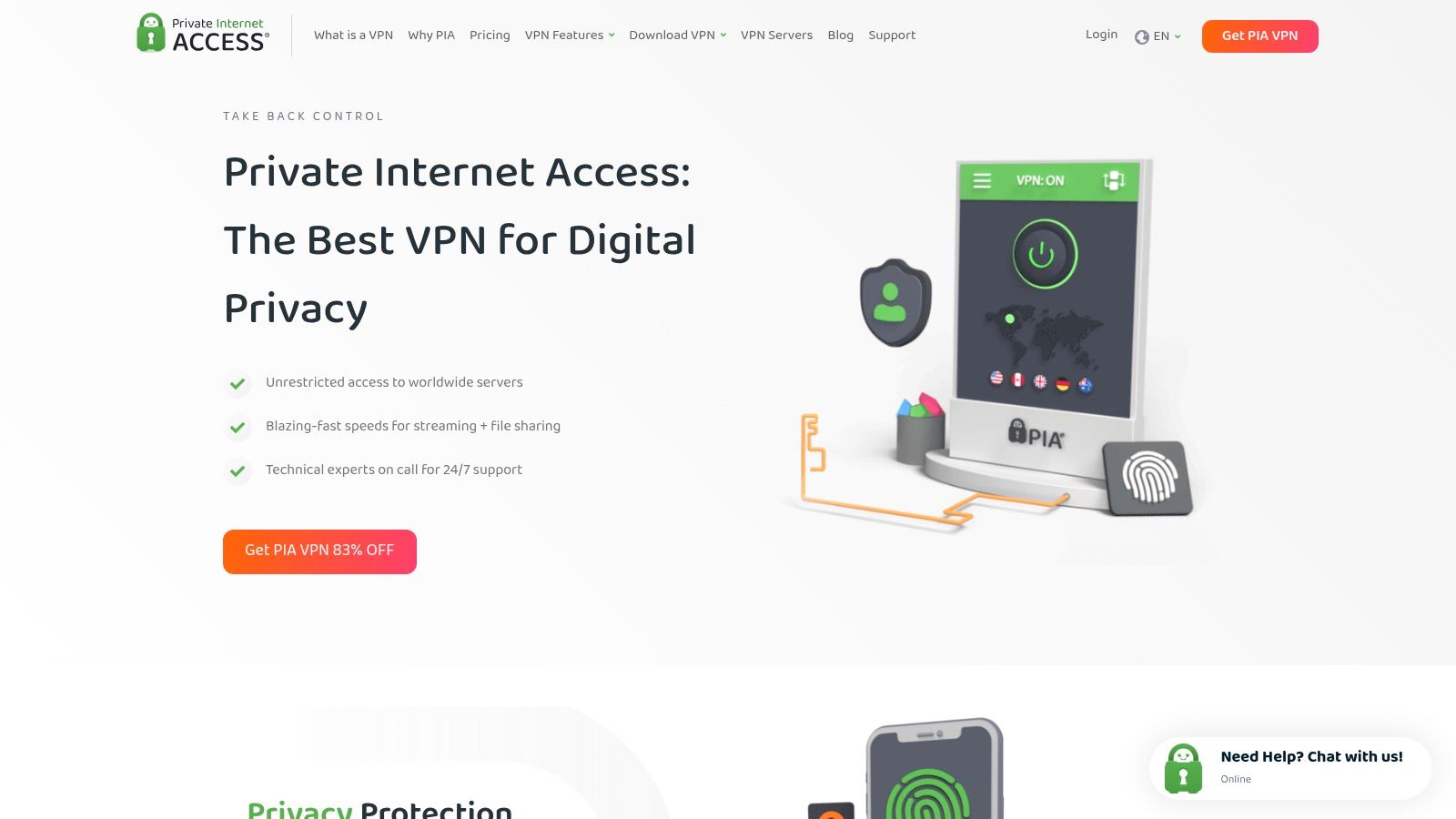
    5. Private Internet Access (PIA) Official Website

    Private Internet Access (PIA) secures its position through its official website, which acts as the gateway to one of the most customizable and privacy-focused VPNs available. The platform clearly targets users who value technical control and transparency. It effectively communicates PIA’s core strengths, such as its massive server network and open-source applications, making it a compelling choice for those looking to fine-tune their connection. The site provides direct access to its affordable long-term plans and highlights its proven no-logs policy, which has been verified in court.

    Private Internet Access (PIA) Official Website

    The website provides an impressive level of detail about its advanced features, such as MACE (its ad, tracker, and malware blocker) and split tunneling. A key differentiator from competitors like NordVPN and ExpressVPN is its emphasis on unlimited simultaneous connections and advanced features like port forwarding, making it ideal for users with many devices or specific torrenting needs. Pricing is extremely competitive, especially for multi-year subscriptions, and is backed by a 30-day money-back guarantee. The site’s commitment to user privacy is a central theme, reinforcing why it remains a top choice for those prioritizing cybersecurity and data protection.

    Core Features & Comparison

    FeaturePrivate Internet AccessNordVPNSurfshark
    Simultaneous ConnectionsUnlimitedUp to 10Unlimited
    Unique FeatureAdvanced CustomizationThreat ProtectionNexus Technology
    Server Count~10,000+~6,400+~3,200+
    Price PointLowMid-to-HighLow

    Pros:

    • Vast server network enhances connectivity options.
    • Unlimited device connections on a single subscription.
    • Highly affordable long-term plans offer excellent value.
    • Strong commitment to open-source transparency and privacy.

    Cons:

    • The high degree of customization can be overwhelming for beginners.
    • Connection speeds can be less consistent than top-tier competitors.

    Website: https://www.privateinternetaccess.com/

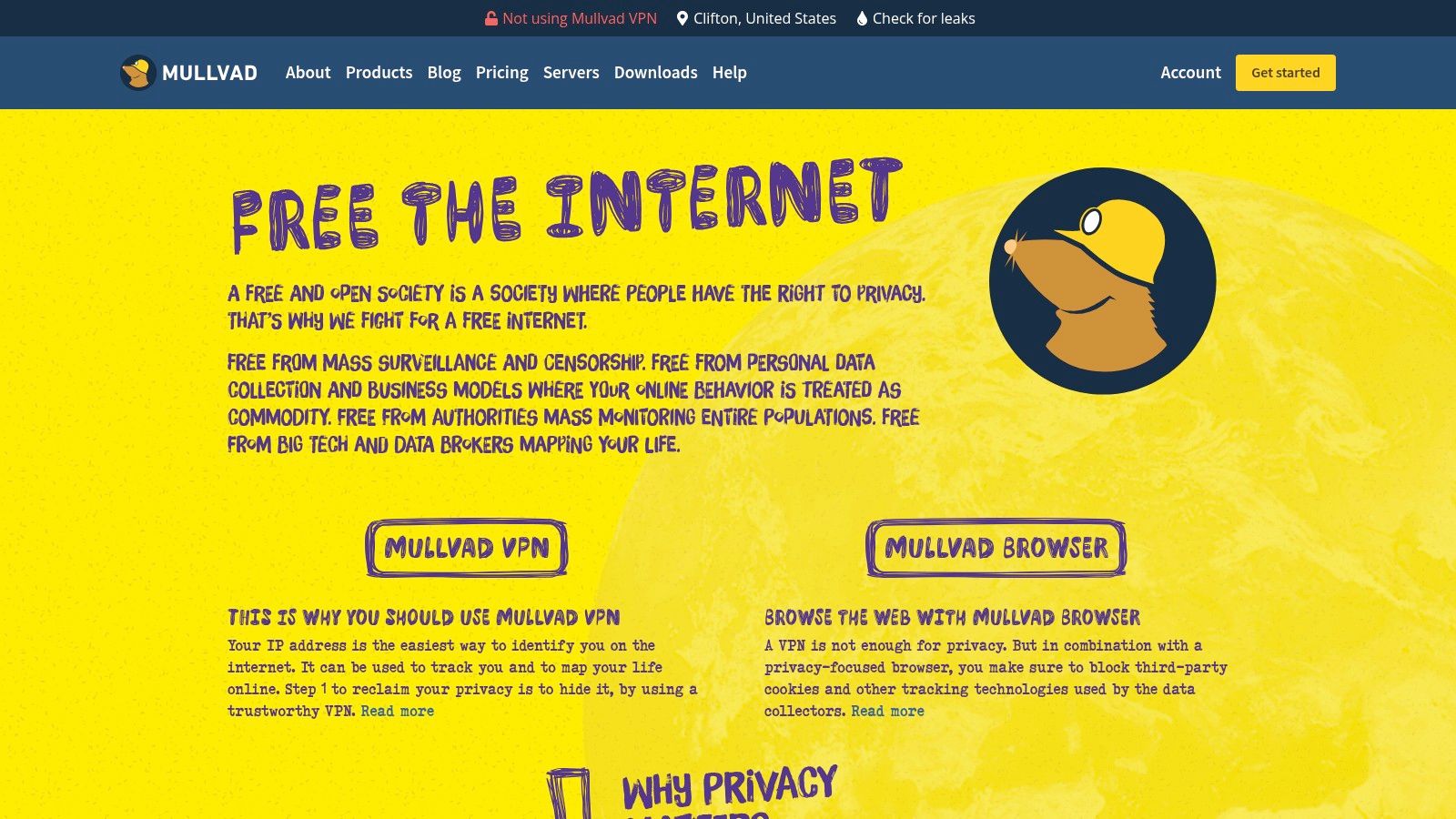
    6. Mullvad VPN Official Website

    Mullvad VPN earns a place on our list for its uncompromising commitment to user privacy and anonymity, all managed through its minimalist and highly functional official website. The platform is a direct reflection of its service philosophy: no-nonsense, transparent, and secure. It forgoes flashy marketing in favor of providing clear, essential information about its open-source applications and robust security protocols. A key differentiator is its anonymous account creation process; the website generates a random account number, completely decoupling your identity from your VPN usage, a stark contrast to the email-based sign-ups required by most services.

    Mullvad VPN Official Website

    The website’s standout feature is its dead-simple, flat-rate pricing, a refreshing departure from the complex, multi-year subscription tiers of competitors. This transparency builds trust and simplifies the decision-making process for users. While it may not be in the top 3 best vpn services for streaming due to a smaller server network, its focus on privacy is second to none. The site also uniquely accepts a wide range of payment methods, including cash mailed to their headquarters, further cementing its position as a tool for true anonymity. This approach positions Mullvad as an essential resource for journalists, activists, and anyone prioritizing privacy above all else.

    Core Features & Comparison

    FeatureMullvadNordVPNSurfshark
    Account CreationAnonymous NumberEmail-basedEmail-based
    Pricing ModelFlat-Rate MonthlyTiered SubscriptionTiered Subscription
    Server Count~650+~6,400+~3,200+
    Simultaneous ConnectionsUp to 5Up to 10Unlimited

    Pros:

    • Exceptional privacy with anonymous account generation and cash payment options.
    • Transparent, simple, and affordable flat-rate pricing model.
    • Fully open-source applications enhance user trust and security.

    Cons:

    • Smaller server network may result in slower speeds in some regions.
    • Lacks the extensive feature set (like specialty servers) of larger competitors.

    Website: https://mullvad.net/

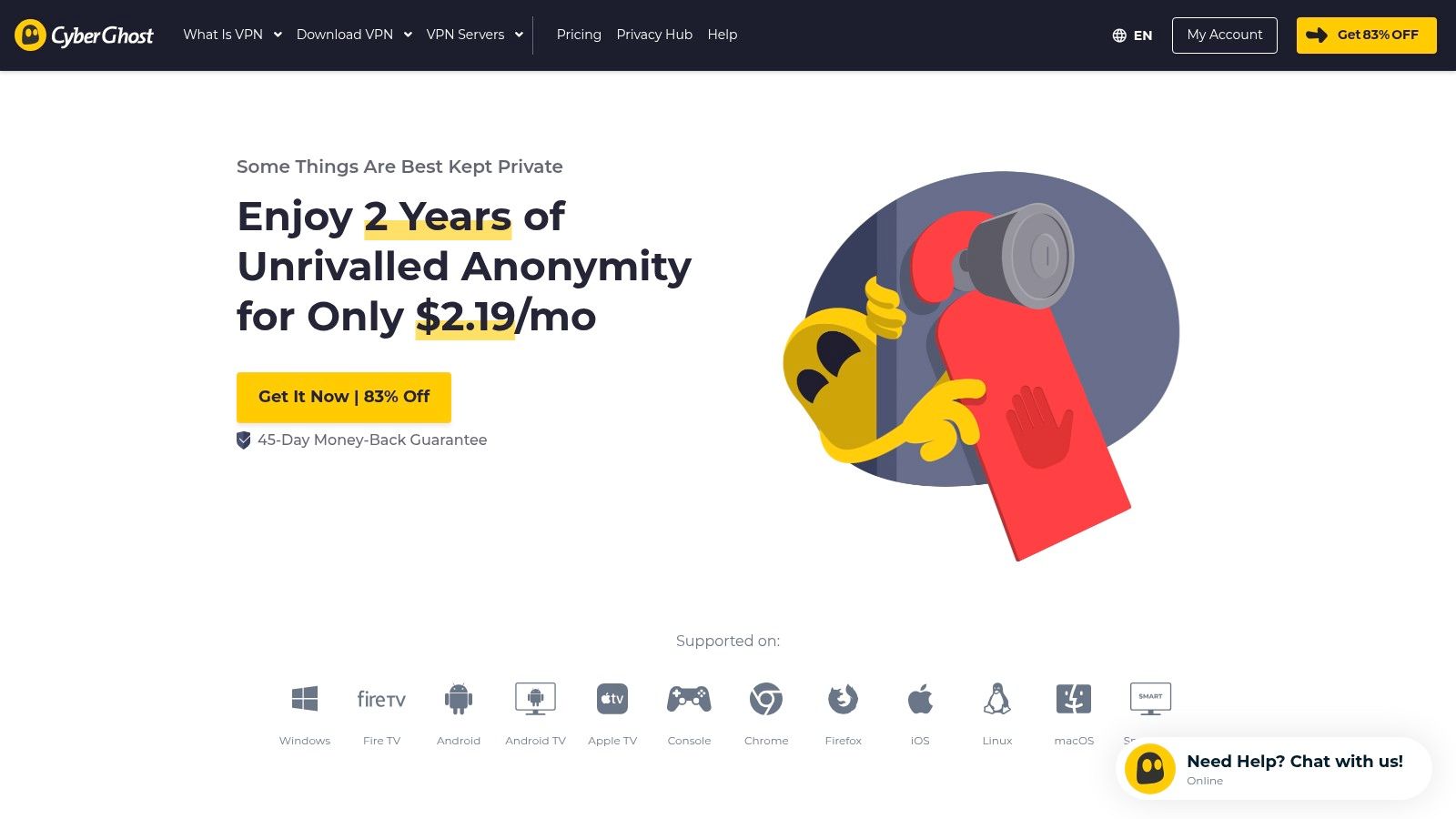
    7. CyberGhost VPN Official Website

    CyberGhost VPN secures its place by prioritizing user-friendliness and specialized performance, all managed through its clean and intuitive official website. The platform is designed for simplicity, making it one of the top 3 best vpn services for those new to VPNs or users who want a hassle-free experience. It clearly outlines its main selling point: optimized servers for specific activities like streaming, torrenting, and gaming. This approach removes the guesswork often associated with finding a server that works with a particular service, a distinct advantage over the more generalized server lists of competitors.

    CyberGhost VPN Official Website

    The website makes it incredibly easy to get started. Pricing plans are displayed transparently, and CyberGhost stands out by offering an exceptionally generous 45-day money-back guarantee on its longer-term plans, giving users ample time to test its capabilities risk-free. This extended trial period is a significant benefit compared to the standard 30-day guarantees from NordVPN and ExpressVPN. The site also provides easy access to its wide range of apps and offers helpful setup guides, ensuring a smooth onboarding process for users on any device.

    Core Features & Comparison

    FeatureCyberGhostNordVPNSurfshark
    Simultaneous ConnectionsUp to 7Up to 10Unlimited
    Unique FeatureStreaming-Optimized ServersThreat ProtectionUnlimited Devices
    Server Count~11,700+~6,400+~3,200+
    Money-Back Guarantee45 Days30 Days30 Days

    Pros:

    • Extremely user-friendly interface, perfect for beginners.
    • Dedicated servers optimized for unblocking specific streaming platforms.
    • Industry-leading 45-day money-back guarantee offers a longer trial.

    Cons:

    • Lacks some of the advanced configuration options found in NordVPN.
    • Connection speeds can be less consistent than top-tier competitors.

    Website: https://www.cyberghostvpn.com/

    8. Windscribe VPN Official Website

    Windscribe secures its place in discussions of top VPN services by offering one of the most generous and functional free plans in the market, all managed through its straightforward official website. The platform clearly distinguishes its free and paid tiers, allowing users to understand the value proposition without aggressive upselling. It serves as the primary portal for downloading the VPN client and managing R.O.B.E.R.T., its highly customizable server-side tool for blocking ads, malware, and trackers. This approach makes Windscribe a compelling entry point for users new to VPNs who want robust features without an immediate financial commitment.

    Windscribe VPN Official Website

    The website is designed for transparency, featuring a no-nonsense layout that details its privacy policies and feature set. A key advantage over many competitors is the flexible “Build A Plan” option, which lets users purchase access to specific server locations for just $1 per month each. This a-la-carte model is a unique offering not found with major providers like NordVPN or ExpressVPN. While the free plan is a major draw, upgrading to Pro unlocks the full server network and unlimited data, making it a competitive, low-cost premium service.

    Core Features & Comparison

    FeatureWindscribe (Pro)NordVPNSurfshark
    Simultaneous ConnectionsUnlimitedUp to 10Unlimited
    Unique FeatureBuild A Plan / R.O.B.E.R.T.Threat ProtectionNexus Technology
    Free PlanYes (10GB/mo)NoNo
    Price PointLow-to-MidMid-to-HighLow

    Pros:

    • Excellent free tier with a generous 10GB monthly data limit.
    • Highly customizable ad and tracker blocking with the R.O.B.E.R.T. feature.
    • Flexible and affordable “Build A Plan” pricing model.

    Cons:

    • Smaller server network compared to industry leaders like NordVPN.
    • Connection speeds can be inconsistent, especially on the free plan.

    Website: https://windscribe.com/

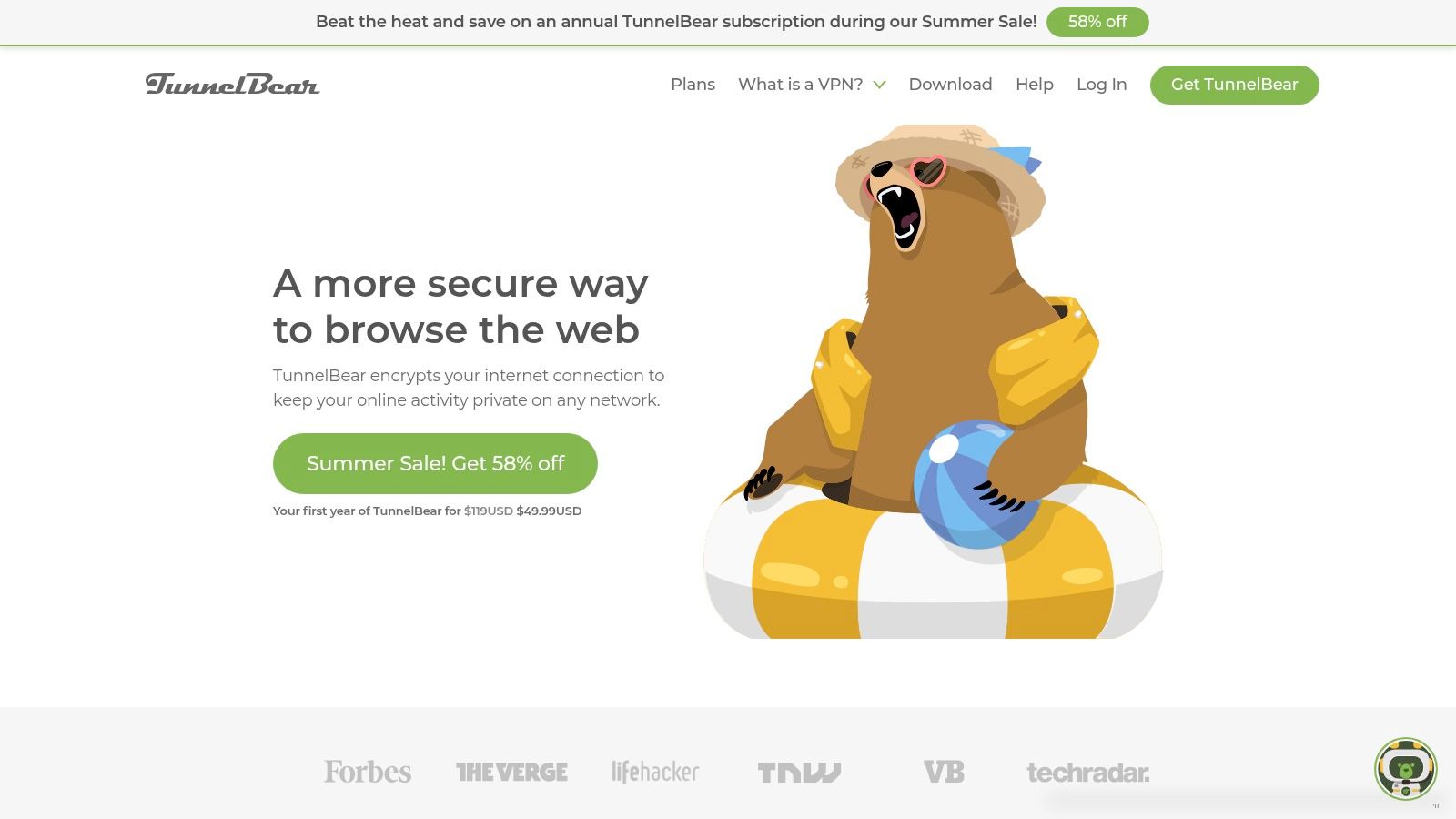
    9. TunnelBear VPN Official Website

    TunnelBear carves out its niche by prioritizing simplicity and transparency, making its official website a welcoming entry point for VPN newcomers. The platform’s charming, bear-themed design immediately sets it apart from more technically-focused competitors. It effectively communicates the service’s core value: making online privacy accessible to everyone, regardless of their tech expertise. The site clearly explains its features without overwhelming visitors with jargon, making it an excellent starting point for users intimidated by complex security software.

    TunnelBear VPN Official Website

    The website excels at building trust through radical transparency. A key differentiator is its prominent display of annual, independent security audits, a practice that instills confidence in its privacy commitments. Unlike the top-tier services that focus on performance metrics, TunnelBear’s site highlights its free plan, offering 2GB of secure data per month. This allows users a genuine, risk-free opportunity to test the service, which is a significant advantage for those unsure about committing to a paid subscription. The user journey from landing page to download is exceptionally smooth and straightforward.

    Core Features & Comparison

    FeatureTunnelBearNordVPNSurfshark
    Simultaneous ConnectionsUnlimitedUp to 10Unlimited
    Free PlanYes (2GB/mo)NoNo
    Server Count~5,000+~6,400+~3,200+
    Obfuscation FeatureGhostBearObfuscated ServersCamouflage Mode

    Pros:

    • Extremely user-friendly interface, perfect for beginners.
    • Strong commitment to transparency with regular, public security audits.
    • Generous free version for light usage and testing.

    Cons:

    • Lacks the advanced features and customization of top-tier VPNs.
    • Free plan data cap is restrictive for streaming or heavy use.

    Website: https://www.tunnelbear.com/

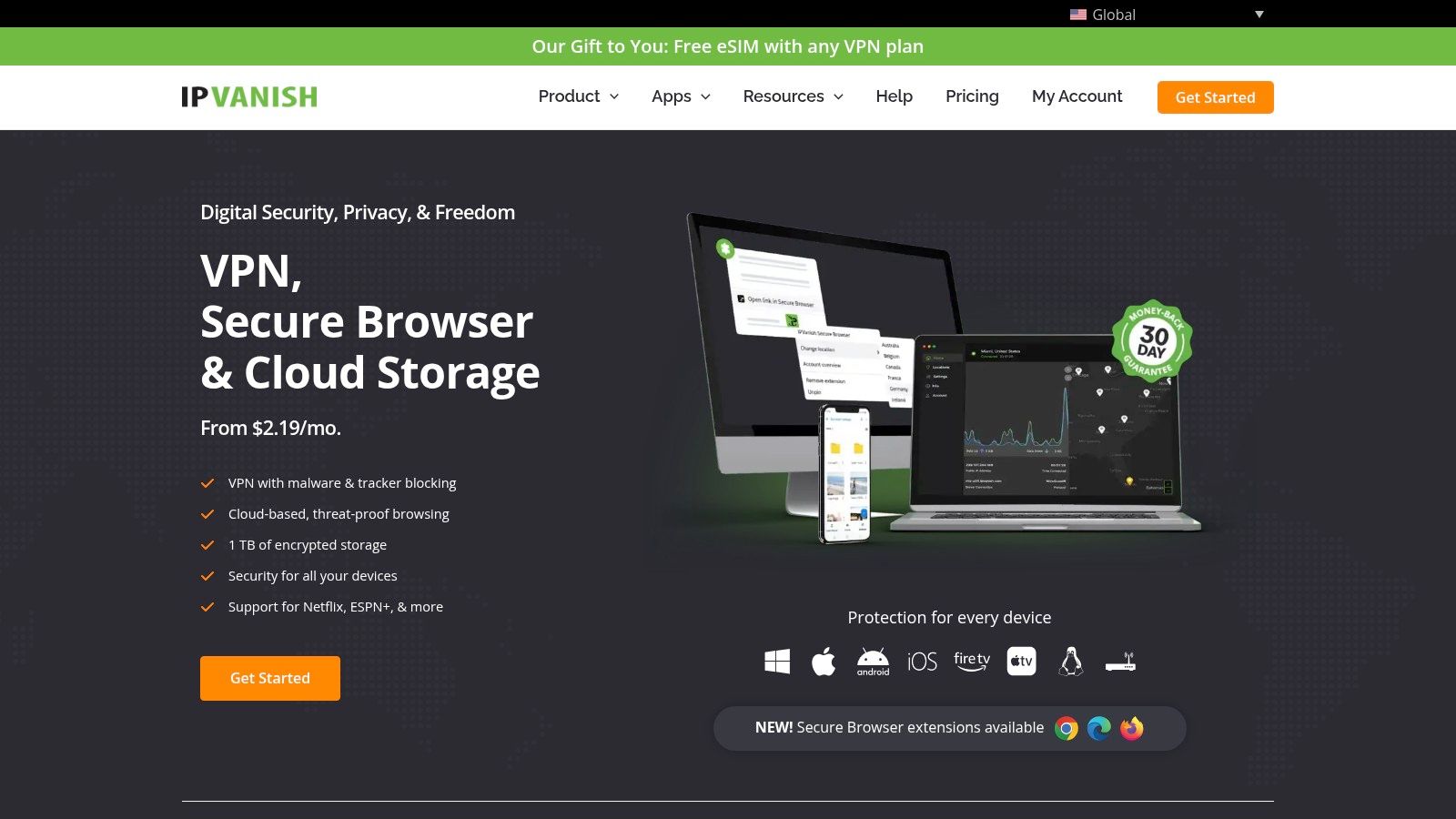
    10. IPVanish VPN Official Website

    IPVanish secures its place as a strong contender by focusing on high-speed connections and robust security, all managed through its direct and functional official website. The platform clearly lays out its services, emphasizing its ownership of its server network, a key differentiator that gives it greater control over performance and security. This makes it a compelling option among the top 3 best VPN services for users prioritizing raw speed for activities like streaming and torrenting. The site is straightforward, providing easy access to software downloads, support, and transparent plan details without overwhelming visitors.

    IPVanish VPN Official Website

    The website effectively highlights its value proposition, particularly its unlimited simultaneous connections, a feature that puts it on par with Surfshark and ahead of NordVPN and ExpressVPN. A standout benefit promoted on the site is the inclusion of SugarSync secure cloud storage, offering an added layer of value not typically found with other VPN providers. Pricing is presented clearly with a 30-day money-back guarantee for yearly plans, giving new users a confident entry point. The 24/7 live chat support is also a major plus for anyone needing immediate assistance.

    Core Features & Comparison

    FeatureIPVanishNordVPNExpressVPN
    Simultaneous ConnectionsUnlimitedUp to 10Up to 8
    Unique ProtocolWireGuardNordLynxLightway
    Server Count~2,400+~6,400+~3,000+
    Added BenefitSugarSync StorageThreat ProtectionN/A

    Pros:

    • Unlimited device connections on a single subscription.
    • Excellent speeds suitable for 4K streaming and P2P file-sharing.
    • Comes with complimentary SugarSync secure storage.

    Cons:

    • Based in the US, which is part of the Five Eyes intelligence alliance.
    • Smaller server network compared to industry leaders like NordVPN.

    Website: https://www.ipvanish.com/

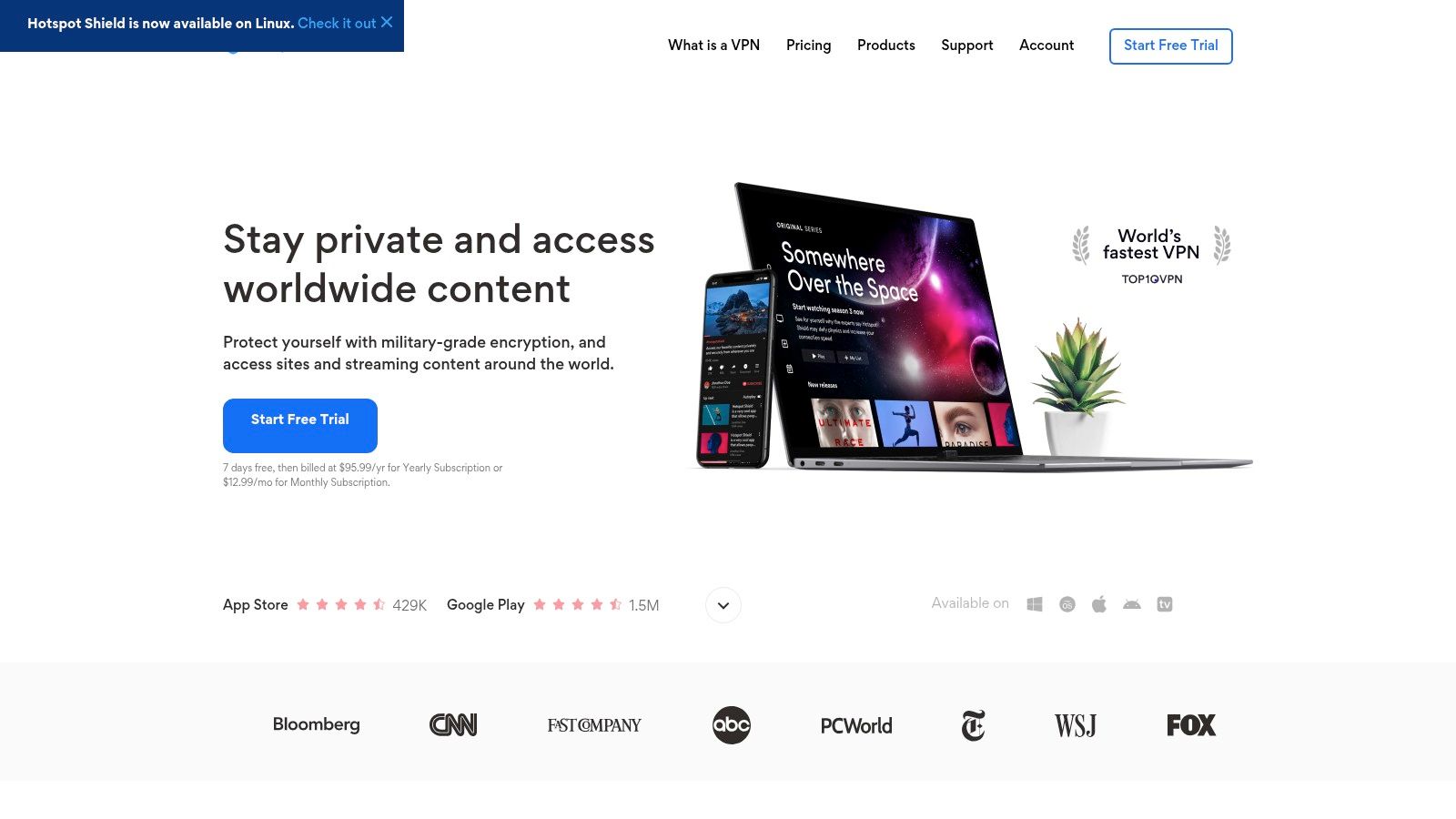
    11. Hotspot Shield VPN Official Website

    Hotspot Shield carves out its niche by prioritizing raw speed, a focus clearly communicated through its official website. The platform highlights its proprietary Catapult Hydra protocol as the engine behind its high-performance connections, making it a strong contender for users whose primary need is uninterrupted streaming, gaming, or large-file downloading. The website presents a straightforward proposition, offering both a free and a premium version, allowing potential users to test the service’s core functionality, albeit with data caps and ads. This freemium model is a key differentiator from top-tier services that only offer money-back guarantees.

    Hotspot Shield VPN Official Website

    The user experience on the site is clean, guiding visitors directly toward downloading the app or upgrading to a paid plan. While Hotspot Shield is often included in discussions of the best VPN services for its speed, its US jurisdiction can be a concern for privacy purists, unlike NordVPN (Panama) or ExpressVPN (British Virgin Islands). The website details its premium features, including malware protection and access to over 3,200 servers, but the primary draw remains its performance, powered by Hydra. Pricing for premium plans is competitive, often presented with steep discounts for longer commitments.

    Core Features & Comparison

    FeatureHotspot ShieldExpressVPNSurfshark
    Simultaneous ConnectionsUp to 10Up to 8Unlimited
    Unique ProtocolCatapult HydraLightwayWireGuard
    Server Count~3,200+~3,000+~3,200+
    Free VersionYes (Limited)NoNo

    Pros:

    • Exceptional connection speeds with the Catapult Hydra protocol.
    • Offers a functional free version for basic use.
    • User-friendly interface suitable for VPN beginners.

    Cons:

    • Based in the US (part of the Five Eyes intelligence alliance).
    • The free version is supported by ads and has data limitations.

    Website: https://www.hotspotshield.com/

    12. VyprVPN Official Website

    VyprVPN solidifies its place as a strong contender by focusing on privacy and bypassing restrictive networks through its official website. The platform clearly articulates its core mission: providing digital freedom. It does this by highlighting its proprietary Chameleon™ protocol, designed to defeat VPN blocking and throttling in censorship-heavy regions. The site is direct, offering users immediate insight into its independently audited no-logs policy and its ownership of its entire server infrastructure, a key trust factor that sets it apart from many competitors.

    VyprVPN Official Website

    The user experience on the VyprVPN website is streamlined for quick comprehension and purchase. It presents its plans without complex tiers, making the decision-making process simple. A significant advantage is its emphasis on the Chameleon™ protocol, a feature that makes it a top choice for journalists, activists, and travelers needing reliable access to an open internet. Pricing is competitive, and all plans include the full feature set and a 30-day money-back guarantee, ensuring users can test its censorship-bypassing capabilities risk-free.

    Core Features & Comparison

    FeatureVyprVPNExpressVPNNordVPN
    Simultaneous Connections10Up to 8Up to 10
    Unique ProtocolChameleon™LightwayNordLynx
    Server Count~700+~3,000+~6,400+
    Price PointMid-RangeHighMid-to-High

    Pros:

    • Proprietary Chameleon™ protocol is excellent for bypassing deep packet inspection.
    • Owns and manages its entire server network for enhanced privacy.
    • Strong, independently audited no-logs policy.

    Cons:

    • Significantly smaller server network than industry leaders like NordVPN.
    • Lacks the extensive extra features found in services like Surfshark.

    Website: https://www.vyprvpn.com/

    Top 12 VPN Services Feature Comparison

    VPN ServiceCore Features ✨User Experience ★★★★☆Value Proposition 💰Target Audience 👥Unique Selling Points 🏆Price Points 💰
    NordVPN7,600+ servers, NordLynx, P2P & Onion Over VPNHigh-speed, 24/7 supportPremium security & speedStreaming & privacy seekersStrict no-logs, specialty servers$$$ (Higher priced)
    SurfsharkUnlimited connections, CleanWeb, MultiHopUser-friendly, budget-friendlyAffordable unlimited devicesFamilies & multi-device usersUnlimited simultaneous connections$ (Budget-friendly)
    ExpressVPN105 countries, Lightway protocol, TrustedServerConsistent high-speed, strong supportHigh performance & privacyPerformance-focused usersTrustedServer tech, Lightway protocol$$$ (Higher priced)
    Proton VPNSecure Core, open-source apps, strong encryptionPrivacy-centric, free tier availableFree unlimited data optionPrivacy advocates & tech usersSwitzerland base, Secure Core architecture$$ (Moderate to expensive)
    Private Internet Access10,000+ servers, advanced encryption, P2P supportCustomizable, privacy-focusedAffordable long-term plansTech-savvy & privacy focusedUnlimited connections, strong customization$-$$ (Affordable)
    Mullvad VPNAnonymous accounts, flat-rate, open-source appsPrivacy-first, transparentSimple pricing modelPrivacy puristsAnonymous sign-up, accepts cash$$ (Flat-rate pricing)
    CyberGhost7,000+ servers, streaming servers, kill switchEasy interface, streaming optimizedGood for streamingStreamers & casual usersDedicated streaming servers$-$$ (Affordable)
    WindscribeFree 10GB, R.O.B.E.R.T. ad blocker, multi-protocolStrong privacy, user-friendly appsGenerous free planCasual & privacy usersFree 10GB data planFree / $
    TunnelBearFree 2GB, VigilantBear kill switch, GhostBearEasy for beginners, transparentSimple & free optionBeginners & light usersRegular security auditsFree / $
    IPVanish1,600+ servers, unlimited connections, SugarSyncHigh-speed, 24/7 supportSpeed & security focusStreamers & torrentersUnlimited devices, secure storage included$$ (Moderate)
    Hotspot Shield3,200+ servers, Hydra protocol, free limited planHigh-speed, friendly UISpeed with extra securityGeneral users & streamersProprietary Hydra protocol$-$$ (Free & paid plans)
    VyprVPN700+ servers, Chameleon protocol, no-logs auditPrivacy-focused, user-friendlyPrivacy & bypass censorshipAnti-censorship & privacy usersChameleon protocol for bypassing VPN blocks$$ (Moderate)

    Final Thoughts

    Navigating the crowded VPN market can be a daunting task, but understanding your specific needs is the key to making the right choice. Throughout this guide, we’ve dissected the offerings of the industry’s leading providers, moving beyond marketing claims to focus on real-world performance, security architecture, and practical use cases. Our deep dive into the top 3 best vpn services has revealed that while NordVPN, ExpressVPN, and Surfshark all provide exceptional security and privacy, they cater to distinctly different user profiles and priorities.

    The decision ultimately comes down to a personalized cost-benefit analysis. No single VPN is universally “the best”; the best one is the one that aligns perfectly with your digital lifestyle, threat model, and budget.

    Recapping Your Top Choices

    To simplify your final decision, let’s crystallize the core strengths of our top contenders:

    • NordVPN: The ultimate choice for users prioritizing maximum security and a feature-rich toolkit. Its Threat Protection suite, specialized servers (Double VPN, Onion Over VPN), and blazing-fast NordLynx protocol make it a powerhouse for tech-savvy individuals, small businesses, and anyone handling sensitive data. If comprehensive, multi-layered security is your non-negotiable, NordVPN is your answer.
    • ExpressVPN: The gold standard for reliability, ease of use, and unparalleled streaming access. Its proprietary Lightway protocol delivers consistent, high-speed connections, and its TrustedServer technology sets a benchmark for privacy. For users who need a VPN that “just works” for unblocking global content on any device, from smart TVs to routers, ExpressVPN’s simplicity and effectiveness are unmatched.
    • Surfshark: The undisputed champion of value and affordability. Offering unlimited simultaneous connections on a single subscription, it’s the ideal solution for families, households with numerous gadgets, or small teams. Features like CleanWeb 2.0 and Alternative ID provide significant value, making it the go-to for budget-conscious users who refuse to compromise on core security and functionality.

    Actionable Steps to Making Your Decision

    Before you commit, take these final steps to ensure you’re making a confident choice. Your selection process for one of the top 3 best VPN services should be as secure as the connection it provides.

    1. Re-evaluate Your Primary Use Case: Are you primarily a streamer, a torrent user, a remote worker, or a privacy advocate? Match your main activity to the VPN that excels in that area. For instance, a streamer should lean towards ExpressVPN or Surfshark, while a security-focused business owner might prefer NordVPN.
    2. Consider Your Device Ecosystem: How many devices do you need to protect simultaneously? If the answer is more than a handful, Surfshark’s unlimited connections offer unbeatable value. If you need robust and simple apps for a specific device like an Apple TV or a gaming console, check which provider offers the most streamlined setup.
    3. Leverage the Money-Back Guarantee: All three of our top picks offer a risk-free 30-day money-back guarantee. This is not just a trial; it’s your opportunity to conduct a real-world test. Sign up for your top choice and put it through its paces. Test server speeds, try unblocking your favorite streaming services, and see how the app feels on your most-used devices. If it doesn’t meet your expectations, getting a refund is a straightforward process.

    By moving from abstract features to this hands-on evaluation, you transition from a reader to an empowered user. You are now equipped with the knowledge to select a VPN that will not only protect your digital footprint but also enhance your online freedom and capabilities for years to come.


    Beyond securing your connection, optimizing your digital presence is the next frontier for growth. If you’re looking to elevate your business with AI-powered content creation and workflow automation, explore what creavoid has to offer. Visit creavoid to discover how our intelligent tools can help you scale your operations and marketing efforts efficiently.

  • Create Your Digital Transformation Roadmap in 2025

    Create Your Digital Transformation Roadmap in 2025

    Think of a “digital transformation roadmap” less as a stuffy corporate document and more as your strategic playbook for survival and growth. It’s the bridge that connects where your business is today to where it needs to be tomorrow. This plan is absolutely essential for making sure your tech investments actually push the business forward, instead of just becoming another line item on a budget.

    Why Your Business Needs This Roadmap Now

    Image

    Let’s cut through the buzzwords. A digital transformation roadmap isn’t an IT department’s wish list or a catalog of trendy software to buy. I’ve seen too many companies make that mistake.

    Without a clear plan, “transformation” efforts become a mess of fragmented, expensive projects that go nowhere. You end up with powerful tools nobody uses or automated processes that solve the wrong problems. A solid roadmap prevents this chaos by tying every single action back to a specific, measurable business goal.

    The Urgency is Real

    The pressure to evolve isn’t some distant threat—it’s right here, right now. Nimble competitors, free from clunky legacy systems, can swoop in and steal customers with better digital experiences. At the same time, your customers’ expectations have completely changed. They demand seamless, personal, and instant service, a standard set by digital-first companies.

    In this environment, standing still is the biggest risk you can take.

    The data backs this up. By 2025, a staggering 94% of organizations are expected to have digital initiatives underway. It’s not a niche activity anymore; 32% of managers see it as a basic requirement for survival. If you’re curious about the numbers, Veritis.com offers more insights into digital transformation trends.

    Here’s a common pitfall I see all the time: treating digital transformation as a one-and-done project. It’s not. It’s a continuous evolution, and your roadmap should be a living document that adapts to new challenges and opportunities.

    It’s About More Than Just Technology

    A successful roadmap isn’t just about bolting on new tech. It’s about making strategic improvements in key areas that deliver real, tangible value. Before we dive into the “how,” let’s get a clear picture of what we’re building.

    The table below summarizes the core components we’ll be breaking down. Think of it as a high-level overview of the journey ahead.

    PillarKey FocusBusiness Outcome
    Operational EfficiencyAutomating repetitive tasks and streamlining workflows.Reduced errors, lower costs, and a more productive team.
    Customer EngagementCreating smoother, more personalized customer journeys.Increased loyalty, higher satisfaction, and better retention.
    Core SystemsUpdating foundational technology to support growth.Greater agility, improved security, and future-ready operations.

    Ultimately, a good roadmap focuses on these pillars to deliver concrete results. It’s about building a stronger, more competitive business from the inside out, ensuring every dollar you spend on technology turns into measurable success.

    Before you even think about buying new software or hiring a single developer, the most important work of your digital transformation has to happen. This isn’t about servers or code; it’s about getting the right people in a room and figuring out your “why.” This is the strategic foundation, and skipping it is the fastest way to waste a lot of time and money.

    A successful transformation is built on a crystal-clear, shared understanding of your goals. You need to get your key leaders together—from the C-suite to the managers on the front lines—and ask some tough questions. What specific business problems are we actually trying to fix? What does a “win” look like in three years?

    Without this alignment, you’ll end up with a mess. Different departments will pull in opposite directions, creating a patchwork of disconnected tools instead of a unified, powerful strategy.

    Get Your A-Team in Place

    First things first: you need to assemble a cross-functional transformation team. This can’t be some sleepy steering committee that meets once a quarter. This group needs real authority to make decisions and drive change.

    Your team should be a mix of people who can speak for every part of the business:

    • Executive Leadership: You need a champion to provide the vision, secure the budget, and keep the momentum going.
    • IT and Technology: These are the folks who will assess technical feasibility and what your infrastructure can handle.
    • Operations: They bring a dose of reality, grounding the strategy in the day-to-day work that actually gets done.
    • Marketing and Sales: They represent the voice of your customer and keep everyone focused on revenue goals.
    • Human Resources: Don’t forget the people! HR is critical for managing the change, including training and communication.

    Having this mix of perspectives ensures your roadmap isn’t built in an echo chamber. It becomes a plan the entire organization can get behind because they had a hand in creating it. The potential here is massive; the global digital transformation market is expected to explode from USD 1.42 trillion in 2025 to USD 13.26 trillion by 2035. You can discover more insights from the 2025-2035 market forecast report to see why this foundational work matters.

    Define What Success Actually Looks Like

    With your team assembled, it’s time to define success with sharp, meaningful KPIs. So many companies fall into the trap of focusing only on cutting costs. While that’s a piece of the puzzle, real transformation creates value across the entire business.

    I’ve seen this happen countless times: companies chase technology for technology’s sake. The goal isn’t to be “more digital.” The goal is to solve a business problem. Your KPIs must reflect the problems you’re trying to solve.

    Ditch the generic, fluffy goals and get specific with metrics that truly move the needle.

    KPI CategoryWeak KPI ExampleStrong KPI Example
    Customer ImpactIncrease website trafficBoost customer lifetime value (CLV) by 15%
    Operational ImpactImplement new softwareReduce order fulfillment time by 25%
    Employee ImpactConduct training sessionsImprove employee productivity scores by 20%

    See the difference? These stronger KPIs force you to connect every tech investment to a real business outcome. A higher CLV isn’t just a number; it’s the direct result of a better customer experience, which should be at the heart of any digital transformation.

    Let’s Talk Real-World: A Retail Scenario

    Let’s bring this down to earth. I once worked with a mid-sized retailer whose online and in-store experiences were completely disconnected. It was a mess. In their foundational meetings, one major pain point surfaced: the returns process was a nightmare for customers. You couldn’t easily return an online purchase in-store, and vice versa. This led to frustrated customers and, you guessed it, lost sales.

    The team didn’t just jump to buying a new point-of-sale system. Instead, they set a clear, foundational goal that became their North Star: “Create a unified, hassle-free returns process across all channels within 12 months.”

    This simple but powerful objective immediately clarified their priorities:

    1. Integrate Inventory Systems: They had to get a single view of their stock, whether it was in a warehouse or a back storeroom.
    2. Rethink In-Store Processes: Staff needed new tools and training to handle online returns without a headache.
    3. Update the E-commerce Platform: The website had to clearly communicate the new, super-flexible return options.

    By starting with a specific, customer-focused problem, they built a strategy that made sense. Every decision that followed—from the tech they chose to the training they rolled out—was measured against that one core goal. That’s the power of building your roadmap on a rock-solid strategic foundation.

    Mapping Your Journey From Now to Next

    Okay, you’ve got your strategic foundation. Now for the fun part: turning that big-picture vision into a plan you can actually execute. This is where we build your digital transformation roadmap, moving from those high-level goals to concrete, scheduled projects.

    Think of this roadmap as a living document. It’s meant to guide your decisions, not be a rigid blueprint that shatters the first time something unexpected happens.

    The first move is a brutally honest gap analysis. You need a clear-eyed look at where you are today versus where you want to be. Where are the biggest disconnects? This isn’t about pointing fingers or finding fault; it’s about pinpointing the most fertile ground for meaningful change.

    Image

    This visual really gets to the heart of it. Your roadmap is the deliberate path you construct to bridge the gap between your current reality and your future ambitions.

    Break It Down Into Phases

    One of the biggest mistakes I see companies make is trying to do everything at once. It’s a “boil the ocean” approach that almost always ends in blown budgets, a burnt-out team, and ultimately, failure.

    A much smarter way is to break the journey into manageable, sequential phases. Each phase should deliver tangible value on its own and build momentum for whatever comes next.

    For example, a growing e-commerce business might phase its transformation like this:

    • Phase 1 – Foundational Customer Data: First, get a grip on your customer data. This means digitizing core service channels and implementing a CRM. The goal is a single, unified view of every customer interaction.
    • Phase 2 – Operational Excellence: With customer data flowing, you can now focus on efficiency. Automate inventory management and order fulfillment to cut down on manual errors and speed up shipping.
    • Phase 3 – Personalization at Scale: Finally, use the rich data from Phase 1 and the new efficiencies from Phase 2 to launch personalized marketing campaigns and on-site product recommendations.

    See how each step logically builds on the last? This creates a rock-solid foundation for more advanced capabilities later on. If you’re looking for the right systems for these phases, our guide on essential e-commerce tools and platforms is a great place to start your research.

    Prioritize With an Impact vs. Effort Matrix

    So you’ve got a list of potential projects. How do you decide what to tackle first? My go-to tool for this is simple but incredibly powerful: the impact versus effort matrix. It helps you get past gut feelings and make truly strategic prioritization decisions.

    Just plot each initiative on a four-quadrant grid:

    1. High Impact, Low Effort (Quick Wins): Do these first. They deliver major value without draining your resources and create that all-important early momentum.
    2. High Impact, High Effort (Major Projects): These are your big, strategic game-changers. They require serious planning and investment but are absolutely critical for long-term success.
    3. Low Impact, Low Effort (Fill-ins): Tackle these only when you have spare capacity. Don’t let them distract you from the more important stuff.
    4. Low Impact, High Effort (Thankless Tasks): Avoid these like the plague. They burn time and money for almost no return.

    This simple exercise forces your team to have tough, necessary conversations about the true value and real cost of each project. It ensures you’re putting your energy where it will make the biggest difference.

    Remember, the whole point of a digital transformation roadmap is to drive business outcomes. By prioritizing high-impact initiatives, you ensure your early efforts show a clear ROI. This is absolutely crucial for keeping your executives bought in and your team motivated.

    With your projects prioritized and sorted into phases, you can finally build a realistic timeline. Assign clear ownership for every single initiative and define specific, measurable milestones.

    A milestone isn’t “Improve customer service.” It’s “Launch the new support chatbot on the website by the end of Q2.” These concrete checkpoints make progress impossible to ignore and keep everyone accountable, turning your strategic map into a practical guide for your journey from now to next.

    Choosing the Right Technology and Partners

    So, you’ve got your priorities mapped out. Now for the exciting part: picking the tools and allies that will actually bring your digital transformation roadmap to life.

    This stage isn’t about chasing the shiniest new toy. It’s about making smart, strategic decisions that directly support the business goals you’ve already laid out. Think of it this way: the right technology stack empowers your strategy; the wrong one will end up dictating it.

    It’s easy to get fixated on the sticker price of a new platform, but I’ve seen that mistake sink more than a few projects. The real number you need to focus on is the Total Cost of Ownership (TCO). This goes way beyond the initial purchase to include implementation fees, employee training, ongoing maintenance, and the costs of integrating it with everything else.

    Evaluating Your Technology Options

    As you start assessing software or platforms, run every single option through a simple but crucial filter.

    First, is it scalable? You need something that can grow with your business without forcing you to rip everything out and start over in two years. Second, can it play nicely with your existing systems? A slick new tool that creates data silos is a step backward, not a step forward.

    Imagine a mid-sized retailer looking to upgrade their e-commerce game. A cheap, standalone platform might look like a bargain at first. But if it can’t talk to their inventory management or CRM, the manual data entry required will quickly demolish any initial cost savings. Worse, it creates a nightmare experience for both staff and customers.

    The most expensive piece of technology is always the one your team refuses to use. Prioritize user experience and ease of adoption above all else. If a tool is clunky or confusing, no amount of fancy features will make up for the fact that nobody wants to log in.

    The Great Debate: Build vs. Buy

    One of the biggest forks in the road you’ll face is whether to build a custom solution from scratch or buy something off the shelf. There’s no universal “right” answer here. The best choice is completely dependent on your specific needs, your team’s resources, and your long-term vision.

    Laying out the options side-by-side can really clarify which path makes sense for a particular initiative.

    Comparing Technology Sourcing Strategies

    Choosing how to source your technology is a major decision point. This table breaks down the three main paths—building custom, buying off-the-shelf, or a hybrid approach—to help you see which one aligns best with your project’s goals, budget, and timeline.

    StrategyBest ForProsCons
    Buy (Off-the-Shelf)Standard business functions like HR, accounting, or CRM where you don’t need to reinvent the wheel.Faster implementation, lower upfront cost, comes with built-in support and regular updates.Limited customization, you might pay for features you don’t need, risk of vendor lock-in.
    Build (Custom)Unique business processes that give you a core competitive advantage and can’t be replicated by a standard tool.Perfectly tailored to your exact needs, gives you total control over features and future development.High initial cost, much longer development timeline, you’re responsible for all ongoing maintenance.
    Hybrid (Mix & Match)Leveraging the best of both worlds—using a standard platform for its core strengths while building custom pieces for unique needs.Cost-effective, speeds up deployment, allows for targeted innovation where it matters most.Requires careful planning to ensure seamless integration, can create some management complexity.

    A hybrid approach is often the sweet spot. For instance, you might buy a market-leading CRM platform but then build a custom integration to connect it to your proprietary manufacturing software. If you’re leaning toward building, it’s worth exploring the nuances of working with external teams. You can get some great insights from this guide on the pros and cons of outsourcing software development to help shape your strategy.

    Ultimately, this isn’t just about code; it’s about finding the most effective way to solve a business problem.

    Selecting Strategic Partners, Not Just Vendors

    The final piece of this puzzle is picking the right people to work with. There’s a huge difference between a vendor and a partner. A vendor sells you a product. A true strategic partner, on the other hand, acts like an extension of your own team, bringing deep industry expertise and a genuine investment in your success.

    When you’re vetting potential partners, you need to look past the slick sales pitch.

    • Ask for case studies, but get specific. You want to see work they’ve done in your industry. Do they actually understand your unique challenges?
    • Talk to their current clients. Don’t just take their word for it. Ask for references and find out if they are responsive, helpful, and proactive problem-solvers.
    • Drill down on their support model. What happens after the project goes live? What does their ongoing support and training look like?

    A great partner doesn’t just hand you the keys and walk away; they stick around to help you learn how to drive. They offer guidance, share best practices, and work alongside you to make sure the technology actually delivers on its promise. This collaborative relationship is often the single biggest factor in whether a new system fuels real growth or just ends up gathering digital dust.

    Putting Your Roadmap Into Action and Sparking Change

    A beautifully designed digital transformation roadmap is completely worthless if it just sits on a server gathering digital dust. The plan is only the starting point. What truly separates successful transformations from expensive failures is creating real, tangible momentum. This is where your strategy document turns into progress your team can see, feel, and actually get behind.

    Image

    The sheer scale of a multi-year transformation can feel paralyzing. So, instead of trying to boil the ocean, think like a software developer and adopt an agile mindset. Break down your massive projects into smaller, manageable “sprints”—these are short, focused work cycles, usually lasting one to four weeks.

    This approach lets you deliver value incrementally. At the end of each sprint, you have a tangible improvement, whether it’s a new feature on your website or a freshly automated report. It’s a game-changer because you can gather immediate feedback, adapt your plan based on what’s actually happening, and avoid costly detours without derailing the entire project.

    The Human Side of Transformation

    Honestly, the technology is the easy part. The real challenge—and where a staggering 70% of transformations fail—is the people. You aren’t just installing new software; you’re fundamentally changing how people do their jobs. If you don’t master change management, you’re setting yourself up for failure. It’s non-negotiable.

    Success really boils down to getting your team to move from “the way we’ve always done it” to embracing new possibilities. This takes a deliberate, empathetic, and persistent communication strategy.

    • Communicate the ‘Why’ Relentlessly: Don’t just announce what is changing. You have to constantly explain why it’s changing and, most importantly, what’s in it for them. Frame it around making their work less frustrating and more impactful.
    • Find Your ‘Change Champions’: In every company, there are influential and respected employees. Identify them and bring them into the fold as advocates. A recommendation from a trusted peer is often far more powerful than any top-down directive.
    • Establish Feedback Loops: Create safe, open channels for employees to voice concerns, ask questions, and share ideas. This simple step makes them feel like active participants rather than just being told what to do.

    Training That Actually Sticks

    Running a single, one-off training session on a new tool and calling it a day is a classic recipe for low adoption. I’ve seen it happen time and again. Effective training needs to be an ongoing process designed to build confidence, not just check a box on a project plan.

    Forget the generic slideshows. Focus on hands-on, role-specific workshops. Show your sales team exactly how the new CRM will help them track leads more effectively. Let the operations team get their hands dirty with the new productivity automation tools that will eliminate their most tedious tasks.

    The real goal of training isn’t just to teach features; it’s to build conviction. When an employee genuinely believes a new tool will make their job better, adoption becomes a pull, not a push.

    Governance and Celebrating Progress

    To keep your digital transformation on track, you need a simple governance framework. This isn’t about creating soul-crushing bureaucracy; it’s about maintaining visibility and accountability. Regular, brief check-in meetings are perfect for monitoring progress against your KPIs, spotting risks before they blow up, and ensuring the project stays on budget.

    This framework is also your secret weapon for celebrating small wins. Did a team successfully automate a weekly report, saving five hours of manual drudgery? Acknowledge it publicly. Did the new customer service chatbot handle its first 100 queries without a hitch? Celebrate it!

    These small victories build a powerful story of progress. They prove to the entire organization that the change is real, positive, and worth all the effort. This is the momentum that turns a one-time project into an enduring culture of continuous improvement—a critical driver in today’s business world.

    The scale of this global push is immense. In 2024, spending on digital transformation is projected to reach $2.5 trillion, with a forecast to hit a massive $3.9 trillion by 2027. The United States is a major force here, accounting for 35.8% of this spending. These numbers really underscore why getting the execution right is so critical.

    Answering Your Key Roadmap Questions

    Even the most buttoned-up digital transformation roadmap is going to stir up questions. That’s a good thing. When you’re tackling something this big, you and your team are bound to hit some gray areas and a few hurdles.

    Let’s cut through the noise and get straight to the practical answers you need. My goal here isn’t to talk theory; it’s to give you the real-world clarity to keep things moving forward with confidence.

    How Long Should Our Digital Transformation Roadmap Be?

    I’ve seen plans that stretch out for five years and some that are hyper-focused on just one. In my experience, a three-year horizon is the strategic sweet spot. It’s long enough to aim for and achieve real, substantial change, but short enough that it doesn’t become totally irrelevant in a market that shifts on a dime.

    The real trick is in how you structure it. The first 12 months need to be mapped out in incredible detail—think specific projects, clear deadlines, and assigned owners. For years two and three, you can afford to be a bit broader, focusing on directional goals rather than granular tasks.

    It’s a lot like planning a cross-country road trip. You know your final destination (the three-year vision), and you have a precise, turn-by-turn plan for today’s drive (year one). But you’re also ready to take a scenic detour if you hear about a better route along the way (adapting in years two and three).

    What Are the Most Common Mistakes We Should Avoid?

    Honestly, the biggest tripwires are almost always about people and processes, not the tech. I’ve seen more promising initiatives stall for these same few reasons than I can count.

    • Ignoring the Culture: You can’t just drop a new piece of software on a team and expect magic. A new tool is useless if the old mindset and clunky processes stick around.
    • No Executive Sponsorship: If you don’t have a visible, vocal champion in the C-suite, your initiative will eventually get starved of resources and authority. It’s a slow, painful death.
    • Poor Communication: Failing to constantly, and I mean constantly, explain the “why” behind the changes. When people don’t understand the purpose, fear and resistance are the natural result.
    • Measuring the Wrong Things: Chasing quick cost savings is tempting, but it’s shortsighted. The real wins are in long-term gains like better customer loyalty and higher employee morale.

    Your digital transformation roadmap has to tackle these human factors head-on from day one. They aren’t secondary—they’re the whole ballgame.

    How Do We Measure the True ROI of This Transformation?

    Thinking about Return on Investment (ROI) as just a cost-versus-savings formula is a massive mistake. To get the full story of the value you’re creating, you need a balanced scorecard.

    Yes, you have to track the financial side of things. But to really justify the long-term investment and prove the deep impact, you need to be measuring success across these key areas:

    Metric CategoryKey Performance Indicators (KPIs) to Track
    Operational MetricsFaster project cycle times, reduced error rates, increased process automation.
    Customer MetricsHigher Net Promoter Score (NPS), improved customer retention rates, increased customer lifetime value (CLV).
    Employee MetricsBetter employee engagement scores, lower staff turnover, increased productivity per employee.

    This holistic view connects the dots between your transformation work and a healthier, more profitable business from every angle.

    How Can We Get Our Team to Embrace These Changes?

    Here’s a hard truth: you don’t command buy-in, you have to earn it. People resist change when they feel like it’s being done to them instead of with them.

    It starts with being absolutely relentless in your communication. Don’t just talk about what’s changing; focus on why it matters. Frame it in terms of how it will make their jobs less frustrating and more valuable.

    Then, get them involved. Create “change champions” in different departments who can be your advocates on the ground and give you honest feedback. Provide fantastic, hands-on training that builds confidence, not insecurity.

    And maybe most important of all? Celebrate the early wins. Publicly recognize the people who are leaning in and making it happen. That positive energy is contagious and builds the momentum you need to see it through.


    Ready to turn your roadmap from a document into a reality? At creavoid, we specialize in building the technology and automation that bring your vision to life. Learn how our AI-driven digital transformation services can accelerate your growth.

  • Outsourcing Software Development in 2025: Key Strategies for Success

    Outsourcing Software Development in 2025: Key Strategies for Success

    The Evolving Landscape of Software Development Outsourcing

    The Evolving Landscape of Software Development Outsourcing

    Software development outsourcing has undergone a significant transformation. It’s evolved from a primarily cost-focused strategy to a vital tool for business growth and innovation. Several key factors have fueled this change, including the growing complexity of software projects, the demand for specialized tech skills, and the increasingly global nature of the tech talent pool. Businesses are adapting to the ever-changing demands of technology, and outsourcing is a key part of that adaptation.

    From Cost-Cutting to Strategic Partnerships

    In the early days, outsourcing was often seen as a way to cut expenses by taking advantage of lower labor costs overseas. Today, it’s less about simply saving money and more about accessing a worldwide network of talent and achieving specific business objectives.

    For instance, a company might outsource the development of a mobile app to a team specializing in mobile development, allowing their internal team to concentrate on other core projects. This strategic use of outsourcing allows businesses to tap into niche skills and accelerate their development timelines. The growth of the outsourcing market itself emphasizes this shift.

    The global market for outsourced services reached $620.381 billion in 2020. This underscores the strategic importance of outsourcing in today’s business world. Companies are using it to improve efficiency, control costs, and access specialized skills. Projections show a 5.54% CAGR in the coming years, demonstrating the growing reliance on this model. You can find more detailed statistics at Invedus. As software needs increase across industries, businesses are turning to outsourcing to stay competitive and adapt to rapid technological changes.

    The Maturation of the Global Talent Ecosystem

    The global talent pool for software development has matured considerably. This maturation is characterized by increased specialization, better communication infrastructure, and the rise of Agile development methodologies. Businesses can now find highly skilled developers worldwide who can integrate seamlessly with their in-house teams. The adoption of cloud-based collaboration tools like Slack and Microsoft Teams has made communication and project management in outsourced projects even easier.

    Key Drivers of Modern Outsourcing

    Several key factors are driving the current trend of outsourcing software development:

    • Access to Specialized Skills: Finding and hiring in-house experts in areas like AI, machine learning, and blockchain can be challenging and costly. Outsourcing offers a way to access this expertise without the expense of full-time employees.


    • Faster Time to Market: Outsourcing allows businesses to quickly build development teams and accelerate project timelines, giving them a competitive advantage.


    • Increased Flexibility and Scalability: Outsourcing provides the flexibility to scale development resources up or down depending on project needs and market conditions.


    • Focus on Core Competencies: By outsourcing non-core development tasks, businesses can free up internal resources to focus on their core strengths and strategic initiatives.

    To illustrate how software development outsourcing has evolved, let’s take a look at the following table:

    The table below, “Evolution of Software Development Outsourcing”, showcases the transition of software development outsourcing over time, moving from a simple cost-reduction tactic to a strategic partnership model.

    EraPrimary MotivationRelationship TypeCommon ServicesExpected Outcomes
    1990s – 2000sCost ReductionVendorBasic programming, testingLower expenses
    2000s – 2010sAccess to skills, Time to MarketClient-VendorApplication development, web developmentImproved efficiency, faster project delivery
    2010s – PresentStrategic PartnershipPartnerSpecialized development (AI, Cloud, Mobile), Product developmentInnovation, business growth, competitive advantage

    This table highlights the key shifts in outsourcing motivations, relationship dynamics, and the types of services commonly outsourced. The evolution demonstrates a clear progression towards strategic collaboration and a focus on achieving core business goals.

    This evolving landscape presents significant opportunities for businesses of all sizes. By taking a strategic approach to software development outsourcing, companies can not only reduce costs but also gain access to a global talent pool, accelerate innovation, and achieve their business objectives more efficiently.

    Unlocking the Real Benefits Beyond Cost Savings

    While cost reduction is a major motivator, the perks of outsourcing software development go far beyond simply trimming expenses. Smart businesses are using outsourcing to access specialized expertise, often lacking in their local talent pool. This access can be a true difference-maker, empowering companies to take on complex projects they might otherwise find difficult to staff internally.

    Accessing Specialized Expertise and Talent

    One of the most compelling reasons to outsource is the opportunity to connect with a global network of specialists. Imagine a company wanting to integrate AI into its operations. They might struggle to find local data scientists with the right experience. Outsourcing offers a solution, linking them with qualified AI professionals worldwide. This targeted approach ensures projects are managed by individuals with the most relevant skills, resulting in higher quality outcomes. Plus, outsourcing helps overcome recruitment challenges, especially in competitive tech sectors.

    Accelerating Time-to-Market and Enhancing Flexibility

    Speed and adaptability are essential in today’s dynamic business world. Outsourcing lets companies quickly build development teams and launch products faster. This speed can be a significant competitive edge, helping businesses capitalize on emerging opportunities and capture market share. Furthermore, outsourcing provides operational flexibility, allowing companies to scale teams up or down as needed. This adaptability is especially valuable in fluctuating markets, enabling businesses to remain agile and responsive to changes in demand.

    Quantifying the Benefits for Executive Buy-In

    Savvy CTOs know that building a solid business case requires more than just comparing hourly rates. They quantify the benefits of outsourcing by looking at factors like faster time-to-market, access to specialized skills, and increased operational agility. For example, some companies have cut their time-to-market by a remarkable 40-60% with strategic outsourcing. The global IT outsourcing market is expected to reach $682.3 billion this year, with IT services representing 72% of all global outsourcing contract values. This trend reflects a fundamental shift in how companies approach business operations, particularly in software development.

    With ongoing software engineer shortages, businesses are increasingly turning to outsourced talent, especially from regions like the Philippines, India, and Eastern Europe. These areas offer skilled engineers at a lower cost than local hiring, allowing companies to save up to 40% by tapping into a global talent pool. Learn more at Kinetic Staff. By presenting a complete view of the potential return on investment, CTOs can make persuasive arguments that resonate with executive decision-makers and secure approval for outsourcing initiatives. This approach goes beyond simple cost analysis, emphasizing the strategic advantages outsourcing provides.

    Selecting the Right Outsourcing Model That Actually Works

    Outsourcing software development isn’t a one-size-fits-all approach. Different models cater to varying needs and priorities. Choosing wisely is crucial for project success, depending on factors like scope, budget, and required communication. Let’s explore the common models and determine the best fit for your business.

    Understanding the Core Models

    Several outsourcing models exist, each with unique characteristics. Understanding these nuances is key to making an informed decision.

    • Offshore Outsourcing: Partnering with a team in a distant country often offers significant cost advantages. However, communication and time zone differences can present hurdles.


    • Nearshore Outsourcing: Working with a team in a neighboring country or similar time zone simplifies communication. Potentially more expensive than offshoring, it balances cost and accessibility.


    • Onshore Outsourcing: Collaborating with a team within your own country simplifies communication and project management. This often comes at a higher cost.


    • Project-Based Outsourcing: Outsourcing an entire project to an external team who manages it from beginning to end. Ideal for well-defined projects with clear deliverables.


    • Dedicated Teams: Building a dedicated external team that works solely on your projects, acting as an extension of your in-house team. This offers greater control and flexibility.


    • Staff Augmentation: Supplementing your existing team with specialized external experts to address skill gaps. Useful for short-term needs or specific project phases.

    To help visualize the differences between these models, let’s examine a comparison table:

    Introduction to Table: The following table compares different outsourcing models to help businesses choose the right approach. It highlights key factors like cost-efficiency, communication ease, and more.

    Outsourcing ModelCost EfficiencyCommunication EaseTime Zone OverlapCultural AlignmentBest For
    Offshore OutsourcingHighCan be challengingLimitedPotential differencesBudget-sensitive projects
    Nearshore OutsourcingModerateEasier than offshoreModerateMore likely alignmentBalancing cost and communication
    Onshore OutsourcingLowerEasiestHighStrong alignmentSeamless collaboration
    Project-Based OutsourcingModerateVaries by vendorVaries by vendorVaries by vendorWell-defined projects
    Dedicated TeamsModerateTypically strongCan be tailoredCan be tailoredLong-term projects & flexibility
    Staff AugmentationModerate to HighTypically strongCan be tailoredCan be tailoredFilling specific skill gaps

    Conclusion of Table: As the table demonstrates, each model has its pros and cons. Consider your priorities and project requirements when making your decision.

    Choosing the Best Fit

    The optimal outsourcing model depends on your specific needs and goals. Consider these factors:

    • Project Complexity and Scope: Complex projects benefit from dedicated teams or staff augmentation. Simpler projects might suit project-based outsourcing.


    • Budget Constraints: Offshore outsourcing offers the lowest cost, while onshore is the highest. Nearshore represents a middle ground.


    • Communication Requirements: For crucial real-time communication, onshore or nearshore models are often preferable.


    • Control and Management Preferences: Dedicated teams offer more control than project-based outsourcing.


    • Cultural Alignment and Language: Cultural similarities can improve collaboration and understanding.


    Infographic about outsourcing software development

    This infographic illustrates the differences between in-house and outsourced software development regarding average cost, time to market, and access to specialized skills. Outsourced development generally offers cost savings and faster access to specialized skills, leading to a quicker time to market.

    Decision Frameworks for Success

    Successful companies use decision frameworks to guide their outsourcing model selection. These frameworks consider:

    • Cost-benefit analysis: Weighing the costs of different models against potential benefits.


    • Risk assessment: Identifying potential risks, like communication issues or quality concerns.


    • Communication plan: Defining how communication will be managed across different locations.


    • Service Level Agreements (SLAs): Establishing clear expectations for service quality and delivery timelines.

    By carefully evaluating these factors and using a structured decision framework, businesses can confidently select the outsourcing model that best aligns with their unique needs, setting them up for success. This strategic approach maximizes the benefits of outsourcing to achieve business objectives.

    Global Talent Hotspots: Where Smart Companies Are Looking

    Global Talent Hotspots

    Finding the right people for your projects is crucial, especially when you need creative talent. For insightful guidance on this, creative staffing solutions offers valuable resources. Many companies recognize that top software development talent isn’t always found locally. This understanding has fueled a significant rise in outsourcing, with businesses actively seeking talent in global hotspots. But where are these hotspots located, and what makes them so attractive?

    Beyond Traditional Outsourcing Destinations

    While India remains a significant player in outsourcing, companies are increasingly exploring emerging tech hubs. These new hubs offer a variety of benefits, from specialized tech skills to more favorable costs. Diversifying talent sources helps mitigate risk and provides access to a larger pool of skilled professionals. This allows businesses to strategically select the location that best fits their project needs.

    Eastern Europe: A Rising Tech Powerhouse

    Eastern Europe has become a major force in software development. Countries like Ukraine and Poland have robust technical education systems, producing highly skilled developers. These developers are proficient in a wide range of programming languages and technologies. Ukraine has particularly become a hub for AI development. Poland, with its strong IT infrastructure and burgeoning startup scene, attracts businesses seeking expertise in web and mobile development. The proximity to Western Europe and strong English language skills in these regions further facilitate smooth communication and collaboration.

    Latin America: Bridging the Gap

    Latin America offers nearshore advantages for North American businesses. Argentina, for instance, boasts a thriving mobile development community. Brazil’s expanding tech sector provides expertise in areas like cloud computing and cybersecurity. Countries such as Colombia and Mexico are also becoming increasingly popular for outsourcing software development due to their attractive cost structures and minimal time zone differences with the U.S. This allows for efficient real-time communication and streamlined project management.

    Southeast Asia: A Growing Force

    Southeast Asia is another region gaining traction in software development outsourcing. Vietnam, in particular, is known for providing high-quality software development at competitive prices. The region’s growing number of tech universities and increasing English proficiency are making it a compelling alternative to more established outsourcing locations. This trend also extends to nearby countries like the Philippines. The expansion of available talent pools greatly benefits businesses looking to diversify their outsourcing strategies. North America remains a highly lucrative market for software outsourcing, with its value projected to reach $227.40 billion by 2027. This growth is fueled by factors such as rising labor costs, talent shortages, and the increasing complexity of software projects. Many U.S. companies are outsourcing to nearshore and offshore teams in regions like Latin America, Europe, and Asia to address the skills gap. The increasing demand for cloud solutions, AI-powered applications, and cybersecurity expertise further encourages businesses to partner with outsourcing firms that can deliver effective and affordable solutions. Learn more about North American Software Outsourcing Statistics.

    Evaluating Potential Locations

    When choosing an outsourcing location, consider these key factors:

    • Technical Expertise: Does the region have a proven track record in the technologies your project requires?


    • Cost of Labor: Does the location offer a cost advantage compared to your local market?


    • Communication and Collaboration: How easy is it to communicate with teams in that location? Are there language barriers or significant time zone differences?


    • Business Culture: Does the region’s business culture align with your company’s values and work style?

    By carefully evaluating these factors, businesses can select the optimal location for their software development outsourcing needs. This strategic approach enables companies to access top-tier talent and maximize the return on their outsourcing investment.

    Avoiding the Painful Pitfalls of Outsourcing

    Outsourcing software development offers a wealth of benefits, but it’s not a magic bullet. It comes with its own set of potential challenges that, if left unchecked, can lead to frustration and even project failure. This section explores some common pitfalls and, importantly, offers strategies to navigate them successfully.

    Communication Breakdowns: Bridging the Distance

    One of the most frequent hurdles in outsourcing software development is miscommunication. This can arise from language barriers, cultural differences, or simply a lack of well-defined communication processes. Imagine, for instance, a simple misinterpretation of a key project requirement. This seemingly small issue can snowball into significant delays and expensive rework.

    To prevent this, establish crystal-clear communication channels and expectations right from the start. Regular video conferences, comprehensive project documentation, and using collaborative project management tools like Asana can dramatically improve communication flow and keep everyone aligned.

    Quality Control: Maintaining High Standards

    Another significant concern is maintaining consistent quality. Variations in coding standards and testing practices can result in software bugs and performance problems. How can you avoid this? Implement rigorous quality assurance processes.

    This means defining specific quality metrics, conducting regular code reviews, and implementing thorough testing procedures at every stage of development. Think of it as building quality into the product from the ground up.

    Security Risks: Protecting Your Assets

    Outsourcing inherently involves sharing confidential information with external teams. This naturally raises concerns about protecting your intellectual property and securing sensitive data. A well-drafted contract, with explicit clauses on intellectual property rights and confidentiality, is absolutely essential.

    In addition, ensure your outsourcing partner follows stringent security protocols and adheres to all relevant data privacy regulations, like GDPR. Protecting your assets should be a top priority.

    Contractual Disputes: Clarity from the Start

    Ambiguous contracts can easily lead to disputes later on. Clearly define the project scope, deliverables, payment terms, and intellectual property ownership within the contract. This clarity helps prevent misunderstandings and ensures everyone is on the same page regarding expectations. Choosing the right vendor is also crucial; carefully evaluate your options, including whether to Outsource SEO Services.

    Managing Expectations: Realistic Goals and Timelines

    Unrealistic expectations about project timelines and deliverables can create unnecessary stress and disappointment. Work collaboratively with your outsourcing partner to establish realistic goals and timelines. Account for potential delays and incorporate buffer time to handle unforeseen issues. A pragmatic approach is key.

    Building a Governance Framework: Maintaining Oversight

    Staying informed about the project’s progress without micromanaging is a delicate balance. Establish a clear governance framework that outlines roles, responsibilities, and reporting procedures. Regular progress reports, using key performance indicators (KPIs), and maintaining open communication channels allow for effective oversight without hindering the outsourcing team’s autonomy.

    Contingency Planning: Preparing for the Unexpected

    Even with the most meticulous planning, unexpected issues can arise. Develop a contingency plan to address potential problems such as unforeseen delays, team member turnover, or changes in project requirements. This proactive approach minimizes disruptions and keeps the project moving forward.

    By addressing these potential pitfalls proactively, businesses can dramatically improve the chances of a successful outsourcing experience. This approach not only mitigates risks but also cultivates a stronger, more productive working relationship with the outsourcing partner. The result? Better outcomes and a more positive experience for everyone involved. Effective communication, clearly defined contracts, robust quality control, and consistent oversight are essential ingredients for achieving your software development goals through outsourcing.

    Building Genuine Partnerships (Not Just Vendor Relationships)

    Building Genuine Partnerships

    The success of outsourced software development often depends on the relationship you build with your outsourcing partner. Simply viewing them as a vendor often leads to subpar results. A true partnership, however, can unlock exceptional outcomes.

    This involves a shift in perspective, moving from transactional interactions toward a collaborative and mutually beneficial relationship. It’s about seeing your outsourcing partner as an extension of your team, not just a service provider.

    Onboarding and Knowledge Transfer: Setting the Stage for Success

    Effective onboarding and knowledge transfer are essential. This involves clearly communicating project goals, sharing necessary documentation, and providing access to relevant systems. Think of it as integrating a new member into your internal team.

    The smoother the integration, the faster they can contribute meaningfully. This lays the groundwork for open communication and effective collaboration throughout the project’s life cycle. A well-onboarded team is a productive team.

    Cultural Integration: Bridging the Gaps

    When collaborating with teams across geographical and cultural boundaries, understanding and respecting those differences is key. Acknowledging different communication styles, work ethics, and holidays fosters respect and understanding.

    This cultural sensitivity builds trust and strengthens the partnership. For instance, adjusting communication schedules to accommodate different time zones shows consideration and facilitates smoother interactions. This might involve scheduling meetings at times convenient for both parties, requiring some flexibility.

    Communication Protocols and Collaboration Tools: Staying Connected

    Clear communication protocols are the backbone of successful outsourcing. Establishing preferred communication channels, setting clear expectations for response times, and utilizing collaborative tools streamlines interactions.

    Tools like Slack, Microsoft Teams, or dedicated project management platforms keep everyone connected and informed, regardless of location. These platforms create a central hub for communication, document sharing, and progress tracking, promoting transparency and accountability.

    Regular video conferences enable face-to-face interaction, essential for building rapport and tackling complex issues. This personal touch can significantly improve communication and collaboration.

    Management Techniques for Distributed Teams: Fostering Ownership

    Managing a distributed team requires a different approach than managing an in-house team. Emphasize clear goals, provide consistent feedback, and encourage autonomy. Empowering outsourced teams to take ownership of their work builds a sense of responsibility and pride.

    This involves clearly defining roles and responsibilities, providing the necessary resources, and trusting the team to manage their workload. Regular check-ins and progress reviews help keep the project on track and allow for adjustments as needed.

    Inspiring Excellence: Going Beyond Requirements

    Forward-thinking companies encourage their outsourced teams to contribute ideas and go the extra mile. This means fostering a collaborative environment where ideas are welcomed and valued. Recognizing and rewarding outstanding performance cultivates a culture of excellence.

    This can be as simple as acknowledging a team member’s creative solution or celebrating milestones. When outsourced teams feel valued, they become more invested in the project’s success and contribute beyond the minimum requirements. A common pitfall is improper vendor selection; carefully consider whether to Outsource SEO Services. Building genuine partnerships can transform outsourcing arrangements into engines for innovation and growth, delivering exceptional results.

    Future-Proofing Your Outsourcing Software Development Strategy

    The outsourcing world is always evolving. To keep up, your software development outsourcing approach needs to be just as adaptable. This section dives into the latest trends and how innovative companies are maximizing the value of their external development partners.

    Embracing Emerging Trends

    Several key trends are shaping the future of outsourcing software development:

    • AI-Augmented Programming: AI tools like GitHub Copilot are becoming increasingly common for developers, improving both productivity and the quality of code. This translates to outsourced teams potentially delivering better work, faster.


    • Blockchain-Based Contracting: Blockchain technology is gaining traction for secure and transparent contract management. This has the potential to minimize disputes and simplify payment processing.


    • Microservice Specialization: Outsourcing specific microservices gives companies access to specialized expertise and facilitates building more adaptable and scalable applications. For instance, a company could outsource the creation of a payment processing microservice to a team with deep experience in financial technology.

    These trends are just a snapshot of the changing software development outsourcing landscape. Keeping current on these advancements is key for businesses that want to remain competitive.

    Innovative Strategies for Competitive Advantage

    Forward-thinking companies are exploring new ways to enhance their outsourcing strategies:

    • Outcome-Based Pricing: Moving away from hourly rates and toward measurable outcomes better aligns incentives and promotes improved performance. This model prioritizes specific results over simply paying for time.


    • Hybrid Team Structures: Combining internal and outsourced teams lets companies capitalize on the strengths of both, leading to a more flexible and budget-friendly workforce. This approach gives businesses greater control over core project elements while still utilizing external expertise for specialized tasks.


    • Advanced Collaboration Platforms: Investing in cutting-edge collaboration tools like Slack or Microsoft Teams improves communication, project management, and knowledge sharing across geographically dispersed teams, ultimately improving efficiency and productivity.

    By using these strategies, companies can break free from traditional outsourcing models and forge more dynamic, efficient, and results-oriented partnerships.

    From Obsolete Practices to Future Capabilities

    Some traditional outsourcing practices are becoming less effective. For example, depending solely on fixed-price contracts for involved projects can stifle innovation and lead to disagreements. Similarly, prioritizing only cost reduction can limit access to top talent.

    To thrive in the future of outsourcing, companies need to develop these capabilities:

    • Agile Project Management: Adopting agile methodologies enables greater flexibility and responsiveness to evolving project requirements. This adaptability is crucial in today’s dynamic development environment.


    • Strong Communication and Collaboration Skills: Clear communication and collaboration are essential for effectively managing distributed teams and achieving shared goals.


    • Data-Driven Decision Making: Using data analytics to track performance and pinpoint areas for improvement helps refine outsourcing strategies and maximize return on investment.

    By moving past outdated practices and fostering these key capabilities, businesses can position themselves to take advantage of emerging opportunities in the outsourcing arena and maintain a competitive edge.

    Ready to elevate your software development? creavoid offers specialized AI solutions, custom software development, and performance-driven online marketing to help your business succeed. Visit creavoid today to find out more.

  • Maximizing Home Entertainment and Business Productivity with NAS Devices

    Maximizing Home Entertainment and Business Productivity with NAS Devices

    Understanding NAS Devices: The Basics

    Network Attached Storage (NAS) devices are specialized storage solutions that connect to a network, allowing multiple users and devices to access and share data efficiently. Unlike traditional external hard drives, NAS devices operate through a dedicated operating system, providing enhanced performance, scalability, and features suitable for various applications. Whether used for home entertainment or business productivity, NAS devices fulfill storage needs by supporting various media formats and file types.

    The core function of a NAS device is to provide centralized data storage that is accessible from anywhere on the network. This makes it an ideal solution for multimedia streaming in home settings and file sharing in business environments. Home users can store and access movies, music, and photos while enjoying seamless playback on devices like smart TVs, tablets, and smartphones. Conversely, businesses can utilize NAS to store important documents, manage backups, and facilitate collaboration among team members.

    NAS devices are available in various types, designed to meet different user requirements. Entry-level NAS units are intended for personal use, featuring a few hard drive bays and limited processing power. In contrast, business-oriented NAS solutions offer advanced features such as RAID configurations, higher performance specifications, and support for virtualization. It is crucial to choose a NAS that’s tailored to the specific needs of the users, whether for simple home use or complex enterprise tasks.

    When setting up a NAS device, key hardware requirements include sufficient storage capacity, an adequate processor, and enough RAM to ensure smooth operation. Connecting the NAS to a reliable network is also essential for optimal performance. As storage and streaming demands continue to grow, understanding these aspects of NAS devices becomes increasingly important for maximizing home entertainment experiences and enhancing business productivity.

    Enhancing Home Entertainment with NAS

    Network-Attached Storage (NAS) devices significantly enhance home entertainment setups by providing a centralized platform for managing and streaming media content. This innovation allows users to store a vast library of movies, TV shows, music, and photos, enabling seamless access from various devices connected to the home network. By integrating a NAS into the home entertainment system, individuals can experience streamlined media playback without the limitations often imposed by traditional media storage solutions.

    Home Entertainment NAS Devices (Network Attached Storage)
    Home Entertainment NAS Devices (Network Attached Storage)

    One of the standout features of NAS devices is their compatibility with numerous media server applications, such as Plex and Emby. These applications facilitate the organization of media files, providing an easy-to-navigate interface for users. Additionally, users can transcode media on-the-fly, allowing for optimal streaming quality across different devices, regardless of their specifications. This ensures that all family members can enjoy their favorite content, whether they are using a smart TV, mobile device, or tablet.

    Setting up a NAS as a home media library is relatively straightforward, thanks to user-friendly interfaces and comprehensive setup guides. Users can quickly upload their media collections, categorize files, and even edit metadata for a polished appearance. Moreover, NAS devices support a range of file formats, ensuring that all media types can be made available for streaming without compatibility issues.

    Advanced features of NAS for enhancing home entertainment extend beyond local access. Many NAS solutions offer remote access capabilities, allowing users to stream content from outside their home network. This feature is particularly beneficial for families on the go, enabling streaming of movies or music from anywhere with an internet connection. Additionally, users can share their media libraries with family and friends, fostering a collaborative entertainment experience. Overall, utilizing NAS for home entertainment creates a versatile and enriching environment for all users involved.

    Boosting Business Productivity with NAS

    In today’s competitive landscape, businesses increasingly rely on Network Attached Storage (NAS) devices to optimize productivity and streamline operations. NAS systems provide a centralized data storage solution, making it easier for teams to access, share, and manage files efficiently. This collective access reduces the time spent searching for documents, thereby facilitating smoother workflows and enhanced collaboration among team members.

    One significant advantage of NAS is its ability to automate backup processes, ensuring that critical business data is safeguarded against loss. By implementing a NAS system, companies can schedule regular backups, thereby minimizing the risk of data corruption or accidental deletion. This is particularly vital in the era of remote work, where employees access files from various locations and devices. Consequently, organizations can maintain data integrity and continuity in their operations, regardless of where their employees conduct their work.

    Business Productivity NAS Devices (Network Attached Storage)
    Business Productivity NAS Devices (Network Attached Storage)

    Moreover, many NAS devices come equipped with specialized applications designed for business use, such as file sharing and project management tools. Applications like Trello or Asana can integrate with NAS platforms to automate task assignments, monitor project progress, and optimize team collaboration, enhancing overall productivity. These tools allow for real-time updates and communication, which are essential in a remote working environment where teams may be scattered.

    Data security remains a primary concern for businesses, and NAS systems address this through various security protocols. Organizations can implement user permissions to restrict access based on roles, thus protecting sensitive information from unauthorized personnel. Additionally, many NAS systems support encryption and remote access controls, further safeguarding business data while allowing legitimate users flexibility in accessing resources from different locations.

    In conclusion, NAS devices are invaluable assets for businesses aiming to enhance productivity and efficiency. By centralizing file storage, ensuring reliable backups, and enhancing collaboration through integrated applications, companies can significantly improve their operational effectiveness, particularly in remote settings.

    Choosing the Right NAS Device for Your Needs

    When selecting a Network Attached Storage (NAS) device, it is crucial to assess your specific requirements, whether they lean towards home entertainment or business productivity. The first factor to consider is storage capacity. You must evaluate the amount of data you plan to store, including documents, media files, and backups. For home users, a NAS with a capacity between 4TB to 10TB is often sufficient for multimedia storage and streaming. Conversely, businesses may require larger capacities, with options exceeding 50TB, to accommodate extensive data needs.

    Data protection is another critical consideration. Many NAS devices offer features such as RAID configurations, which provide redundancy in case of a drive failure, ensuring that your data remains safe. For business users, robust backup solutions and comprehensive security measures, like encryption and remote access controls, are essential to protect sensitive information.

    The user interface of the NAS system also plays a role in decision-making. An intuitive and user-friendly interface makes it easier for individuals and teams to manage their data. Home users may prefer simpler interfaces for easy setup and media streaming, while businesses should look for advanced management features that support collaboration and administration functions.

    Compatibility with existing devices is equally important. Ensure that the NAS you choose is compatible with your current operating system, smart TVs, and other devices to streamline data access. Popular NAS brands often include models that work seamlessly with various platforms.

    When it comes to specific models, several top-rated NAS devices stand out. For budget-conscious buyers, options such as the Synology DS220+ or QNAP TS-451+ offer excellent value without compromising functionality. Meanwhile, emerging technologies such as NVMe storage integration are becoming more common, providing faster data access and enhanced performance for both entertainment and business usage. Through careful consideration of these factors, you can select a NAS device that meets your specific needs, thus maximizing your home entertainment or business productivity experience.

  • Closely: Best LinkedIn Automation Tool for B2B Sales

    Closely: Best LinkedIn Automation Tool for B2B Sales

    I remember the days of manually sending LinkedIn connection requests, one by one, hoping to grow my professional network. Like many of you, I spent countless hours crafting personalized messages, tracking responses, and trying to keep up with follow-ups. That’s why I’m genuinely excited to share my experience with Closely, a LinkedIn automation tool that’s transformed how I approach B2B sales and networking.

    Why LinkedIn Matters for Your B2B Success

    Before diving into Closely, let’s talk about why LinkedIn has become the powerhouse of B2B sales. With 900 million users globally and counting (expected to hit 1 billion by 2025), LinkedIn isn’t just another social network – it’s where business happens. What really caught my attention was discovering that LinkedIn generates 80% of all B2B leads compared to other social platforms. When you’re trying to reach decision-makers and Fortune 500 executives, that’s exactly where you want to be. The platform’s visitor-to-lead conversion rate outperforms both X and Facebook by nearly three times!

    The Struggles of Manual Outreach

    Here’s the thing, while LinkedIn is incredibly powerful, most successful deals require multiple follow-ups, and keeping track of hundreds of conversations quickly becomes overwhelming. I learned this the hard way, spending entire weekends just trying to stay on top of my outreach efforts. Here’s what manual outreach typically involves:

    • Time-Consuming Messaging: I spent hours crafting individual messages, which quickly became overwhelming.

    • Tracking Challenges: Remembering who I reached out to and when was a challenge in itself.

    • Complex Follow-Ups: Coordinating follow-ups across various time zones often left me stressed and confused.

    • Inconsistent Engagement: The struggle to keep every conversation alive meant I missed out on many opportunities.

    That process felt like trying to fill an ocean with a teaspoon, and I knew there had to be a better way.

    What is Closely?

    Closely is a LinkedIn automation tool designed to help sales and marketing teams streamline their outreach efforts and improve their results. Designed with safety in mind, Closely mimics human behavior with a built-in warm-up feature that gradually increases activity, reducing the risk of account flags or bans.

    Whether you’re a sales rep, recruiter, or growth marketer, this tool automates tasks like sending connection requests, personalized messages, profile views, and even email outreach—all from one intuitive dashboard.

    Why you should have it;

    1. Find and connect with targeted leads: Closely enables you to search for and connect with LinkedIn profiles that match your ideal customer profile using sales navigator search.

    2. Send personalized messages: You can create and automate personalized connection requests and follow-up messages to engage with your target audience.

    3. Engage with posts and profiles: Closely can automate profile views and post engagements to increase your visibility and build relationships.

    4. Manage campaigns efficiently: The tool helps you organize and manage your LinkedIn outreach campaigns, track performance, and optimize your strategy.

    Essentially, Closely acts as your LinkedIn assistant, helping you to scale your outreach efforts without spending countless hours on manual tasks.

    Why You Should Use A LinkedIn Automation Tool Like Closely?

    Closely offers a range of benefits for sales and marketing professionals looking to enhance their LinkedIn presence and drive better results:

    1. Save Time and Increase Efficiency: Automate repetitive tasks like sending connection requests and messages, freeing up your time to focus on more strategic activities.

    2. Generate More Leads: By automating outreach to targeted prospects, Closely helps you expand your network and generate a consistent flow of leads.

    3. Improve Engagement and Response Rates: Personalized messages and automated engagement can lead to higher connection acceptance and response rates compared to generic outreach.

    4. Enhance LinkedIn Presence: Consistent profile views and post engagement increase your visibility within your network and the LinkedIn ecosystem.

    5. Track and Optimize Campaigns: Closely provides analytics and reporting features to monitor campaign performance, identify what works best, and refine your approach for optimal results.

    6. Integration with CRM and Other Tools: Closely integrates with popular CRM systems and other sales and marketing tools, streamlining your workflow and data management.

    Closely vs. Competitors: A Quick Comparison

    While Closely is a strong contender in the LinkedIn automation space, it’s helpful to see how it compares to some of its competitors. Here’s a brief overview of a few alternatives:

    Feature

    Closely

    LinkedIn Sales Navigator

    Lusha

    Apollo.io

    Salesloft

    Primary Focus

    LinkedIn Automation

    Sales Intelligence & LinkedIn Platform

    Contact Data & Prospecting

    Sales Intelligence & Engagement Platform

    Sales Engagement & Workflow Automation

    LinkedIn Automation

    Yes

    Strong Features

    Limited Automation Capabilities

    Limited LinkedIn Automation

    Yes, Part of Broader Platform

    Lead Generation

    Yes, Targeted LinkedIn Lead Generation

    Yes, Advanced Search Filters & Lead Lists

    Yes, Contact Data Enrichment & Prospecting

    Yes, Extensive Database & Prospecting Tools

    Yes, Part of Broader Sales Engagement Suite

    Personalization

    Yes, Advanced Personalization Options

    Basic Personalization

    Basic Personalization

    Advanced Personalization Features

    Advanced Personalization Features

    CRM Integration

    Yes

    Yes

    Yes

    Yes

    Yes

    Pricing

    Competitive, Multiple Plans

    Higher Price Point

    Pay-as-you-go or Subscription

    Enterprise-focused Pricing

    Enterprise-focused Pricing

    Please Note: This is a simplified comparison. Each tool offers a wide range of features and functionalities, and the best choice depends on your specific needs and priorities.

    Key Takeaways from the Comparison:

    1. Closely excels in LinkedIn Automation: If your primary goal is focused and effective LinkedIn outreach automation, Closely offers a robust and dedicated solution.

    2. LinkedIn Sales Navigator is a broader sales intelligence platform: While offering some LinkedIn features, Sales Navigator is more focused on sales intelligence and provides advanced search and insights within LinkedIn itself, but less automation.

    3. Lusha and Apollo.io are strong for contact data: These tools are excellent for enriching contact data and providing broader prospecting capabilities beyond just LinkedIn.

    4. Salesloft is an enterprise-grade sales engagement platform: Salesloft offers a comprehensive sales engagement suite, including LinkedIn automation as part of a larger platform, geared towards larger sales teams with complex workflows.

    Closely’s Strengths:

    1. Dedicated LinkedIn Automation: Closely’s core focus is LinkedIn automation, making it highly specialized and feature-rich in this area.

    2. User-Friendly Interface: Closely is known for its intuitive and easy-to-use interface, making it accessible for users of all technical levels.

    3. Affordable Pricing: Compared to some broader sales engagement platforms, Closely offers competitive and flexible pricing plans, making it accessible for smaller businesses and individual professionals.

    closely linkedin automation tool's interface

    Who is Closely For?

    Closely is ideally suited for individuals and businesses seeking a specialized and efficient solution for LinkedIn outreach automation. Its strong suite of features, user-friendly interface, and affordable pricing make it particularly attractive for smaller businesses and professionals looking to enhance their marketing efforts on LinkedIn. If optimizing your LinkedIn automation strategy is your priority, Closely stands out as a top choice. Closely is particularly well-suited for:

    1. Sales Professionals: Sales representatives, business development managers, and sales leaders looking to generate leads (or lead management), connect with prospects, and nurture relationships on LinkedIn.

    2. Marketing Experts: Marketing professionals focused on LinkedIn for content distribution, brand building, and engaging with potential customers.

    3. Small to Medium-Sized Businesses (SMBs): Businesses looking for a cost-effective and efficient way to scale their LinkedIn outreach and lead generation efforts.

    4. Agencies: Marketing and sales agencies managing LinkedIn outreach campaigns for their clients.

    Integrations and Automation Features for Enhanced Outreach

    Closely enhances your workflow by offering seamless integration with widely-used CRMs and tools. It supports a range of systems, including HubSpot CRM, Zoho CRM, Salesforce, and Pipedrive, facilitating direct management of leads and campaigns within these platforms for a streamlined process.

    By connecting Closely to your chosen CRM with just a few clicks, you’ll be able to handle LinkedIn automation straight from the comfort of your CRM dashboard. This connection not only saves time, but also optimizes outreach efforts efficiently. With Closely as your LinkedIn outbound platform, you can efficiently manage your lead generation process while benefiting from advanced analytics. This allows you to track campaign performance, refine strategies, and make data-driven decisions that boost your outreach efficiency.

    The platform’s multi-channel capabilities also enable you to run simultaneous campaigns, whether on LinkedIn or via email, giving you the flexibility to optimize your outreach efforts across different channels while maintaining a cohesive LinkedIn outbound platform strategy.

    dıscover aı agents, supercharge your marketıng efforts

    Is Closely Right for You?

    If you’re looking to automate your LinkedIn efforts, generate more leads, and save valuable time, Closely is definitely worth exploring.

    We encourage you to:

    1. Visit the Closely website: https://closelyhq.com/ to explore their features and pricing in detail.

    2. Check out their Help Center: https://help.closelyhq.com/en/ to learn more about how to use the tool effectively.

    3. Consider signing up for a free trial (if available) or requesting a demo to experience the power of Closely firsthand.

    Conclusion

    The future of B2B sales is increasingly digital, and LinkedIn remains at the forefront of professional networking. With tools like Closely, you can stay ahead of the curve while maintaining authentic connections with your prospects. Whether you’re just starting with LinkedIn automation or looking to upgrade your current process, Closely offers the features and support needed to succeed in modern B2B sales. The platform’s commitment to security, combined with its powerful automation capabilities, makes it a valuable tool for anyone serious about scaling their LinkedIn outreach.

    Remember, successful B2B sales isn’t just about reaching more people – it’s about reaching the right people with the right message at the right time. Closely helps you achieve exactly that, while saving you countless hours in the process.

    Have you tried LinkedIn automation tools before? What are your experiences? Share your thoughts and questions in the comments below!

  • Best Valentine’s Day Gifts for Tech Lovers in 2025

    Best Valentine’s Day Gifts for Tech Lovers in 2025

    Key Highlights

    1. This Valentine’s Day, ditch the clichéd gifts and surprise your sweetheart with something unique and practical: tech gifts!
    2. Whether it’s for him, for her or for the tech-loving couple, this list has something for everyone.
    3. From smart gadgets that make life easier to fun and entertaining devices, you are sure to find the perfect present.
    4. Don’t forget to personalize your gift to show how much you care.
    5. Make this Valentine’s Day memorable with an unforgettable tech gift they will love and use.

    Introduction

    Valentine’s Day is almost here! It’s time to choose the perfect gift for your loved one. If you want a special and memorable gift, check out these best tech gifts! There are new gadgets and cool devices that any tech lover will enjoy. This blog post will look at some of the best tech gift options. It will help you find the perfect Valentine’s Day gift!

    1. Best Valentines Day Gift for Her

    image 1

    Ladies first! Let’s talk about some great Valentine’s Day gifts ideas for the special woman in your life. This Valentine’s Day, make her smile with a meaningful and useful tech gift that she will love. From smart jewelry to advanced beauty gadgets, there’s something here for every woman.

    Whether she loves tech or enjoys elegant things, this list has you covered. Take a look at our top picks!

    Smart Jewelry

    Smart jewelry is a great mix of style and usefulness. It makes a wonderful Valentine’s Day gift for her. These lovely items can do more than just look good. They can track fitness and show notifications while still being fashionable.

    If your girlfriend likes staying connected, think about getting her a smart ring or bracelet. These can quietly let her know about calls, messages, and social media updates. There are many styles to match her preferences, check some options below:

    High-Tech Beauty Gadgets

    If you’re looking for valentines day gift ideas for wife or girlfriend make sure to give something that treats her and improves her beauty routine. High-tech beauty gadgets are very popular. They show you care about how she takes care of herself.

    One of the very good choice is a facial cleansing brush or a microcurrent device. These gadgets clean, massage, and refresh her skin, making her feel new and glowing.

    Wireless Earbuds or Stylish Headphones

    For the music lover or podcast fan, wireless earbuds or trendy headphones are the best tech gifts for Valentine’s Day. These gifts are thoughtful and can improve her audio experience at home or while she is out.

    You can choose from many stylish designs and brands that will match her taste. Noise-canceling headphones help block distractions when she is on the go or busy at work. This way, she can fully enjoy her favorite music. True wireless earbuds provide great convenience and are easy to carry. They are perfect for workouts or running errands.

    With great sound quality and modern designs, these Valentine’s Day gifts will impress her and enhance her audio experience.

    Portable Photo Printers

    In today’s world, printed photos are rare! A portable photo printer is a one of the best valentine gift for girlfriend if she likes to remember special times. This is a caring Valentine’s Day gift because it lets her print her favorite memories from her smartphone right away.

    These small printers use wireless technology. This means she can print photos directly from her phone. She won’t need to wait for prints or deal with tricky setups!

    Whether she wants to print photos for a scrapbook, make unique gifts, or add special memories to her space, a portable photo printer will bring her joy and keep those moments safe. Here are the best recommendations:

    Smartwatches

    Smartwatches make great valentine’s day gift for women who want to stay organized and connected. They are both useful and stylish. These devices can improve her daily routine. She can track her fitness goals, check notifications, and even make payments from her wrist.

    You can find smartwatches for every style and budget. If your girlfriend cares about fitness, pick a smartwatch that has health features like heart-rate tracking, sleep analysis, and workout tracking.

    If she likes a little luxury, many top brands provide smartwatches with elegant designs and high-quality materials. Some of these even let her change watch faces and straps, so she can match her outfit.

    Apple Watch SE (2nd Gen)Fitness & Sleep Tracker – Buy Here!
    Fitbit Versa 4GPS, 24/7 Heart Rate, 40+ Exercise Modes – Buy Here!
    SAMSUNG Galaxy Watch 6Personalized HR Zones, Health Wellness Insights –
    Buy Here!

    Digital Writing Tablets

    A digital writing tablet is a great tech gift for anyone who loves to create or takes a lot of notes. It makes a nice Valentine’s Day gift since it replaces regular notebooks and helps her share her thoughts and ideas in a digital way.

    These tablets feel like writing on paper, but they are good for the environment, so there’s no need for lots of paper. They come in different sizes, making it easy to take them anywhere.

    With features like pressure sensitivity and palm rejection, she can write, draw, or doodle comfortably and accurately. Some tablets also let her sync with cloud services, so her notes are safely saved.

    Massage Guns or Heated Massagers

    Who doesn’t enjoy a nice massage? This Valentine’s Day, show her you care about her health with a massage gun or a heated massager. They are among the best tech gifts for easing muscle tightness after a long day and help her relax.

    Massage guns give strong percussive therapy deep in the muscles. They are great for athletes or anyone who feels sore or stiff. Heated massagers give soft warmth and gentle vibrations to ease muscle pain, aches, and stress.

    Pick a model that has various intensity levels, massage heads, and heat settings. This way, she can have a massage experience that suits her needs. This thoughtful Valentine’s Day gift shows that you care about her health and well-being.

    Check out best Massage Gadgets in Our Store!

    Smart Coffee or Tea Makers

    For the coffee lover or tea fan in your life, a smart coffee or tea maker is a great gift this Valentine’s Day. These gadgets are nice additions to her kitchen and can improve her daily caffeine routine.

    These machines offer comfort and personalization. Just think about starting your day with a hot cup of coffee or tea without any effort!

    With features like timers you can set, different brew strengths, and even voice control, she can wake up to the smell of her favorite drink or plan a brew for later. Some models even let her create special brewing profiles – how cool is that!

    2. Best Valentine Gift Ideas for Men

    Man gaming with accessories

    Men are often hard to shop for. But finding a great Valentine’s Day gift for him doesn’t have to be hard. This year, try something different. Surprise him with a tech gift that matches what he likes. Whether he enjoys gaming, music, or technology, there are many exciting choices.

    Here’s a list of Valentine gift ideas for men. They are useful, new, and will surely impress him.

    Gaming Accessories

    Level up your man’s gaming experience this Valentine’s Day with some cool gaming accessories. If he loves to game, then this is one of the best tech gifts for him.

    You might think about getting a new gaming headset. This will give him great audio and help him talk clearly with his friends while playing. Look for features like surround sound, noise cancellation, and comfort for long hours of gaming.

    A new gaming mouse or keyboard can also boost his game setup. It will help him perform better with better precision, quick response, and customizable features. There are many choices that suit different gaming styles and tastes.

    Bluetooth Speakers

    For the man who enjoys music or podcasts, a Bluetooth speaker is a great gift idea for Valentine’s Day. You can choose small and portable speakers for easy use outside. There are also larger speakers that work better at home. Some Bluetooth speakers even resist water. This is great for taking them on outdoor trips or by the pool.

    With many styles and options, you will surely find the right speaker for him this Valentine’s Day.

    Smart Wallets

    In today’s world, help him mix function and safety with a smart wallet. If he often loses his wallet or wants a modern way to carry his things, a smart wallet is one of the best tech gifts you can give him.

    These wallets come in many styles and have features like RFID blocking, which protects his cards from electronic theft. Many smart wallets also have Bluetooth trackers, making it easy for him to find his wallet with his phone if he loses it.

    Some even include power banks, letting him charge his phone while on the go. It’s a useful and stylish gift that is sure to impress.

    3. Fun Valentine’s Gifts for Tech Lovers

    Are you searching for a Valentine’s gift that stands out and adds fun to your love for tech? If yes, you are in the right place. These fun Valentine’s gifts are great for couples who enjoy discovering new tech together. Whether you are having a movie night outdoors or adding stylish gadgets to your home, these gifts are just right.

    With these entertaining and unique gift ideas, you can bring excitement and newness to your Valentine’s Day celebration.

    Mini Projectors

    Transform any room into a home theater with a mini projector. It is one of the cool items to get this Valentine’s Day! These fun gifts are great for couples who love movie nights, binge-watching shows, or gaming together.

    These small projectors provide great image quality and are easy to carry. You can set them up in your living room, bedroom, or even outside for a romantic movie night under the stars.

    Just connect them to your laptop, streaming stick, or gaming console and enjoy a movie-like experience. Here are our top picks:

    Smart Mugs

    For couples who enjoy starting their day with a warm drink, smart mugs make fun Valentine’s gifts. These cool mugs can keep drinks at just the right temperature for a long time.

    No more lukewarm coffee or tea! Smart mugs often have apps that let users pick their favorite temperature and track how much caffeine they’ve had.

    Some models even show custom greetings and alerts. This is a thoughtful and useful gift they will use every day and it’s a great smart living product to have.

    Voice-Controlled LED Lights

    Set the mood for a romantic night with voice-controlled LED lights! These fun Valentine’s gifts add a sprinkle of magic and shine to any space. They work with voice assistants like Alexa or Google Assistant. You can control the lights using easy voice commands.

    Change the colors, adjust the brightness, or set the perfect lighting for romance without even moving. Many LED lights also have features like syncing with music and customizable schedules. This lets you create your own special lighting experiences.

    Just think about creating the perfect vibe for a romantic dinner or a cozy movie night using just your voice – how awesome is that?

    Fitness Trackers

    For couples who love staying fit, fitness trackers are great fun Valentines gifts. They help motivate and support each other as they work towards a healthier lifestyle. These devices can track steps, heart rate, sleep, and more. They provide important info about your overall fitness.

    Many fitness trackers also have extra features. These include tracking workouts, counting calories, and even GPS to follow outdoor runs. Sharing fitness goals and progress with each other can make your connection stronger and keep you inspired.

    Pick from different brands and styles that fit your taste. Some fitness trackers look like nice bracelets or watches, so you can wear them throughout the day.

    Check out best Fıtness Tracker ın our store

    4. Cool Stuff to Buy for Valentine’s Day

    Still looking for the perfect tech gift? This part is for you! Here, you will find unique and fun Valentine’s Day gifts that will surprise and please your loved ones. This list features everything from subscription boxes full of the latest gadgets to classic gaming consoles.

    So this Valentine’s Day, think beyond the usual chocolate gifts. There are so many cool stuff to buy. Give your special someone something creative, thoughtful, and unforgettable!

    Subscription Boxes with Tech Gadgets

    If you don’t know what to get, a subscription box with tech gadgets is a great idea for Valentine’s Day. These boxes send the latest tech gadgets right to their door each month.

    It makes for an exciting and unique Valentine’s Day gift that keeps giving all year long. Every month, they will get a box filled with surprises made just for them. These could be related to gaming, smart home tools, wearable devices, and more.

    Subscription boxes are among the best tech gifts. They offer a fun way to discover new gadgets. They can try different items without spending too much money on a single purchase. It’s a perfect way for them to check out the newest tech trends.

    Personalized 3D-printed Accessories

    Give a gift that is as special as your friendship with personalized 3D-printed accessories. These items are really cool to get! 3D printing tech lets you make things like custom phone cases, jewelry, keychains, or even home decor.

    You can add names, initials, important dates, or funny inside jokes to make them unique and meaningful. This is a nice way to turn something normal into a special keepsake.

    You can design the accessories yourself using 3D software. Or you can find creators online who provide custom 3D printing services. They will appreciate your effort and thoughtfulness!

    Retro Gaming Consoles

    Relive the fun of old-school video games with retro gaming consoles. This Valentine’s Day, take a trip down memory lane. You can share the games you loved as a kid with your partner.

    These consoles are getting more popular. Many come with classic games like Super Mario Bros., Pac-Man, and Tetris already loaded. They are a great way to enjoy some happy gaming time together.

    Look for gaming consoles with HDMI options. This makes it easy to connect to modern TVs. Check if they include two controllers so both of you can play. It’s a caring gift that will spark joyful memories.

    Conclusion

    Valentine’s Day 2025 is getting close. What better way to show your love than with a tech gift made just for your partner? Spread happiness with a thoughtful present that shows your partner’s interests. Love is in the air. With the right tech gift, you can make this Valentine’s Day memorable!

    From stylish gadgets to new devices, these gifts will make your Valentine’s Day special. So why wait? Join the digital age and surprise your loved ones with the newest tech gifts. Look at these popular tech gifts today and make great memories full of joy and fun! Your ideal Valentine’s Day gift is just a click away!

    Frequently Asked Questions

    What are the most popular tech gifts for Valentine’s Day 2025?

    Some great tech gifts to consider for Valentine’s Day are smartwatches, wireless earbuds, portable projectors, and massage guns. These gifts are not just thoughtful, but also useful. They are ideal for tech lovers.

    How can I choose a tech gift that my partner will love?

    Finding the right Valentine’s Day gift is easy! Think about what your partner loves to do. If they enjoy music, a new Bluetooth speaker might be great. If they like to stay fit, you could get them a smartwatch. Also, consider what they need. Often, the best tech gifts are the ones that are really useful!

    Are there any tech gifts suitable for long-distance relationships?

    Sure! Think about getting a digital photo frame to display photos or a subscription to a streaming service for watching together online. These are some of the best tech gifts. They can help you feel close, even when you’re far away.

    What are some unique tech gift ideas for someone who has everything?

    If they already have everything, think about getting personalized gifts. You could choose custom phone cases, engraved earbuds, or a subscription to a unique streaming service. These items are great and make the best tech gifts for people who are hard to buy for!

  • One Of The Best AI Browser Assistant in 2025: HARPA.AI

    One Of The Best AI Browser Assistant in 2025: HARPA.AI

    HARPA.AI - AI Browser Extension

    Key Highlights

    1. HARPA.AI makes online tasks easier. It can summarize web pages and YouTube videos. It also helps you manage your emails and automates your tasks.
    2. It uses the latest AI technology, like ChatGPT Plus, Anthropic Claude, and Google Gemini, right in your browser.
    3. You can enjoy better productivity with AI tools that help you search. It offers web automation and web search for different jobs.
    4. HARPA.AI cares about user privacy. It keeps your data safe and makes sure AI is used responsibly.
    5. Check out the free tier or get premium features available in different plans.

    Introduction

    In today’s fast-paced online world, we want to make the most of the internet. Meet HARPA.AI, an AI helper that can improve your browsing experience. HARPA.AI is a useful tool for your browser. It works well with it and provides many helpful AI features.

    What is HARPA.AI?

    HARPA.AI - Chrome Extension Features

    HARPA.AI is a handy browser extension that uses AI to help you. It acts like a helper right in your browser. With HARPA.AI, you can read hard articles more easily, make boring tasks automatic, and write emails in Gmail. You can even get details from YouTube videos. The best part is you can do all this without needing to switch to a different page.

    HARPA.AI is more than a simple chatbot. It really understands web page content well. It uses powerful language models and the information on the page to provide helpful support, including on Discord. With its mix of AI features and browser tools, HARPA.AI is a great tool for boosting online productivity.

    HARPA.AI | Automation Agent with OpenAI ChatGPT, Anthropic Claude & Google Gemini

    OpenAI’s ChatGPT, Anthropic Claude, and Google Gemini work well with HARPA.AI to improve automation. HARPA.AI acts like an AI assistant that changes how you finish your tasks. It helps you create content for web pages, YouTube videos, and blog entries. With HARPA.AI, making content is easier. It is a useful tool for managing your work. It uses generative AI to make hard tasks simpler and improve the experience for users. Try HARPA.AI and see how it can help you manage tasks with ease and efficiency.

    Use Cases

    The uses of HARPA.AI are endless. It can assist you with several needs and make many tasks easier. Here’s how HARPA.AI can enhance your online experience:

    1. Easy Content Creation: HARPA.AI helps you write blog posts and marketing text quickly and accurately.
    2. Quick Research: With HARPA.AI, you can find key information fast from long web pages and research papers.
    3. Email and Communication: HARPA.AI helps you create professional emails, reply automatically, and keep your inbox tidy.

    Unveiling HARPA AI: A New Era of Chrome Browser Assistance

    Automate your tasks with HARPA.AI Chrome Extension

    HARPA.AI provides a new way to assist people who search the internet. It uses AI technology to link users to the information they need. This tool is designed for students, researchers, marketers, and business professionals. HARPA.AI helps users search the web easily and boosts their productivity.

    The Genesis of HARPA AI: Bridging the Digital Divide

    Finding information is simple with HARPA.AI. This tool helps close the gap in the digital world. It is a dependable helper in our fast-paced, information-filled lives. With HARPA.AI, it is easy to explore the online space with confidence.

    HARPA.AI offers simple tools that anyone can use. It has a friendly design that helps people with all tech skills feel comfortable while using it. HARPA AI wants to provide strong tools to everyone, no matter how much they know about technology.

    How HARPA is Revolutionizing Online Navigation and Tasks

    Using HARPA.AI changes how we use the internet. It makes it easier to find things and helps with boring tasks. With HARPA.AI, you can read long articles quickly and get key details from web pages. A few clicks let you create reports easily.

    HARPA.AI changes the way you automate tasks. It can check web pages for updates, follow prices, and fill out forms for you. This helps you save time and energy. You can focus on what matters more. HARPA.AI is easy to add to your work routine. It is a useful tool in our busy digital world.

    Diving Deep into HARPA.AI’s Feature Set

    HARPA AI offers more than just its key features. It gives you several tools to improve your experience. You can enjoy simple web browsing and smart search choices. It also has automation tools and options to personalize what you see. With HARPA.AI, there is something unique for each person.

    Streamlined Web Browsing and Data Management

    Imagine a world where you can check web pages easily. You can understand the main ideas quickly. You can also find helpful facts without any problems. HARPA AI offers tools to help you do this on any webpage.

    With just a few clicks, you can make long articles shorter. You can also find important points in research papers and PDF files. Moreover, you can change tricky web page content into simple bullet points. HARPA AI is unique because it understands the meaning of web pages in context. Regular browsing tools cannot do this.

    Advanced AI-Powered Search Capabilities

    Use HARPA AI with popular search engines like Google Search. It helps you search faster and more accurately. HARPA AI does more than just find keywords. It understands what you mean and the context of your search. This lets it provide results that really matter.

    FeatureDescription
    AI-Powered Query UnderstandingHARPA.AI understands what you are searching for. It improves your queries to be more accurate.
    Contextual Search ResultsGet results that match closely with the content of the web page you are looking at.
    Hallucination-Free ResponsesHARPA AI focuses on giving correct information. It also provides references and checks sources to fight against misinformation.

    The Bright Side: Advantages of Integrating HARPA AI

    Zero your inbox with the AI Assistant HARPA.AI

    The benefits of using HARPA AI in your daily online life are many. Users feel they get a big boost in how much they can get done. They have a smoother and better time when they browse the internet. Also, they can reach new levels of efficiency.

    Enhanced Productivity and Efficiency for Users

    HARPA AI makes your work easier. It works like your AI helper and can do tasks on its own. This helps you save time. You can use that time to focus on what is most important.

    You can use the HARPA AI app to reply to emails easily. It can handle your social media, like LinkedIn, X (formerly Twitter), Instagram etc. It can also create content and collect data without difficulty. HARPA AI helps you work faster. This means you can achieve more in a shorter time. It’s a useful chat assistant. Just think about how much time you could save in your busy day with this smart AI assistant.

    Cutting-Edge AI Technology at Your Fingertips

    Get the latest news in natural language processing, machine learning, and deep learning with HARPA AI. These technologies improve your online experience. They work together to make your browsing easier and more fun.

    HARPA AI stands out because it focuses on the user. You don’t have to be an expert to use this smart AI tool. Its easy design makes HARPA AI simple to use for anyone. You can enjoy everything it offers, no matter your tech skills.

    Sector-Specific Customization

    Customization of HARPA AI goes beyond just general uses. It is designed to fit the unique needs of different industries. By using its generative AI skills, HARPA.AI can be made to suit various sectors’ requirements. This industry-focused way of working helps businesses make their operations better with tailored solutions. Whether it’s changing the AI to meet SEO needs for websites or connecting with tools specific to certain fields, HARPA AI provides a flexible setup for smooth use and better results.

    Considering the Flip Side: Disadvantages of HARPA AI

    The benefits of HARPA AI are many. But we should examine this new technology closely. Some users may be concerned about data privacy. They might also feel unsure about how to learn and use HARPA AI in their daily activities.

    When people use AI, they may feel anxious about their data privacy. HARPA AI knows this and cares about your privacy. The HARPA AI team works hard to keep your information safe. They use AI properly and make sure your data is secure.

    Your privacy is important to HARPA AI. They process your data right on your device. This makes it harder for anyone who shouldn’t access it. The developers provide clear information about how they manage your data. You can easily understand their actions regarding your data.

    Compatibility and Learning Curve Considerations

    Using HARPA.AI is similar to other smart software. You might need to spend some time learning how to use it. Still, the creators worked hard to make it easy for you.

    The Google Chrome and Microsoft Edge browsers work great with HARPA.AI. This makes it simple for users to move back and forth between the two. The design of the interface is clean and neat. It still looks good, even after a long time of use.

    Pricing Plans

    HARPA.AI provides several pricing plans to meet the needs of different users. If you are an individual wanting basic features, or a business needing advanced tools, HARPA.AI has options for you. Their pricing is fair, and the billing system is clear. This makes it simple for users to select a plan that works for their budget.

    HARPA AI aims to give users good value for their money. It offers regular updates and very good customer support. This helps users get the most from their investment. When you compare HARPA.AI to other AI tools, it stands out because it is affordable. It does not compromise on quality.

    S1-PlanS2-PlanX-Plan (for Life)
    12 $ per month19 $ per month240 $ for Life (Lifetime Deal)

    Website: harpa.ai

    Download: Google Chrome Extension Web Store

    User Reviews and Feedback

    HARPA.AI has received a lot of positive reviews from users. They value its great support and how well it works with web browsers. A key feature is its speed in navigating web pages and using AI for different tasks. Many people also like the simple interface and helpful support from HARPA AI, which improves their online experience. Overall, users feel cheerful about HARPA AI for its smart ideas and useful tools in web browsing.

    Conclusion

    Subscribe to HARPA.AI now to enhance your internet browsing! It has smart features that help you surf the web easily. You can use AI search and tools that improve your productivity. HARPA AI is a helpful assistant for your browser. It helps you explore the web while keeping your privacy safe. Enjoy new technology with HARPA AI today. Sign up now for a better online experience!

    Frequently Asked Questions

    Is HARPA.AI free?

    HARPA.AI has a free version. This lets you use its main features easily. If you need more advanced tools and unlimited access, check out their affordable premium plans on their homepage.


    How does HARPA.AI ensure user privacy and data security?

    User privacy is very important to HARPA.AI. They use strong encryption and security measures to keep data safe. HARPA.AI strictly follows rules to protect user information.

    Can HARPA.AI be customized for specific industries or businesses?

    Yes, HARPA.AI can be tailored for various industries and businesses. It uses tools from ChatGPT, Anthropic Claude, and Google Gemini. By adjusting the assistant to meet specific needs, it can work better in several areas.

    Is it compatible with all web browsers?

    HARPA AI is now an extension for Google Chrome. It works well in the Chrome browser. You can also try it on Microsoft Edge, but it’s not fully supported yet. The team is looking for ways to make it work on other popular browsers too.

  • Rich In-Depth Review of Recraft V3: A Designer’s Dream or Just Hype?

    Rich In-Depth Review of Recraft V3: A Designer’s Dream or Just Hype?

    Recraft V3 is a revolutionary AI model and image generator that promises top-notch quality and customization. Does it live up to these claims? Find out as we review its key features and performance.

    Key Takeaways

    • Recraft V3 is an AI image generation model that offers exceptional image quality, customization, and user control, catering to a diverse audience of over 1.5 million users globally.

    • The platform provides an intuitive interface with robust collaboration tools, allowing teams and individual designers to create high-quality visuals efficiently, while also offering extensive export options that cater to the needs of a professional designer.

    • Despite some minor text inaccuracies, Recraft V3 excels in speed and realism, positioned as a cost-effective alternative to competitors like DALL-E and MidJourney, with a pricing structure that enhances its value for both casual and professional users.

    Introduction to Recraft V3

    Recraft V3 - AI Image Generator
    Recraft V3 – AI Image Generator

    The latest iteration of the Recraft AI image generation tool, known as Recraft V3, is celebrated for its extensive adoption by over 1.5 million users across the globe. Promoted as a premier option for crafting high-quality images, this new recraft model touts unparalleled options for customization and enhanced user control capabilities. It has secured a leading position in various benchmarks, which testifies to its capability in producing top-notch image quality.

    With a focus on enhancing the user experience, Recraft V3 sets out to empower users with superior control over their AI-generated images. It can generate images with high detail and quality across various complex prompts, making it suitable for commercial use and ranking performance on leaderboards. But can it fulfill these ambitious promises?

    Our evaluation will put these claims under scrutiny to determine if Recraft V3 truly revolutionizes the design landscape and adheres to its lofty aspirations. Keep an eye out as we delve into the features offered by this model, assess its performance levels and weigh up its overall worthiness within the realm of AI image generation tools.

    ‍Winning AI image generation quality benchmarks

    Recraft v3 sets new standards in the production of image. Recraft V3 has recently taken part in Artificial Analysis leading text-image modelling competition (As of November 2024). It was ranked number 1 in ELO 1172. Recraft is now producing quality better than those from Midjourney, FLUX and many other image generation firms. Machine learning leaders have been developed by analyzing data from a variety of datasets to evaluate performance and compare them with the performance for different tasks and sets.

    Target Audience for Recraft V3

    Recraft V3 serves a vast array of over 1.5 million users hailing from approximately 200 nations, and it owes its widespread popularity to the platform’s ability to produce images fit for commercial use. This aspect is highly beneficial for pro designers across various work environments, including freelancers, agencies, and expansive design teams—offering them an array of tools that can significantly enhance their creative output.

    Structured with both complimentary and premium options, Recraft V3 ensures accessibility to its extensive suite of AI image editing tools for both novice users and experienced designers. The model promotes collaborative efforts among team members by providing features that allow shared access to projects as well as facilitating instantaneous feedback—an essential component in refining design processes.

    For developers looking to embed sophisticated image generation capabilities into their own software offerings. Recraft provides an API tailor-made for such integration—a boon particularly advantageous for marketers and content producers who aim at crafting eye-catching visual materials efficiently. In essence, Recraft V3 has been crafted with consideration towards satisfying a spectrum ranging from individual artists up to major corporations’ needs.

    Getting Started with Recraft V3

    Embarking on the journey of creating vivid images with Recraft V3 is a hassle-free experience, designed to enable users to rapidly engage in image generation. One initiates by selecting Recraft V3 from the list of available models. To unlock access to all its creative features, users simply register or log into the system.

    To generate an image, participants articulate their vision for the picture they want created, specifying aspects like style, subject matter, color schemes and distinctive features. With these details provided as input through a prompt and once ‘Generate AI image’ is clicked, Recraft V3 utilizes AI technology via an AI image generator for swift production of high-resolution visuals. This empowers convenient exploration across different prompts and adjustments enabling dynamic images creation.

    After the platform has produced an initial visual piece using AI generation techniques, content creators have opportunities to tailor settings according to their specialized preferences—altering size,color variation, and other variables are among those modifiable attributes.The user-friendly design makes it accessible even to novices within the field of imagine manipulation ensuring that process reconfiguring generated results remains smooth outcome enhancing activities.

    Tools and Requirements

    Recraft V3 - Generative AI Images Tools
    Recraft V3 – Generative AI Images Tools

    For optimal functionality, a stable internet connection is crucial since Recraft V3 functions on both desktop and mobile platforms. It has been developed to provide easy access whether you are using a computer or mobile devices including those powered by iOS or Android.

    The refreshed version of the model introduces an array of export possibilities, enabling users to save their work in formats like SVG, PNG, and JPG based on what best aligns with their requirements. The addition of advanced features such as vector art image generation and a comprehensive assortment of AI-powered editing tools increases its adaptability for vector image generation.

    Recraft V3 is designed to facilitate various design endeavors owing to its device compatibility range and multiplicity of export choices. Designers can leverage this toolset for crafting and disseminating high-fidelity images across different mediums.

    Design Interface and Usability

    Recraft V3 - Design Interface and Usability
    Recraft V3 – Design Interface and Usability

    Recraft V3’s design platform is laden with advanced features while remaining accessible, though mastering its capabilities may require some dedication from professional designers. The time spent learning the system pays off due to Recraft V3’s emphasis on intuitive user experiences that cater equally to novices and experts in design.

    Its array of tools for refining custom styles without having to retrain the model offers creative freedom for testing various visual themes. Recraft V3 enhances this versatility by incorporating sophisticated options such as color modification and background elimination, which are essential for producing refined, professional-looking designs.

    Collaborative efforts are made seamless through real-time interaction within the platform – a feature particularly beneficial during an iterative design process. Professional designers can effectively collaborate, share their creations instantly, and receive prompt feedback. Precision in text sizing and placement contributes to making navigation straightforward throughout the image creation journey.

    Lastly, Recraft V3 provides diverse models including photo-realistic images and generate vector art selections among its image templates. This wide-ranging support accommodates different aesthetic preferences allowing creators to generate visuals that precisely match their intended style—be it highly detailed realism or abstract vector illustrations.

    Customization Features

    Recraft V3 excels at customization, granting users precise control over the integration of text into their designs. This model is particularly effective for elaborate projects that require careful attention to where and how text appears. By manipulating various attributes such as size, location, and style of the text, users can tailor each design to meet specific needs. Designers benefit immensely from this granular level of personalization when tackling intricate tasks.

    The platform empowers designers by allowing them to upload reference images that help ensure consistency with brand identity across all their creations. The ability to refine image proportions and aspect ratios offers additional ways for users to customize their work on Recraft V3. Thus enabling a distinctive branding approach while ensuring visual harmony throughout different endeavors.

    Recraft V3 is adept at crafting detailed scenes with precision management over elements like quantity, color schemes, and spatial arrangement within an image. These functionalities render it an invaluable resource for designers aiming to produce sophisticated graphics filled with complexity and aesthetic appeal.

    Material and Durability

    Recraft V3 accommodates the use of both vector and raster image formats, giving designers the flexibility to select the ideal format for their unique project requirements. Downloads in high-resolution are offered, pivotal for tasks that demand images with clarity and intricate detail.

    When considering printing designs, it is essential to acknowledge that the longevity of printed visuals heavily relies on the caliber of paper and ink employed. By opting for appropriate materials, designers can guarantee that their printed images preserve their integrity over an extended period. This makes Recraft V3 a dependable option when aiming to produce enduring graphics.

    Image Quality and Realism

    Recraft V3 - Photorealistic AI Image Generation
    Recraft V3 – Photorealistic AI Image Generation

    The exceptional image generation capabilities of Recraft V3 have earned it a prominent position on Hugging Face’s Text-to-Image Benchmark and Artificial Analysis (As of November 2024). Users heap praise on the model for producing images with extraordinary realism and attention to detail, underlining its dominance in terms of performance quality.

    In the realm of generating hyper-realistic AI images, Recraft V3 has managed to eclipse other existing models by delivering superior image quality and lifelike results. Despite infrequent minor lapses in text representation, the overall visual fidelity produced by this new model remains impressively high-grade. This emphasis on intricate details positions it as an ideal tool for designers who aim to generate visually captivating content.

    Feedback from users reinforces that despite sporadic textual discrepancies, Recraft V3’s output is visually compelling due to its fine-tuning towards anatomical precision—ensuring realistic proportions and spatial integrity within generated images. Such meticulousness plays a significant role in crafting top-tier visuals.

    In summation, what sets Recraft V3 apart is not just its outstanding AI-generated image clarity but also its commitment to achieving realism and accurate anatomical depiction—a claim backed up by developer assertions. Benchmarked through community-driven evaluations where it outshines rivals such as DALL-E 3 and Midjourney, Recraft V3 proves itself as a leading figurehead in the sphere of AI-powered text-to-image creation processes.

    Speed and Efficiency

    Speed and efficiency in image generation with Recraft V3.

    Recraft V3 is capable of creating images in a mere 15 seconds, offering an effective solution for designers seeking swift graphic outputs. The ability to produce quality graphics quickly is particularly advantageous for those who need immediate results without sacrificing the integrity of their designs. Recraft V3’s image creation pace is notably quicker than that of its rival DALL-E 3, which takes approximately double the time at around 7 seconds per image.

    Despite its rapid production capabilities, Recraft V3 places a significant emphasis on maintaining high-quality output, which may cause it to take slightly longer compared to others that prioritize speed above all else. Nevertheless, this compromise between meticulousness and promptness serves well for endeavors where detailed imagery is essential but urgency isn’t paramount.

    For assignments necessitating extensive detail work, Recraft V3 optimizes rendering speeds effectively even if it doesn’t lead the pack in velocity among similar tools. Designers who value the aesthetic excellence of their images over quick generation rates will find this balance agreeable and suitable for their needs.

    Handling Complex Scenarios

    Recraft V3 excels in producing precise and attractive renderings of every component, an essential feature for dealing with complex scenes. It demonstrates its remarkable talent in controlling a multitude of elements accurately, whether the task involves creating a vibrant urban environment or executing an elaborate interior design.

    When applied to situations mirroring real life, Recraft V3 showcases its proficiency in navigating through complex scenes. Despite facing minor hurdles like sporadic textual errors, these do not detract from its adeptness at fabricating detailed and aesthetically pleasing designs.

    Overall Value and Cost-Benefit Analysis

    Recraft V3 has structured its pricing to accommodate the varying needs of users, ranging from those who use it occasionally to professionals. The cost for producing 100 images is only $4.00, which may be more cost-effective than other options available on the market. Despite this affordability, Recraft V3 maintains a high standard in image generation quality and consistently surpasses prominent competitors such as MidJourney and OpenAI.

    As an alternative to DALL-E that stands out for its exceptional image quality and versatile customization features, Recraft V3 has garnered acclaim among design professionals who require precise raster and vector images coupled with expansive editing capabilities that allow greater creative freedom.

    In summary, Recraft V3 melds reasonable pricing with superior performance metrics effectively. Offering a breadth of comprehensive features along with diverse customization possibilities renders it an indispensable asset for designers intent on advancing their work’s caliber through enhanced tools designed specifically for top-quality image generation.

    Summary

    In essence, Recraft V3 emerges as a formidable tool in the realm of image generation, fulfilling its pledges adeptly. Boasting sophisticated features and superior image quality alongside an array of personalization possibilities, it establishes a fresh benchmark within the domain of AI-powered design instruments. It provides professional designers and artistic aficionados alike with enhanced tools and capabilities to elevate their creations.

    We invite you to delve into the experience that is Recraft V3, tapping into its impressive capacity directly. Its synthesis of cost-effectiveness, high-caliber output, and adaptability renders it an excellent acquisition for individuals dedicated to advancing their design aspirations.

    Frequently Asked Questions

    What is Recraft V3 known for in comparison to DALL-E?

    For designers seeking a leading alternative to DALL-E 3, Recraft V3 stands out with its exceptional image quality and broad range of customization options.

    What unique feature does Recraft V3 offer regarding text in images?

    Recraft V3 uniquely enables image generation with text of any size and length, providing significant flexibility that sets it apart from other models.

    What are the main advantages of using DALL-E 3?

    DALL-E 3 offers high-quality image generation, seamless integration with ChatGPT for enhanced text interpretation, and is invaluable for ideation and marketing purposes.

    What are the disadvantages of using DALL-E 3?

    DALL-E 3 offers limited customization tools and exhibits lower text-to-image quality compared to other platforms such as Recraft V3. These constraints may affect the user experience and the quality of generated content.

    How many creators use Recraft, and how many images have been generated on the platform?

    Recraft boasts over 1.5 million creators from 200 countries, having generated more than 200 million images on the platform.