creavoid – Where Innovation Meets the Future

Blog

  • Best AI Tools for Research in 2025: Top Picks for Researchers

    Best AI Tools for Research in 2025: Top Picks for Researchers

    Key Highlights

    1. Discover how AI is revolutionizing research, making it faster and more insightful.
    2. Explore the top AI tools transforming research in 2025, from literature review to data analysis.
    3. Learn how AI tools enhance research accuracy through data analysis, pattern recognition, and error reduction.
    4. Find the most useful AI resources, including AI-powered search engines, writing assistants, and data analysis platforms.
    5. Explore AI tools like ChatGPT, Elicit, Scite, Research Rabbit, Perplexity AI, and more.

    Introduction

    The research process has many steps and can always get better. Recently, artificial intelligence (AI) has become very important. It is now a strong tool that helps improve research in many fields. This article looks at the best AI tools for research. It shows how these tools are changing every step of the research process. Let’s start.

    1. What is AI in Research?

    In research, artificial intelligence, or AI, means creating computer systems that can do tasks usually needing human brainpower. These tasks are things such as learning, figuring things out, solving problems, and understanding natural language to respond to it. AI tools help researchers analyze large amounts of data, find patterns, and gain insights that would be hard to discover otherwise.

    A big reason AI has a strong effect on research is machine learning. Machine learning allows AI systems to learn from data. This helps them get better at specific tasks over time, even without direct programming. So, AI tools can adjust and improve as they receive more information. This makes them very useful in research.

    Why Use AI Tools in Research?

    Imagine being able to look at huge datasets in just a few minutes. You can quickly find important research papers and lower mistakes in your data analysis. This is what AI tools can do for research! They are meant to make your work easier and help you research better and more accurately.

    Thanks to improvements in machine learning, AI tools can now take care of boring tasks. These include data entry, searching for literature, and even doing statistical analysis. This gives you more time and energy to think about the creative and smart parts of your research.

    The best part? AI tools keep learning and getting better. Each time you use them, they learn to spot complex patterns. They also give smart suggestions, which leads to stronger and more trustworthy research results.

    2. Best AI Tools For Research in 2025

    best ai tools for research

    Buckle up, we’re about to explore amazing AI tools that will change how you do research in 2025. From writing helpers to advanced research databases, these tools can make your work easier. They will boost your productivity and help you find important insights.

    Get ready to meet your new research helpers. Each one is better than the last, and they can improve your research skills!

    ChatGPT

    Let’s talk about a star in AI: ChatGPT. This smart language model comes from OpenAI and has amazed many people with its skill in understanding and creating text that feels human. Picture chatting with a very smart assistant that can answer your questions, explain tough articles, and help you think of new ideas. With ChatGPT and its upgraded version, ChatGPT Plus, that’s exactly what you get!

    ChatGPT uses natural language processing (NLP) to make your experience easy and smooth. You can ask in simple English (or other languages that it supports), and ChatGPT will give you clear and helpful answers. Need help with finding good sources for your literature review? No problem! ChatGPT can show you important papers and even summarize them so you can save time.

    But ChatGPT offers more than just looking things up. It’s also a great tool for sparking ideas and exploring your creativity. Are you stuck on a research issue? You can use ChatGPT to brainstorm and discover what fresh views it might share!

    Elicit

    Next up is Elicit. This tool is a game-changer for literature reviews and research synthesis. Elicit uses advanced artificial intelligence to search through large research databases. It finds the most relevant information for your specific research questions. Whether you are doing survey research, looking into specific topics, or trying to understand the literature in your field, Elicit can help.

    One great feature of Elicit is that it can find and combine findings from many research papers. This lets you quickly see what people agree on and where they disagree about a topic. You won’t waste hours going through many articles. Elicit does the hard work and shows you the main findings in a simple way.

    Elicit allows researchers to focus on what matters most. You can analyze data, draw conclusions, and make contributions to your field. It’s like having a personal research assistant. Elicit organizes, analyzes, and summarizes information very quickly and accurately!

    great value

    Check out THE best
    ELICIT offers

    Get offers

    Scite

    Have you ever thought about how a research paper has been cited? You might wonder if those citations support or go against its claims. That’s where Scite comes in! Scite is a strong AI tool that gives you deep insights into how research papers are cited. It helps you understand the evidence behind different arguments better.

    Scite’s “smart citations” feature does more than just tell you how often a paper has been cited. It looks at the text around each citation. This shows you if the citing paper supports, challenges, or just mentions the original research. This is very helpful when you want to judge the strength of evidence for various claims. You can also find potential areas for more investigation.

    With Scite, you can quickly check how credible and relevant research papers are. This saves you from following dead ends and ensures that your research is based on strong evidence.

    Research Rabbit

    Academic research can be challenging, but Research Rabbit assists researchers in navigating this world effectively. This smart AI tool is made to make your research easier. It can help you find important papers and work with your colleagues. If you are doing a literature review or starting a new research project, Research Rabbit can guide you.

    Research Rabbit uses machine learning to find connections between research papers, researchers, and institutions. You can make collections of papers, add notes to them, and share your findings with others. This helps make the research process more teamwork-focused and efficient.

    With strong search features, tools for exploring themes, and easy ways to work together, Research Rabbit helps researchers dive deeper into their topics. You can find new ideas and speed up your discoveries.

    Perplexity

    For many people, writing is an important part of the research process. Perplexity AI is here to make that easier and better. It is more than just a simple paraphrasing tool. Perplexity AI is a complete writing assistant. It can help you come up with ideas, make your writing clearer, and check that your citations are right.

    Perplexity AI works well with your usual writing routine. It gives you helpful tips and insights while you write. It can also help you rephrase sentences, find synonyms, and check for plagiarism.

    With Perplexity AI by your side, you can spend less time struggling with words. You can focus more on the important parts of your research. It’s like having a virtual writing coach. This coach helps you strengthen your ideas and express them clearly.

    Consensus

    Making sense of a lot of data can be tough, but Consensus can help. This platform uses AI that helps you collect, analyze, and understand information.

    Consensus works like a research assistant. It helps you quickly find important trends and insights in huge amounts of data that you might miss otherwise. This tool is very useful for systematic reviews, meta-analyses, and other research projects that need careful data gathering and analysis.

    With Consensus, you don’t have to worry about boring data entry or manual work. This strong AI tool does the hard work for you. You can spend more time understanding your results and making smart choices based on what the data tells you.

    Scholarcy

    Imagine having a tool to read and summarize research papers. It would take out the main points and present them clearly and simply. That’s what Scholarcy does! This smart research helper uses natural language processing to make research easier and quicker.

    One great feature of Scholarcy is its “summary cards” for research papers. These cards show the main findings, methods, and limits of a study. They help you get the main idea of a paper without reading it all. This is super helpful when doing literature reviews or keeping up with the newest research in your area.

    But Scholarcy has more to offer than just summaries. It can extract citations, create reference lists, and even check for plagiarism. With Scholarcy, you’ll have all you need to handle your research well, analyze papers quickly, and improve your research process.

    HARPA AI

    HARPA AI is another cutting-edge tool that researchers can benefit from. This advanced AI platform specializes in data analysis and pattern recognition, making it a valuable resource for researchers looking to uncover hidden insights within their datasets. HARPA AI offers sophisticated algorithms that can identify correlations, trends, and outliers that may go unnoticed with traditional analysis methods.

    Moreover, HARPA AI provides interactive visualization tools that allow researchers to explore their data in a user-friendly manner. By visualizing complex relationships and patterns, researchers can gain a deeper understanding of their data and generate meaningful interpretations more efficiently. You can read everything about HARPA AI right here!

    3. How AI Tools Improve Research Accuracy

    AI is changing research in more ways than just making it faster and more efficient. It helps improve accuracy, too, making sure your results are reliable. So, how do these smart tools do this?

    They reduce human mistakes and find patterns in data that were not seen before. AI is changing how researchers focus on accuracy. Let’s look at some important ways AI makes research more precise and trustworthy!

    Data Analysis and Pattern Recognition

    One main way AI helps improve research accuracy is through its great skills in analyzing data and finding patterns. Regular statistical methods often find it hard to work with huge and complex datasets, but AI does really well in these situations!

    AI tools use machine learning to quickly and precisely examine large amounts of data. They can spot hidden patterns, connections, and oddities that people might miss. This allows researchers to get better insights from their data. It leads to more accurate conclusions and stronger research results.

    Whether you are looking at survey results, doing experiments, or working with large datasets, AI tools help you find important insights. This way, you can make better decisions based on solid evidence.

    Minimizing Human Error

    As much as we try to be perfect, we all make mistakes. This is true when we handle tasks by hand, including research. Errors can happen during data entry or due to different viewpoints. These mistakes can affect how accurate and trustworthy your results are.

    This is where AI comes in! AI tools help with boring and repetitive tasks. They reduce the chances of human error and improve the accuracy of your research. For example, using an AI-powered data extraction tool can help avoid mistakes made during manual data entry. This means the data you use will be correct from the beginning.

    By cutting down on human error, AI tools lead to more reliable research findings. This can help you feel more confident in your conclusions and their influence in your field.

    Real-time Data Processing

    Researchers need real-time insights for various tasks like tracking diseases, monitoring market trends, and analyzing social media. AI tools assist in making informed decisions using up-to-date data.

    AI systems are great at processing data in real time. They constantly look at incoming data and give you useful insights as things happen. This allows you to spot new trends, find problems, and change your research plans right away. You can stay ahead of what is happening.

    Being able to analyze data quickly makes your research better and more flexible. You can respond fast to new information and make smarter choices.

    great value

    Check out Must-have
    AI TOOLS HERe!

    Read More

    4. Most Useful AI Resources for Researchers

    Ready to improve your research skills? We have looked at some of the best AI tools for research, but there is still more out there! Many AI resources can help researchers. Each tool is made to make your research process easier, faster, and more impactful.

    You can use AI search engines that change how you find information. There are also writing helpers that support you in sharing your findings clearly and accurately. Now, let’s look at the most useful AI resources that are available for you!

    AI-Powered Search Engines

    Gone are the days when you have to scroll endlessly through useless search results! AI-powered search engines are changing how we find information. They make it easy to find what you want quickly. These smart search tools use natural language processing (NLP) to get what you really mean with your search, giving you results that matter and saving you time.

    Unlike old search engines that just match words, AI search engines look at context and what you want. They understand the relationship between different pieces of information. This lets you ask more complex questions and still get precise answers that let you explore your topic in depth and with ease.

    Whether you need academic papers, datasets, or expert opinions, AI-powered search engines offer a better and more effective way to sift through the enormous amount of information online.

    Writing Assistants

    No matter how amazing your research discoveries are, it’s very important to share them clearly. This is where AI writing assistants come in! These smart tools work like virtual writing coaches. They help you improve your writing style, make your ideas clearer, and correct your grammar mistakes.

    AI writing assistants like Grammarly and Jasper are changing the writing process for researchers around the globe. They can check grammar and spelling, suggest better writing styles, and find any plagiarized work. They give you feedback as you write, catching mistakes you might overlook. They also suggest ways to make your sentences better and easier to read.

    With an AI writing assistant with you, you can share your research findings confidently. You will feel sure that your work is polished, professional, and free from errors that might distract readers.

    Data Analysis Platforms

    The ability to analyze data effectively is central to modern research, and thankfully, a plethora of AI-powered data analysis platforms are available to make your life easier! These platforms offer a suite of tools designed to streamline your data analysis workflow, from cleaning and preparing your data to visualizing your findings in compelling ways.

    Platform NameKey FeaturesBest For
    TableauData visualization, dashboard creation, interactive reportsResearchers who need to create visually appealing and insightful reports
    Power BIBusiness intelligence, data discovery, data preparationResearchers working with large datasets and complex data analysis
    Python Libraries (Pandas, NumPy, Scikit-learn)Data manipulation, statistical analysis, machine learningResearchers comfortable with programming and seeking advanced analytical capabilities

    Whether you’re a data analysis novice or a seasoned pro, AI-powered data analysis platforms empower you to explore your data more deeply, uncover hidden patterns, and communicate your findings with greater impact.

    Conclusion

    AI tools have changed how research is done. They offer a high level of accuracy and save time. By using tools like ChatGPT, Scite, and Research Rabbit, researchers can analyze data more easily, make fewer mistakes, and get information in real-time. These tools help improve the quality of research and keep it efficient. It is important to use AI resources, like AI-powered search engines and writing assistants, to stay updated in research. Looking ahead to 2025, using AI tools in research will help us make important new discoveries. Join the movement of AI-driven research today. Your research journey can be smarter and more effective!


  • InVideo AI Review: The Best AI Video Generator for 2026

    InVideo AI Review: The Best AI Video Generator for 2026

    Ever felt like you have a powerful message to share but struggle to create professional-quality videos? You’re not alone. InVideo AI is a revolutionary browser-based platform that turns your text prompts into fully produced videos, attracting over 25 million users across 190 countries with its powerful AI-driven features [1]. It’s designed to help you create everything from social media ads and explainer videos to full-length YouTube content, all without needing any video editing experience.

    This guide will show you how InVideo AI works and why it might be the perfect solution for your video creation needs. You’ll discover its most powerful features, see how it compares to other tools, and get actionable tips to start creating videos that captivate your audience.

    invideo video collage

    What is InVideo AI and Why Should You Care?

    InVideo AI is an all-in-one video creation platform that uses artificial intelligence to turn your text prompts into fully produced videos. Think of it as a virtual video production team that handles everything from scriptwriting and scene creation to voiceovers and background music. Unlike traditional video editors that require you to manually piece everything together, InVideo AI automates the entire process, allowing you to create professional-quality videos in minutes.

    So, why is it gaining so much traction? Because it democratizes video creation, making it accessible to everyone, regardless of their technical skills or budget. It empowers you to create high-quality videos at scale, saving you time and money.

    Traditionally, creating a single marketing video could take days or even weeks, involving scriptwriters, voice actors, and video editors. InVideo AI streamlines this entire workflow into a single, intuitive platform. For small business owners, this means you can create compelling video ads for your products without hiring a marketing agency. For content creators, it means you can produce engaging YouTube videos and social media content consistently, growing your audience and your brand.

    “I used to spend half a day on a video. Now it’s 30 minutes. Sales doubled once I started creating all my content in Invideo.” – GLD T&C, Marketing Agency [2]

    invideo editor interface

    Best Practices: Getting the Most Out of InVideo AI

    InVideo AI is packed with powerful features, but knowing which tool to use for your specific goal is key to working efficiently. Instead of a rigid step-by-step process, think of InVideo AI as a creative partner. The best approach is to match the right feature to the right task. This way, you can speed up your workflow and achieve professional results, whether you’re creating a quick social media ad or a detailed tutorial video.

    Here’s a breakdown of InVideo AI’s core features and the best way to use them based on your role and desired outcome.

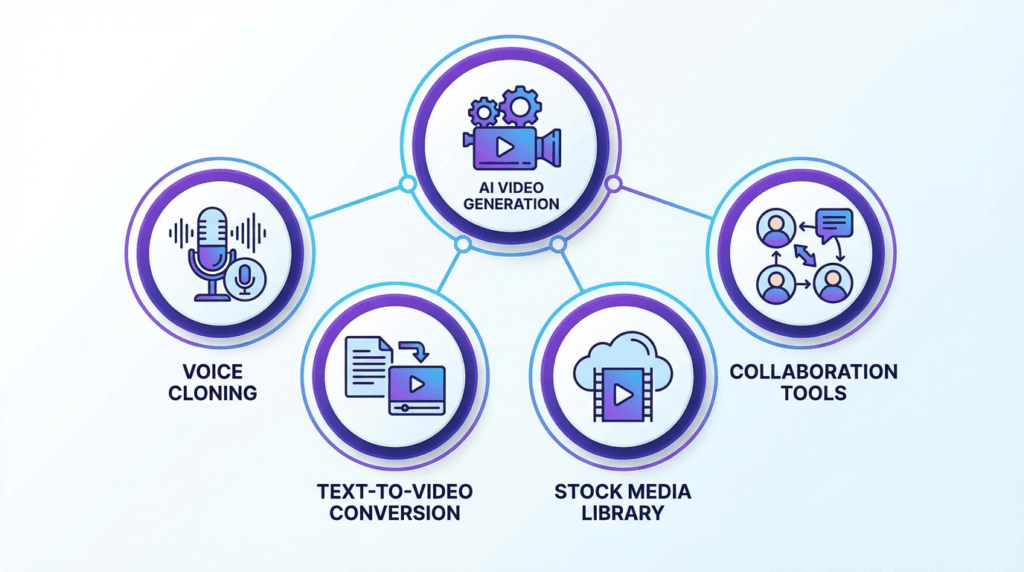
    FeatureWho Should Use It (Roles)For What Outcome
    AI Video GeneratorContent Creators, Marketers, EducatorsTo quickly generate complete videos from text prompts, including script, visuals, voiceover, and music.
    Advanced AI EffectsAdvertisers, Social Media ManagersTo create eye-catching videos with cinematic effects like Drip Flip, Car Crash, and Hero Walk.
    UGC & AvatarsE-commerce Brands, Marketing AgenciesTo create authentic user-generated content style ads and use AI avatars for presentations and tutorials.
    Voice CloningYouTubers, Corporate TrainersTo create a consistent brand voice across all video content by cloning your own voice for use in AI-generated voiceovers.
    AI Colorist & InpaintingProfessional Video Editors, FilmmakersTo perform advanced color correction, remove unwanted objects, and refine video visuals with precision.
    Template LibraryBeginners, Small Business OwnersTo kickstart video projects with thousands of professionally designed templates for various use cases.
    Collaboration ToolsMarketing Teams, Design AgenciesTo work together on video projects in real-time, share feedback, and manage brand assets in a shared workspace.
    invideo ai features

    Is InVideo AI Good for Beginners?

    Absolutely. Its intuitive interface and AI-powered workflow make it one of the best platforms for beginners who want to create high-quality videos without a steep learning curve. The platform guides you through the entire process, from generating a script to selecting visuals and adding a voiceover. You don’t need any prior video editing experience to get started.

    Can I Use My Own Voice in the Videos?

    Yes! InVideo AI offers voice cloning capabilities, allowing you to create a digital replica of your own voice for use in your videos. This feature is perfect for creators and brands who want to maintain a consistent and personal touch across all their video content. You can record your voice directly in the platform, and the AI will generate a voiceover in your own voice for any script you provide.

    How Does InVideo AI Compare to Other AI Video Generators?

    InVideo AI stands out in a crowded market with its comprehensive feature set and ease of use. While many tools focus on a single aspect of video creation, InVideo AI offers an end-to-end solution. Here’s a quick comparison with some popular alternatives:

    FeatureInVideo AIPictorySynthesia
    Core FunctionText-to-video with AI script, visuals, and voiceoverText-to-video from articles and scriptsAI avatar video generation
    Best ForAll-in-one video creation for marketers and creatorsTurning long-form content into short videosCorporate training and presentations
    Voice CloningYesNoYes (with custom avatars)
    Stock MediaExtensive library (including iStock)YesLimited
    PricingStarts at $28/monthStarts at $19/monthStarts at $30/month

    Pros of InVideo AI:

    • All-in-one platform: From script to final video, everything is in one place.
    • Extensive stock media: Access to a massive library of images, videos, and music.
    • Advanced AI features: Voice cloning, AI effects, and more.
    • User-friendly interface: Easy for beginners to get started.

    Cons of InVideo AI:

    • Can be slow to render: Complex videos can take time to process.
    • Limited control over AI: The AI makes a lot of creative decisions, which may not always align with your vision.

    For more details, you can check out our other useful AI Tools articles!

    invideo use cases

    Conclusion: Your Ultimate Video Creation Partner

    InVideo AI has successfully established itself as a leader in the AI video generation space. By combining a powerful AI engine with an intuitive user interface and a massive library of assets, it empowers creators of all skill levels to produce high-quality videos at an unprecedented scale.

    Whether you’re a marketer looking to create engaging video ads, a content creator aiming to grow your YouTube channel, or a business owner wanting to create professional training videos, InVideo AI provides the tools you need to succeed. It’s more than just a video editor; it’s a complete video creation ecosystem.

    Ready to revolutionize your video creation process? Try InVideo AI for free today and see what you can create!

    References

    [1] InVideo. (2025). Invideo AI – Create videos without limits. Retrieved from https://invideo.io/

    [2] InVideo. (2025). The right plans, for the right price. Retrieved from https://invideo.io/pricing/

  • Kittl Review: The Ultimate AI-Powered Design Platform for Creators

    Kittl Review: The Ultimate AI-Powered Design Platform for Creators

    Ever felt like you have amazing design ideas but lack the complex software skills to bring them to life? You’re not alone. Many creators, entrepreneurs, and small business owners struggle to produce professional-quality graphics without a design degree or a big budget. What if there was a tool that bridged the gap between easy-to-use apps and powerful, professional software?

    That’s where Kittl comes in. This browser-based design platform has been making waves, attracting over 8.7 million users with its unique blend of intuitive tools, stunning templates, and powerful AI features [1]. It’s built to help you create everything from t-shirts and logos to social media posts and intricate illustrations, all without the steep learning curve of traditional design software.

    In this guide, we’ll take a close into what Kittl is, how its AI works, and why it might just be the game-changing tool your creative workflow has been missing. You’ll learn how to leverage its most powerful features, see how it stacks up against competitors, and get actionable tips to start creating designs that stand out.

    Various designs created with Kittl including logos, t-shirts, and posters

    What is Kittl and Why Should You Care?

    Kittl is an all-in-one design platform that runs directly in your browser. Think of it as a powerful studio that combines the ease of a template-based editor with the advanced capabilities of professional design software. Unlike tools that are either too simple or too complex, Kittl strikes a perfect balance, making it ideal for both beginners and experienced designers.

    So, why is it getting so much attention? Because it solves a major problem: it makes high-end design accessible to everyone.

    Traditionally, creating detailed, artistic designs required mastering complex programs like Adobe Illustrator. Kittl simplifies this with features like one-click text effects, a massive library of ready-to-use templates, and advanced typography controls that let you create stunning visuals in minutes, not hours. For small business owners, this means you can create a professional logo for your brand without hiring a designer. For print-on-demand sellers, it means you can produce trendy, high-quality t-shirt designs that actually sell.

    “Finally, an easy-to-use graphic design software that offers high-quality downloads, graphics, and fonts with a commercial license for our products and clear licensing terms! With Kittl’s super customizable features, it has been my go-to platform for creating all the designs for my business.” – Sandra Di, Etsy Seller & YouTuber [2]

    Kittl editor interface showing the design workspace

    Best Practices: Getting the Most Out of Kittl

    Kittl is packed with powerful features, but knowing which tool to use for your specific goal is key to working efficiently. Instead of a rigid step-by-step process, think of Kittl as a creative toolbox. The best approach is to match the right tool to the right job. This way, you can speed up your workflow and achieve professional results, whether you’re designing a logo, creating merchandise, or launching a marketing campaign.

    Here’s a breakdown of Kittl’s core features and the best way to use them based on your role and desired outcome.

    FeatureWho Should Use It (Roles)For What Outcome
    AI Image GeneratorContent Creators, Marketers, Print-on-Demand SellersTo quickly generate unique graphics, illustrations, and photos for social media, blog posts, or merchandise when you don’t have stock photos.
    Advanced Text EffectsBrand Designers, T-Shirt Creators, Logo DesignersTo create stunning, professional-grade typography with vintage effects, intricate decorations, and realistic textures that make logos and apparel stand out.
    AI VectorizerPrint Designers, Merch Sellers, Professional DesignersTo convert any raster image (like a JPG or PNG) into a scalable vector graphic (SVG, PDF) for high-quality printing on apparel, banners, or any physical product.
    Mockup GeneratorE-commerce Owners, Freelancers, MarketersTo instantly visualize designs on real products like t-shirts, mugs, and posters. Perfect for creating product listings or presenting concepts to clients.
    Background RemoverSocial Media Managers, Product Photographers, Web DesignersTo create clean, professional-looking product images or headshots by instantly removing distracting backgrounds with a single click.
    Template LibraryBeginners, Small Business Owners, Anyone on a DeadlineTo kickstart any design project—from logos to social posts—with thousands of fully customizable, professional templates, saving hours of work.
    Collaboration ToolsMarketing Teams, Design Agencies, Freelancers & ClientsTo work together on designs in real-time, share feedback directly on the canvas, and manage brand assets in a shared workspace for seamless project delivery.
    Before and after comparison showing AI vectorizer quality improvement

    Kittl FAQs

    Here are answers to some of the most common questions people ask about Kittl:

    • Is Kittl good for beginners?
      Absolutely. While it offers professional-grade tools, its intuitive interface and vast template library make it one of the best platforms for beginners who want to create high-quality designs.
    • Can I use Kittl for print-on-demand?
      Yes! Kittl is a favorite among print-on-demand sellers because it supports vector exports (SVG, PDF) and provides a commercial license with its paid plans, allowing you to sell your designs on products.
    • How does Kittl compare to Canva?
      Kittl offers more advanced typography and illustration tools, making it better for artistic and detailed designs. Canva is more focused on quick social media graphics and presentations. If you want more creative control, especially with text, Kittl is the stronger choice.
    Professional product mockup of a t-shirt with Kittl design

    Conclusion: Your New Creative Powerhouse

    Kittl has successfully carved out a unique space in the crowded world of design software. By blending powerful AI features with an intuitive editor and a rich asset library, it empowers creators of all skill levels to produce stunning, professional-grade work.

    Whether you’re a small business owner designing your first logo, a content creator looking to elevate your visuals, or a print-on-demand seller aiming to create best-selling products, Kittl provides the tools you need to succeed. It’s more than just a design tool; it’s a complete creative ecosystem.

    Ready to unleash your creativity? Try Kittl for free today and see what you can create!


    References

    [1] Kittl. (2025). Kittl | The most intuitive collaborative design platform. Retrieved from https://www.kittl.com/

    [2] Paterson, W., & Di, S. (n.d.). Testimonials. Kittl. Retrieved from https://www.kittl.com/

  • Blackbox AI for Small Business: Your Complete Guide to AI-Powered Development

    Blackbox AI for Small Business: Your Complete Guide to AI-Powered Development

    Blackbox AI for Small Business: Your Complete Guide to AI-Powered Development

    Blackbox AI for small business is changing how entrepreneurs and small teams build software. If you’ve ever wished you could create a custom app without hiring a development team, or wanted to automate tasks without learning to code, you’re in the right place.

    Here’s the thing: most small businesses can’t afford a full-time developer. But that doesn’t mean you should be stuck with clunky, one-size-fits-all software. Blackbox AI is an AI-powered coding assistant that lets you build, customize, and deploy applications faster than you ever thought possible. We’re talking about going from idea to working app in hours, not months.

    Over 30 million people use Blackbox AI, including teams at Amazon, Uber, and Intel [1]. But it’s not just for big companies. Small business owners and tech enthusiasts are using it to create custom tools, automate workflows, and compete with much larger competitors.

    This guide explains exactly what Blackbox AI does, how it works, and how you can use it to grow your business. No fluff, no jargon—just practical advice you can use today.

    What is Blackbox AI and Why Do Small Businesses Need It?

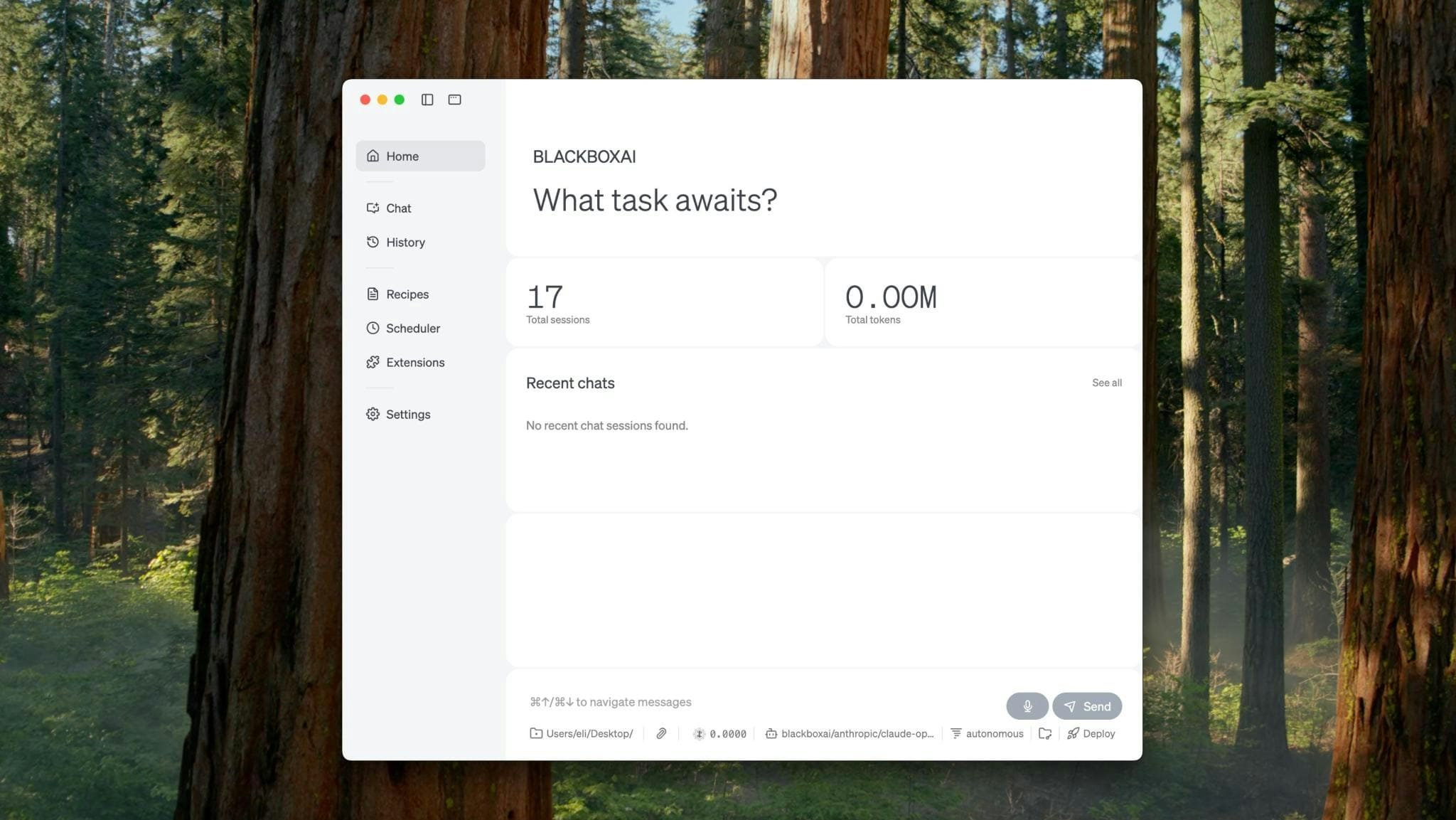
    Blackbox AI is an AI assistant made for coding and software development. Think of it as a complete toolkit that helps you build things online. It’s not just a simple code-completion tool; it’s an entire system that includes an AI chat, a code generator, a full-featured Integrated Development Environment (IDE), and even a no-code app builder.

    The main reason Blackbox AI for small business is so important comes down to one word: speed. In today’s market, getting your ideas out there quickly is everything. Blackbox AI helps you develop and launch applications up to 10 times faster than you could normally. It does this by giving you access to over 300 different AI models, understanding instructions in text, image, and even voice, and providing instant help with coding and debugging.

    For a small business, this means you can finally compete with the big players without needing a huge budget. For example, you can use Blackbox AI’s Autonomous Coding Agent to turn a simple idea into a real, working web application. Just describe what you want, and the AI builds the frontend, backend, and database for you. This makes creating custom software accessible to anyone, not just expert developers.

    Blackbox AI Interface

    How Small Businesses Can Leverage Blackbox AI: A Step-by-Step Guide

    Getting started with Blackbox AI is easier than you might think. You don’t need to be a tech genius to make it work for your business. Here’s a simple, step-by-step guide to get you going:

    1. Figure Out What You Need and Pick a Plan: First, think about what you want to accomplish. Do you want to build a new app, speed up your coding process, or automate some boring tasks? Blackbox AI has several plans, including a free one to get you started. For most small businesses, the PRO PLUS plan is the best bang for your buck, giving you access to tons of powerful features at a great price [2].

    2. Use the Web App for a Quick Start: The fastest way to try Blackbox AI is through its web app. You can access it from any browser. Use the AI chat to ask coding questions, generate some code snippets, and just get comfortable with how it works.

    3. Add It to Your Current Workflow: If you already use a code editor, you can make Blackbox AI a part of it. The VS Code extension is super popular, with over 4.2 million developers using it. This puts all of Blackbox AI’s features right inside your editor, so you get code suggestions and help in real-time as you type.

    4. Let the AI Agent Handle Big Projects: When you’re ready to build something bigger, use the Autonomous Coding Agent. You can give it a simple description of the app you want, and it will generate all the code for you. Just be sure to give it clear instructions, and always check the code it produces to make sure it’s exactly what you want.

    5. Try the App Builder if You Don’t Code: If you’re not a coder, the App Builder is your best friend. It lets you create apps with a visual drag-and-drop interface, no coding required. It’s perfect for making quick prototypes or simple tools for your business.

    Blackbox AI Coding

    Advanced Blackbox AI Strategies for Small Business ROI

    Once you’re comfortable with the basics, you can use these advanced tips to get even more value from Blackbox AI:

    • Talk to It (Literally): Don’t just type! Blackbox AI understands voice commands. You can describe a feature you want to build, talk through a problem, or even upload a screenshot of a user interface you like. It’s a much faster and more natural way to work.

    • Teach It Your Style: Use the custom rules and memory features to make the AI work better for you. It can learn your coding habits and project details, so its suggestions become more helpful and personalized over time.

    • Build Custom Tools with the API: If you’re feeling adventurous, you can use the Blackbox AI API to add its power to your own apps. This gives you the freedom to create completely custom solutions for your business.

    Common Mistakes & Best Practices

    Blackbox AI is a powerful tool, but it’s not magic. Here’s how to use it smartly and avoid common mistakes.

    Common MistakesBest Practices
    Giving vague instructionsBe specific. Tell the AI exactly what you want.
    Trusting the code blindlyAlways test the code the AI writes. It’s a great assistant, but you’re still the boss.
    Ignoring its suggestionsUse the AI’s ideas as a starting point. You can always tweak them.
    Not giving it enough contextShow it your existing code or project files so it can give better advice.
    Sticking to one AI modelTry different models for different tasks. Some are better for simple things, others for complex problems.

    Following these simple rules will help you get the most out of Blackbox AI for your small business and avoid headaches.

    Frequently Asked Questions

    Here are answers to some common questions about Blackbox AI:

    • Is Blackbox AI suitable for small businesses?
      Absolutely. Blackbox AI is perfect for small businesses because it helps you build software and automate tasks without the high cost of hiring developers. It levels the playing field, letting you create the tools you need on a budget.

    • Is Blackbox AI free?
      Yes, there is a free plan with basic features so you can try it out. Paid plans are very affordable and give you access to more powerful tools and higher usage limits [3].

    • Is Blackbox AI better than ChatGPT?
      They’re different tools for different jobs. ChatGPT is great for general questions and writing, but Blackbox AI is built specifically for coding. It offers a much more complete and integrated set of tools for developers and anyone looking to build software.

    • Will Blackbox AI take my developer’s job?
      Nope. It’s a tool to help developers, not replace them. It handles the boring, repetitive parts of coding, so your team can focus on creative problem-solving and building great products.

    If you want to learn more about AI agents in general, check out our guide on How to Build AI Agents for Beginners.

    Conclusion: Your New Partner in Innovation

    Blackbox AI is more than just a tool—it’s a new way for small businesses to build, innovate, and grow. It makes creating software faster, cheaper, and more accessible to everyone. By handling the technical heavy lifting, it frees you up to focus on what you do best: running your business.

    Ready to see what it can do for you? Explore Blackbox AI and start turning your ideas into reality today. Join the millions of other developers and entrepreneurs who are building the future with Blackbox AI.

    Recommended Video

    To see Blackbox AI in action, we recommend watching this comprehensive review and demo:

    Blackbox AI Review | Best AI Coding Assistant? Features…

    References

    [1] BLACKBOX.AI
    [2] Pricing – Blackbox
    [3] Understanding Blackbox AI: Is It Free? Pricing and…

  • A Marketer’s Guide to Using AdCreative.ai

    A Marketer’s Guide to Using AdCreative.ai

    The tool adcreative.ai helps you make better ad visuals with artificial intelligence. This guide shows you how to use it to create high-performing ads for your marketing. The platform saves you time and money.

    Getting to Know AdCreative.ai

    AdCreative.ai solves a common problem for marketers: creating many ad visuals. The platform automates the design process. You provide your brand information, and its AI generates hundreds of ad variations for testing.

    This automation helps with A/B testing. You can compare many ad versions to see what works. This avoids long design meetings and manual work.

    What Sets It Apart

    AdCreative.ai started in 2021 in Paris, France. It was one of the first companies to use AI for making ads. The platform creates social media posts and headlines to increase conversions. You can find more information about the AdCreative.ai company on their website.

    Their homepage clearly states its main benefit. It generates ad creatives focused on conversions.

    Image

    The simple design and free trial make it easy for new users to start. You can begin without feeling confused.

    Key Features You'll Be Using

    Let's review the main features you will use.

    • Brand Setup: You start here. Upload your logo, choose brand colors, and select fonts. The AI uses this to keep all creatives consistent with your brand.
    • Creative Generator: This is the primary tool. You enter your ad copy, select a background, and the AI produces many different designs.
    • Integration Options: You can connect your ad accounts, like Facebook Ads and Google Ads. This saves time by sending creatives directly to your campaigns.
    • Analytics and Scoring: The platform analyzes each creative. It gives each one a performance score. This helps you find the best designs quickly.

    The platform can generate hundreds of ad variations in minutes. This changes your workflow from manual design to strategic decision-making based on data.

    This guide will explain how to set up these features. We will cover creating an account and using the dashboard. My goal is to make you comfortable with the tool.

    Building Your First High-Impact Ad Creative

    You are ready to use adcreative.ai to make ads. The platform helps you go from an idea to a finished ad creative quickly. You do not need design skills to create professional ads that perform well.

    First, you must tell the AI about your brand. You only do this setup once. Upload your company logo and enter your brand's main colors. This step ensures every ad looks like it came from your team.

    Define Your Project and Target Audience

    After setting up your brand, you can start a new project. You first choose the ad format. Select a square post for Instagram or a wide banner for a website. This tells the AI which size and layout to use.

    Next, you define your audience and your message. You give the AI details about your product or service. You also describe the problem it solves. The platform uses this information to suggest headlines and ad copy.

    The AI suggests copy options for you. It takes your input and generates text designed to get attention and clicks. This saves time and helps with writer's block.

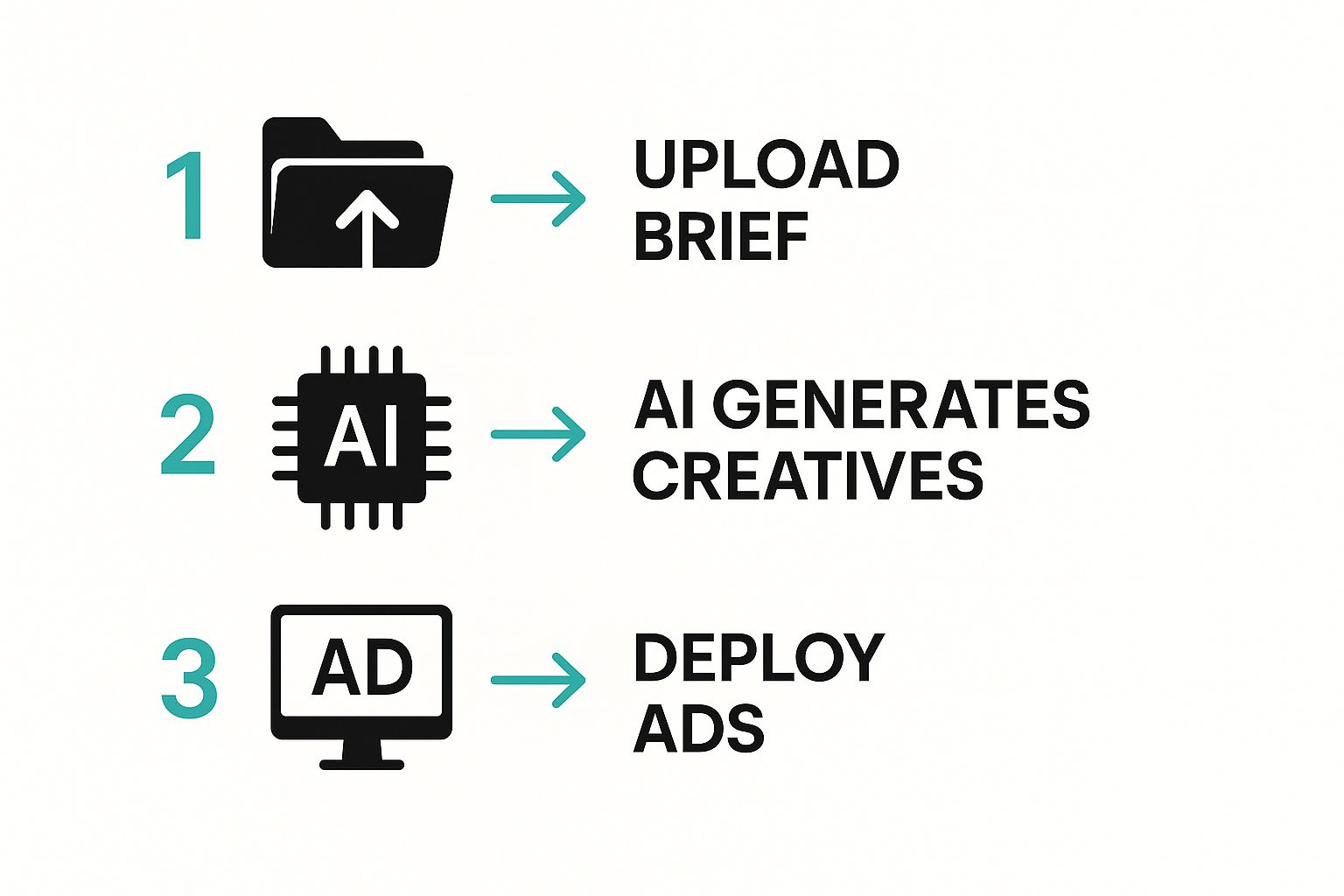
    The platform's workflow is very simple.

    Image

    This image shows how you can move from basic details to a set of professional ad creatives.

    Select Visuals and Generate Creatives

    Once your text is ready, you need visuals. You have two choices. You can upload your own product images. You can also use the platform's built-in stock photo library.

    In August 2022, the company partnered with Getty Images (iStock). This partnership gives users access to high-quality stock photos. The AI can use these images to create custom ads instantly. You can read more about this powerful partnership online.

    With your copy and images selected, you click the "Generate" button. The AI produces dozens of ad variations in seconds. You can then review the options and choose the best ones for your campaign.

    Finalizing and Exporting Your Ad

    The last step is to review the generated creatives. The platform gives a performance score for each design. This score predicts how well an ad might perform. It helps you choose which ads to test first.

    You can make small changes to a creative you like. It is easy to edit the text or change an image.

    When you are happy with a design, you can download it. You can also send it directly to your connected ad accounts like Facebook or Google Ads.

    Pushing Your Creatives to Ad Platforms

    Image

    You have used AdCreative.ai to generate some great ads. The next step is to get them live on your ad networks. The platform makes this process smooth.

    AdCreative.ai has direct integrations with major platforms like Facebook Ads and Google Ads. This connection saves a lot of time. It removes the need to download and re-upload ad files.

    Connecting Your Ad Accounts

    You must connect your ad accounts first. This is a simple, one-time setup. You can find the integration options in your account settings.

    The process is easy. You will log into your Google or Meta account and give permission. After that, your ad accounts will appear as destinations inside AdCreative.ai.

    This integration makes your workflow much faster. Your new creatives can appear in your Google Ads library or Facebook campaign draft in seconds. It removes a slow manual step from your daily tasks.

    This direct link is one reason AI advertising tools are so useful. You can explore various e-commerce tools and platforms to find similar ways to improve efficiency.

    How to Push a Creative

    With your accounts linked, sending an ad to a platform is simple. Go to your library of generated creatives and select one. You will see an option to "push" it to a connected account.

    You just choose your destination, like your main Facebook Ads account, and confirm. The creative goes directly to that platform's media library. It is then ready to be added to a campaign.

    • Select Your Best Creative: Pick the ad with the highest performance score.
    • Choose the Destination: Select the correct platform and account.
    • Confirm the Push: Click the button to send the creative to the platform.

    This method keeps your assets organized and available where you need them.

    Best Practices for Managing Pushed Creatives

    To keep your ad accounts organized, use a clear naming system. When a creative arrives from AdCreative.ai, rename it. A name like "AI-Gen_SummerSale_V1_Square" is very helpful.

    This habit makes it easier to find creatives later. It also helps you track the performance of your AI-generated ads. Your goal is a smooth loop between ad creation and performance analysis.

    How to Analyze and Optimize Ad Performance

    Creating ads with a tool like AdCreative.ai is only one part of the job. The real value comes from analyzing performance data to see what works. This helps you make decisions based on numbers, not guesses.

    The platform connects to your live ad accounts. It pulls real data from your campaigns. The system tracks metrics like click-through rates and conversions for each creative. It then assigns a performance score to each ad.

    Interpreting Your Ad Scores

    After your campaigns run for a while, you will see performance scores in your dashboard. These numbers show how your ads are doing on platforms like Facebook and Google Ads.

    A high score means an ad is performing well. A low score shows that a creative is not connecting with your audience. You should use these scores to decide which ads to scale and which to stop.

    These scores create a direct feedback loop. You use real data to guide your next set of creatives instead of just guessing which ad looks best.

    This data-driven method is becoming standard in marketing. AdCreative.ai was recently acquired by Appier, which shows the demand for AI marketing tools. The platform combines AI models and unique data to automate ad creation. You can read more about this strategic acquisition for more details.

    Applying Insights to Your Next Creatives

    The next step is to apply what you learn to future ads. Look for patterns in your best-performing creatives.

    • Does a specific color scheme perform well?
    • Do certain image types get more clicks?
    • Does one call-to-action work better than others?

    For example, you might find that ads with people in them get better results than product-only ads. This is a valuable insight. You can then ask AdCreative.ai to generate more ads that feature people.

    This research-based approach can be used in other areas of your work. You can check our guide on the best AI tools for research for more ideas.

    By analyzing performance and using insights, you can improve your campaign results over time.

    What's the Bottom Line?

    The performance analytics inside AdCreative.ai make it a key part of your marketing strategy. The platform's ability to score creatives gives you clear feedback.

    You can figure out what works and apply those lessons to your next ads. This process helps you stop spending money on ads that do not work. It improves your return on investment over time.

    Advanced Strategies for Scaling Ad Production

    Using Adcreative.ai for a single ad is useful. The platform's real value appears when you need to produce many ads. The advanced features help you manage this scale without overworking your team.

    This section explains how to use these tools to create ad variations in bulk. We will also cover A/B testing strategies to improve campaign performance.

    Generate Ad Creatives in Bulk

    The bulk creative generation feature is ideal for large campaigns. You can produce hundreds of unique variations with one click. This is useful for testing multiple concepts across different audiences.

    An e-commerce brand can generate variations for every product in a collection. This approach saves many hours of manual design work.

    Systematically A/B Test Your Ads

    Good A/B testing is a structured process to find what works. With the volume of creatives from Adcreative.ai, you can test specific variables accurately.

    You should start by testing only one element at a time. This could be the headline, the main image, or the call-to-action (CTA).

    • Test Headlines: Create ads with the same visual but five different headlines.
    • Test Images: Use the same headline and CTA but test ten different background images.
    • Test Calls-to-Action: Keep the image and headline the same, but try different CTAs like "Shop Now" versus "Learn More."

    This process provides clear data on what works. It turns testing from a guess into a reliable method. AI is changing marketing in many ways. You can discover which AI tools are the most innovative in 2024 to learn more.

    Small changes can lead to big results. A simple button color change from blue to green once increased click-through rates by 15%. This kind of specific testing is possible with bulk creative generation.

    Organize Large-Scale Workflows

    Managing hundreds of ad creatives requires a system. Use clear names for every project inside the platform to stay organized.

    An agency might name a project "ClientName – CampaignType – Q3 2024." This simple step makes finding assets easier later. I also suggest using a spreadsheet to track which creatives are live and their key performance metrics.

    This guide showed how AdCreative.ai can change your ad creation process. It combines AI speed with data from your campaigns. This helps you make smarter decisions.

    The best way to learn is to start experimenting. Test different headlines, images, and audience settings. This is how you find what works best for your brand. Using a platform like AdCreative.ai saves you time. It allows you to focus on high-level strategy instead of repetitive tasks. This approach helps you build a system that constantly improves your performance and drives business growth.

    Got Questions About AdCreative.ai? Let's Talk.

    If you are considering AdCreative.ai, you might have some questions. It is smart to understand the details before you start. Here are answers to some common questions.

    How Much Does AdCreative.ai Cost?

    AdCreative.ai uses a credit system for its pricing. You purchase a number of credits each month. You use these credits to generate ad creatives.

    Most plans offer a trial period. A trial is the best way to test the platform. After the trial, you can choose a monthly subscription that fits your needs.

    What Platforms Can I Use The Ads On?

    You can use the ads almost everywhere. The creatives you generate are yours to download and use on all major ad platforms. This includes Facebook, Instagram, Google, and LinkedIn.

    The platform also has direct integrations with Google Ads and Meta Ads. This feature lets you send your new ads directly to your campaigns.

    Does AdCreative.ai Write The Ad Copy Too?

    Yes, the platform also writes ad copy. The AI generates headlines and body text.

    You provide your product description, and it creates several text options. This is helpful for A/B testing different messages. You can use the text as is or edit it to match your brand's voice.


    At creavoid, we specialize in using powerful tools like this to build data-driven marketing strategies that drive real growth. Visit us at https://creavoid.com to see how we can help you scale.

  • Finding the Top 3 AI App Builder Tools for 2025

    Finding the Top 3 AI App Builder Tools for 2025

    This guide simplifies finding the top 3 AI app builder for your project. No-code platforms let you create powerful apps without programming skills. These tools help you build apps with smart features and launch your ideas quickly.

    This article compares the leading AI app builders. We will look at their features, prices, and best uses. This information will help you choose the right tool for your business goals and technical skill.

    1. Appy Pie

    Appy Pie is a top choice for an AI app builder because it is simple and easy to use. It helps small businesses and entrepreneurs create mobile and web apps without code. The platform uses AI to automatically design app layouts and colors based on your brand. This feature speeds up the initial setup.

    Key Features & User Experience

    Appy Pie has an intuitive drag-and-drop interface. This makes it perfect for beginners. The user experience is direct and guides you through each step. Workflow automation is another key feature. It lets you create automated tasks like sending notifications or updating a database.

    Pros:

    • User-Friendly: Ideal for non-technical users.
    • Affordable: Offers cost-effective plans starting around $16 per app/month.
    • Feature-Rich: Includes a wide range of templates and integrations.

    Cons:

    • Limited Customization: Advanced developers may find the design options restrictive.
    • Performance: Very complex apps can sometimes experience performance lags.

    Website: https://www.appypie.com

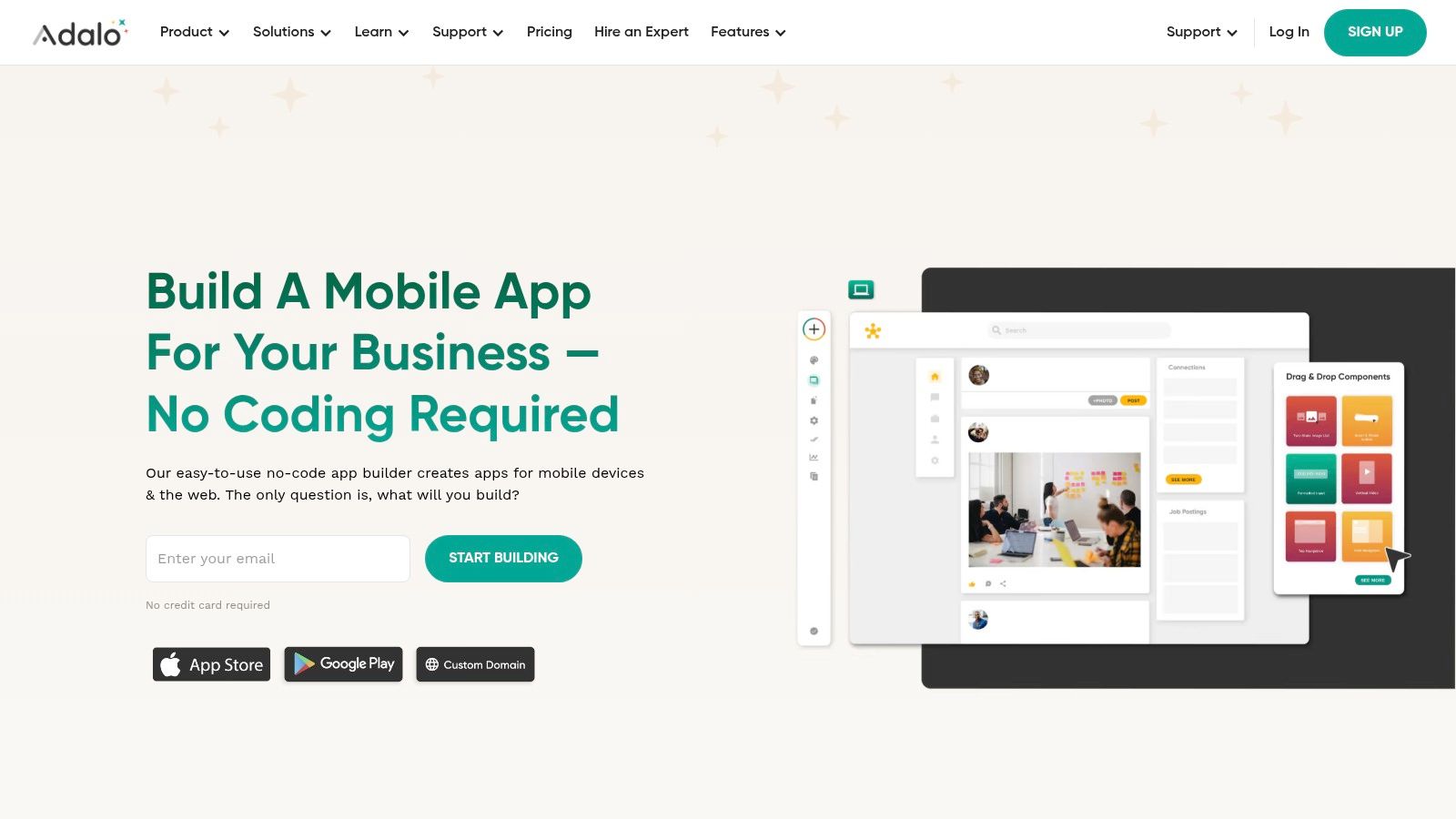
    2. Adalo

    Adalo is another great AI app builder. It focuses on creating visually appealing mobile apps. The platform helps entrepreneurs build and launch apps on the Apple App Store and Google Play Store. You can do this without writing any code. This makes it a powerful tool for quick prototyping.

    Adalo

    Key Features & User Experience

    Adalo is known for its smooth drag-and-drop interface. It gives users total design freedom over the app's layout. The user experience is highly visual and focuses on connecting screens and actions. Key features include a built-in database, user authentication, and API integrations.

    Pros:

    • Intuitive Interface: Perfect for non-technical creators with a design-first approach.
    • Rapid Deployment: Enables fast prototyping and launching of mobile apps.
    • Active Community: Offers robust support through forums and tutorials.

    Cons:

    • Limited Backend: Complex backend logic may require external services.
    • Performance Scaling: Highly complex apps can encounter performance limitations.

    Website: https://www.adalo.com

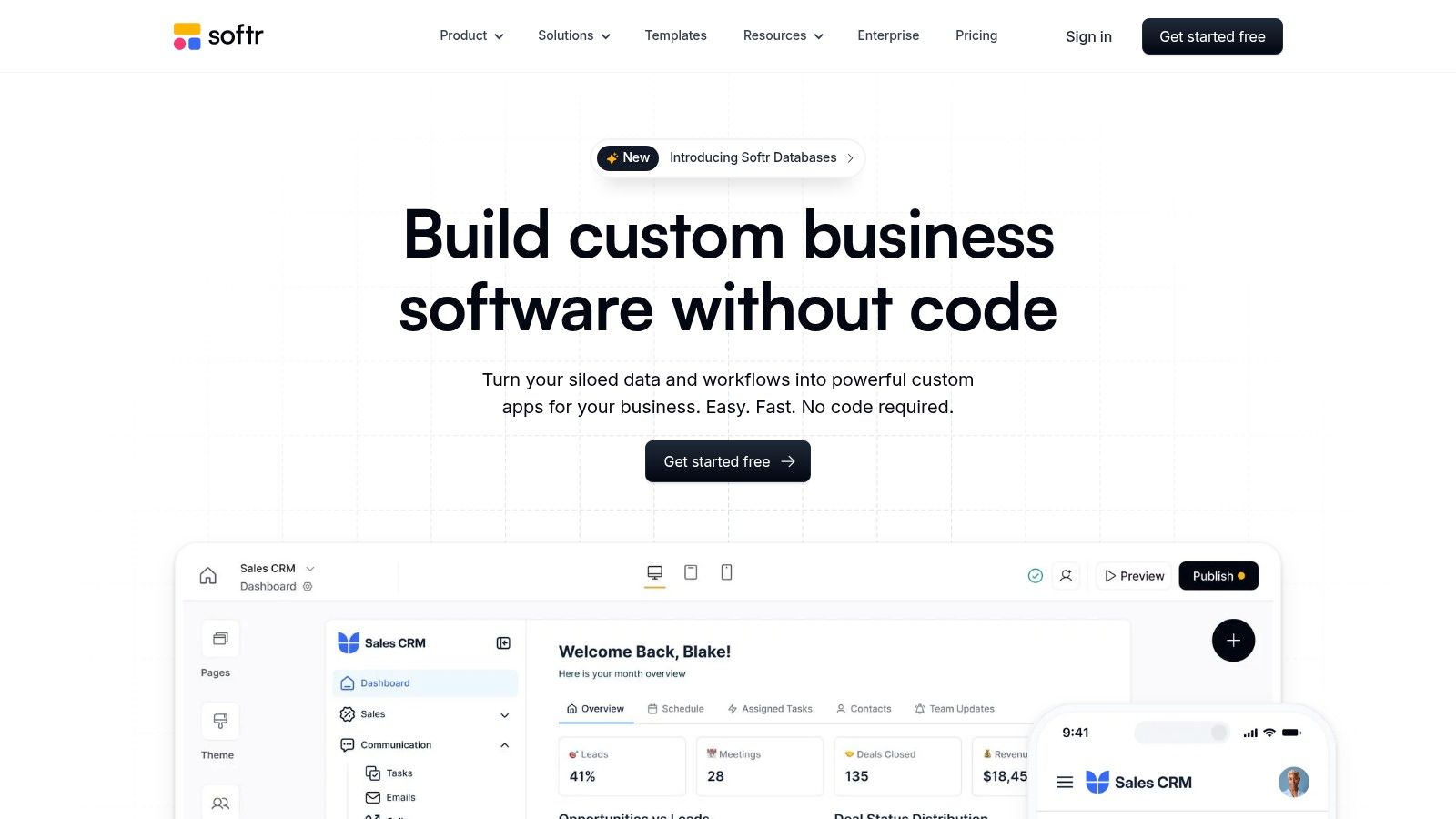
    3. Softr

    Softr completes our list of the top 3 AI app builder platforms. It is an excellent choice for turning data into web applications. The platform allows you to transform Airtable or Google Sheets into client portals or internal tools. Softr uses AI-assisted blocks to generate a user-friendly front-end from your data.

    Softr

    Key Features & User Experience

    Softr’s user experience is simple and intuitive. It uses pre-built, customizable blocks that you arrange to build your interface. This process makes development very fast. Key features include seamless integration with Airtable and Google Sheets. It also has user authentication and built-in SEO tools.

    Pros:

    • Quick Setup: Go from a spreadsheet to a live app in minutes.
    • No Coding Required: Entirely visual and block-based, ideal for non-developers.
    • Data-Centric: Perfect for building client portals, internal tools, or directories.

    Cons:

    • Design Limitations: Less flexible than traditional coding or more advanced builders.
    • Data Dependency: The app’s functionality is tied to Airtable/Google Sheets limitations.

    Website: https://www.softr.io

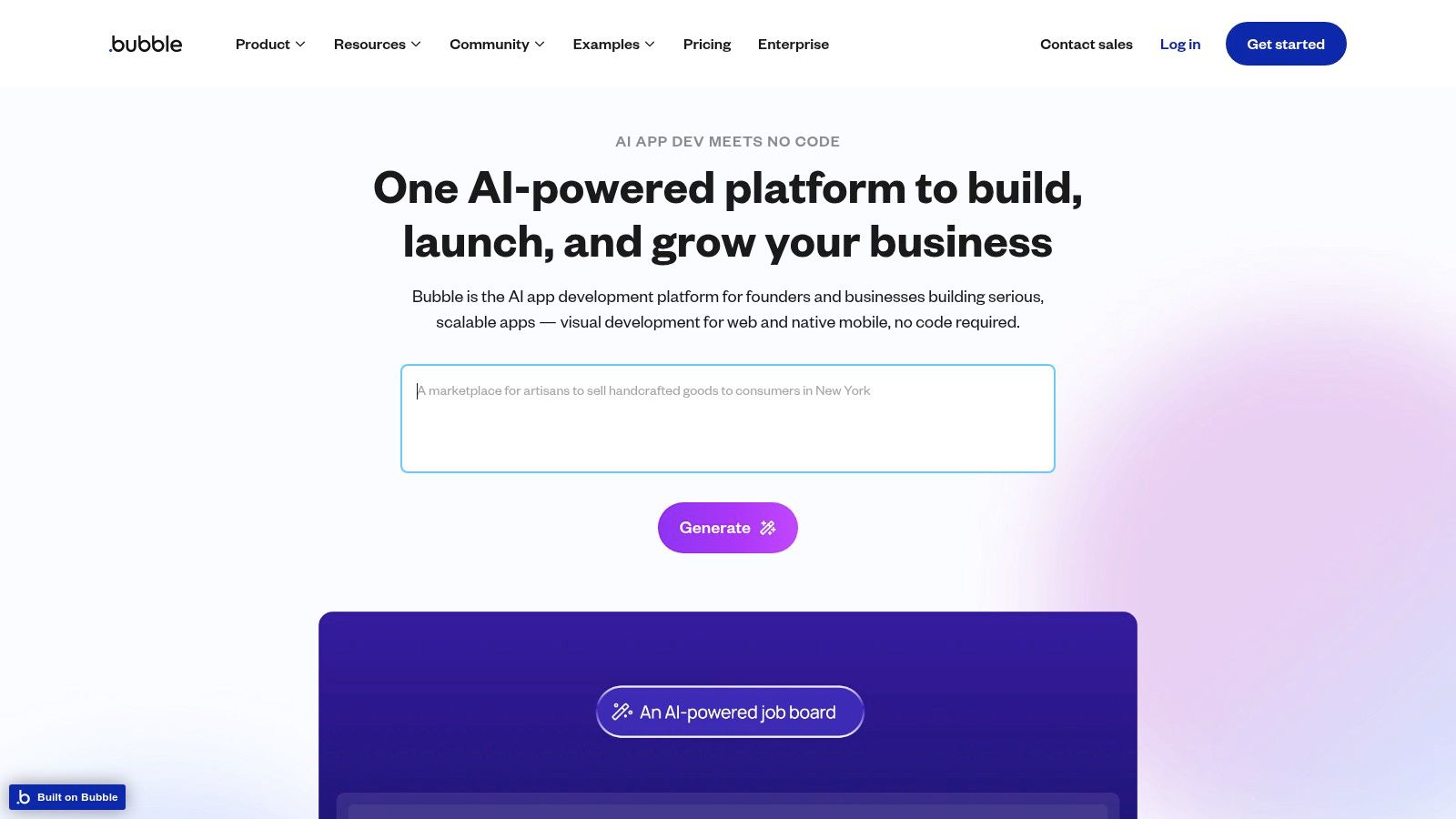
    4. Bubble

    Bubble is a powerful no-code platform for building complex web applications with AI. It gives users full control over design and logic. Bubble allows you to build with AI by integrating services like OpenAI or Google AI through APIs. It is a favorite for startups that need custom products.

    Bubble

    Key Features & User Experience

    Bubble has a visual drag-and-drop editor for precise control over page elements. Its real strength is its customizable backend workflows and database. The platform has a steeper learning curve but lets you build sophisticated applications. You can learn more about no-code platforms to see how it compares.

    Pros:

    • Highly Customizable: Offers near-limitless freedom in design and functionality.
    • Scalable: Suitable for complex SaaS platforms, marketplaces, and internal tools.
    • Strong Community: Extensive documentation, tutorials, and a very active user forum.

    Cons:

    • Steeper Learning Curve: Requires more time to master compared to simpler tools.
    • Performance Tuning: Optimizing complex apps can demand technical understanding.

    Website: https://bubble.io

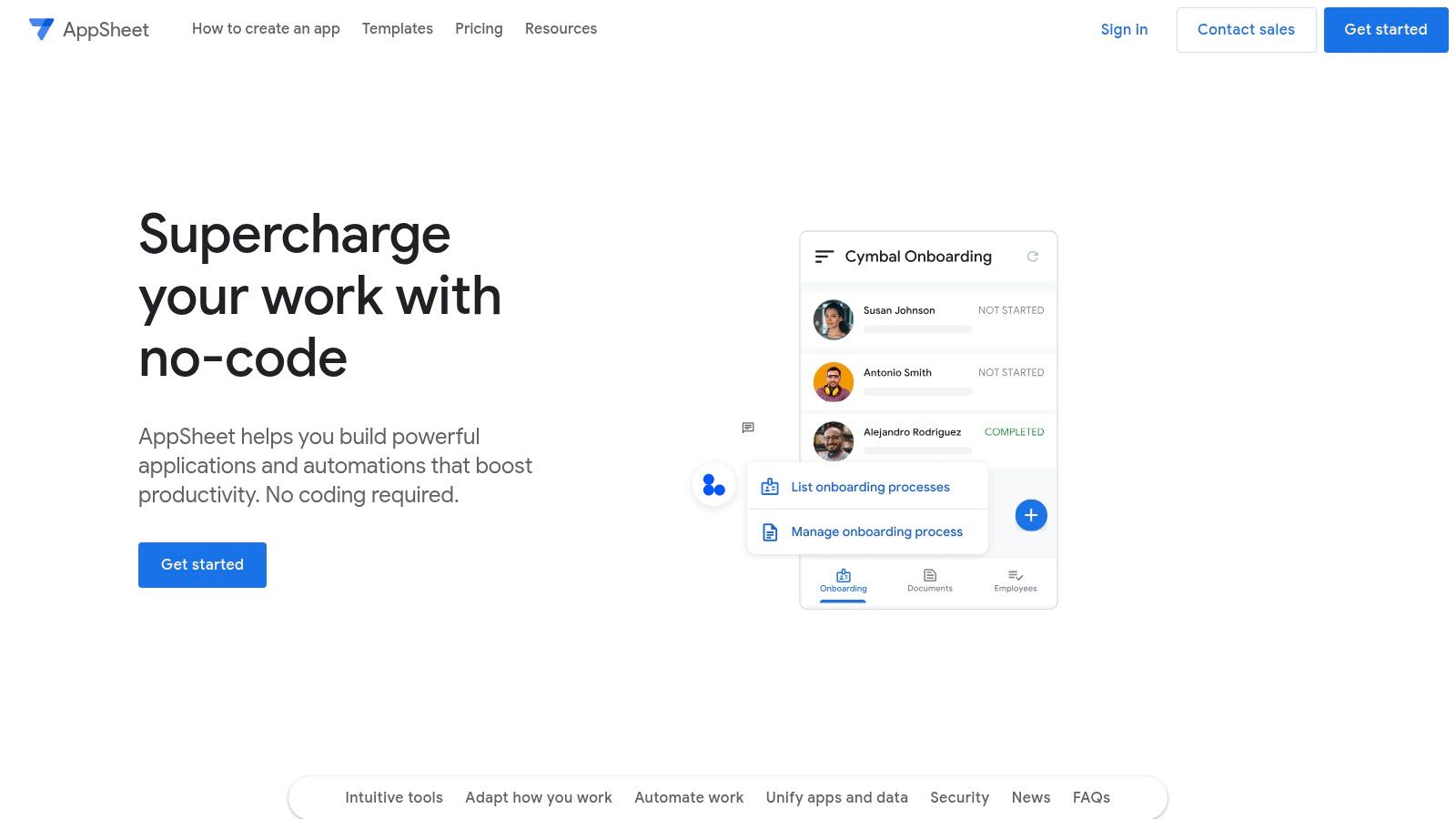
    5. AppSheet by Google

    AppSheet by Google is a strong choice for organizations in the Google ecosystem. It turns data from sources like Google Sheets and Excel into rich applications without code. AppSheet's AI and machine learning automate processes. This makes it great for building internal tools for inventory or field reports. Reading about digital transformation best practices can offer useful context.

    AppSheet by Google

    Key Features & User Experience

    AppSheet's user experience focuses on using existing data. The platform's AI can predict the type of app you want based on your data structure. Key features include workflow automation, offline functionality, and multi-platform deployment. It prioritizes function over design.

    Pros:

    • Seamless Integration: Works perfectly with Google Workspace and other data services.
    • Powerful Automation: Strong AI capabilities for creating intelligent, automated workflows.
    • Enterprise-Ready: Suitable for complex business and data-centric applications.

    Cons:

    • Limited Customization: Design and UI options are more functional than creative.
    • Pricing: Can become costly for larger teams or extensive enterprise use.

    Website: https://www.appsheet.com

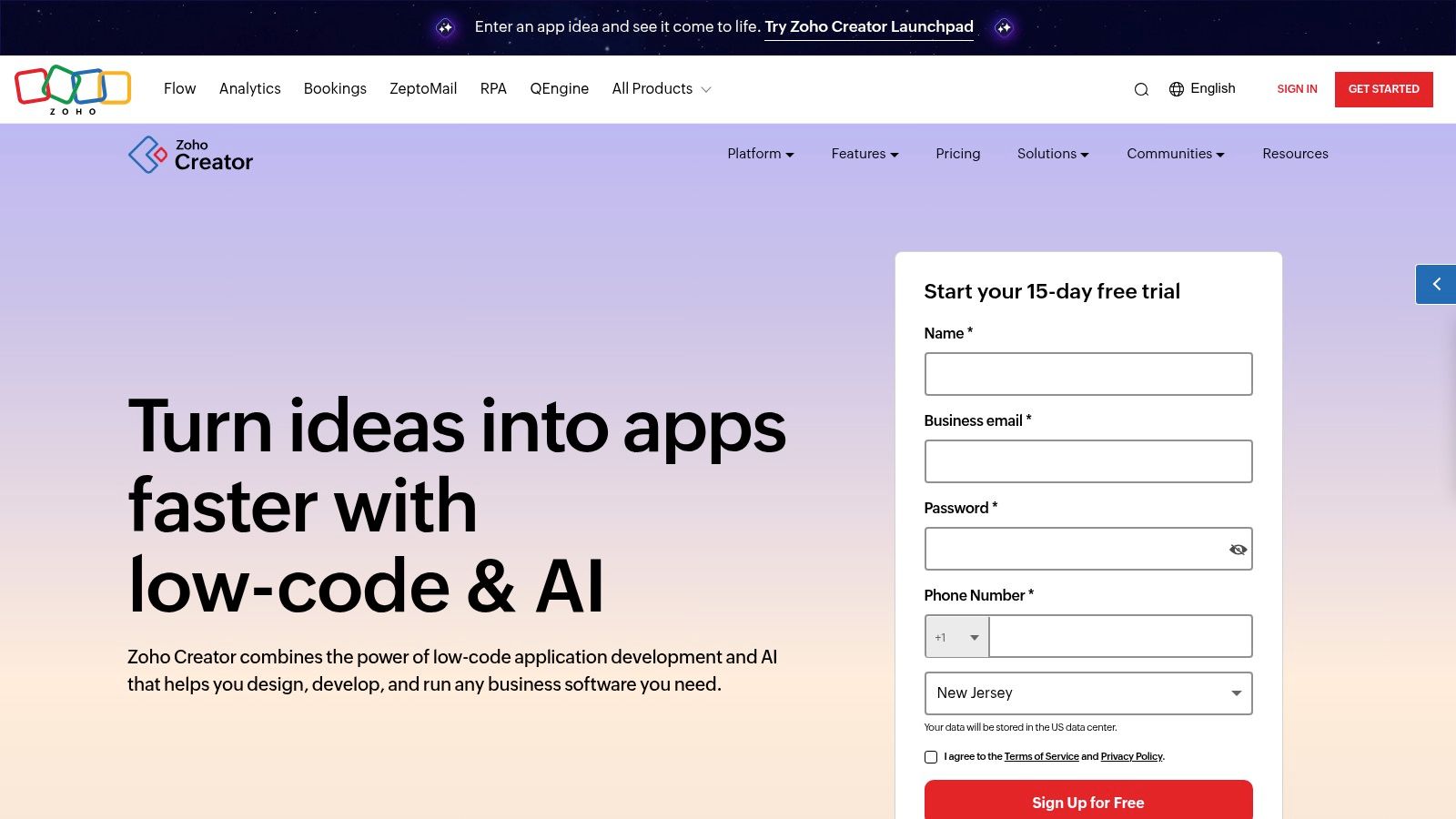
    6. Zoho Creator

    Zoho Creator is a low-code platform for building complex, data-driven applications. It handles detailed business logic, automation, and analytics. Zoho Creator connects with other Zoho tools like CRM and Books. This creates a unified system for your business operations.

    Zoho Creator

    Key Features & User Experience

    Zoho Creator has a drag-and-drop interface and scripting options. Its AI integration allows for features like predictive analytics. The platform supports multi-platform deployment. You can launch your app on web, iOS, and Android from one codebase.

    Pros:

    • Comprehensive Feature Set: Ideal for building powerful, scalable business applications.
    • Zoho Ecosystem: Excellent integration with other Zoho business products.
    • Strong Automation: Advanced workflow automation capabilities for complex processes.

    Cons:

    • Steeper Learning Curve: Can be more challenging for complete beginners.
    • Higher Cost: Pricing can increase significantly for advanced features and more users.

    Website: https://www.zoho.com/creator

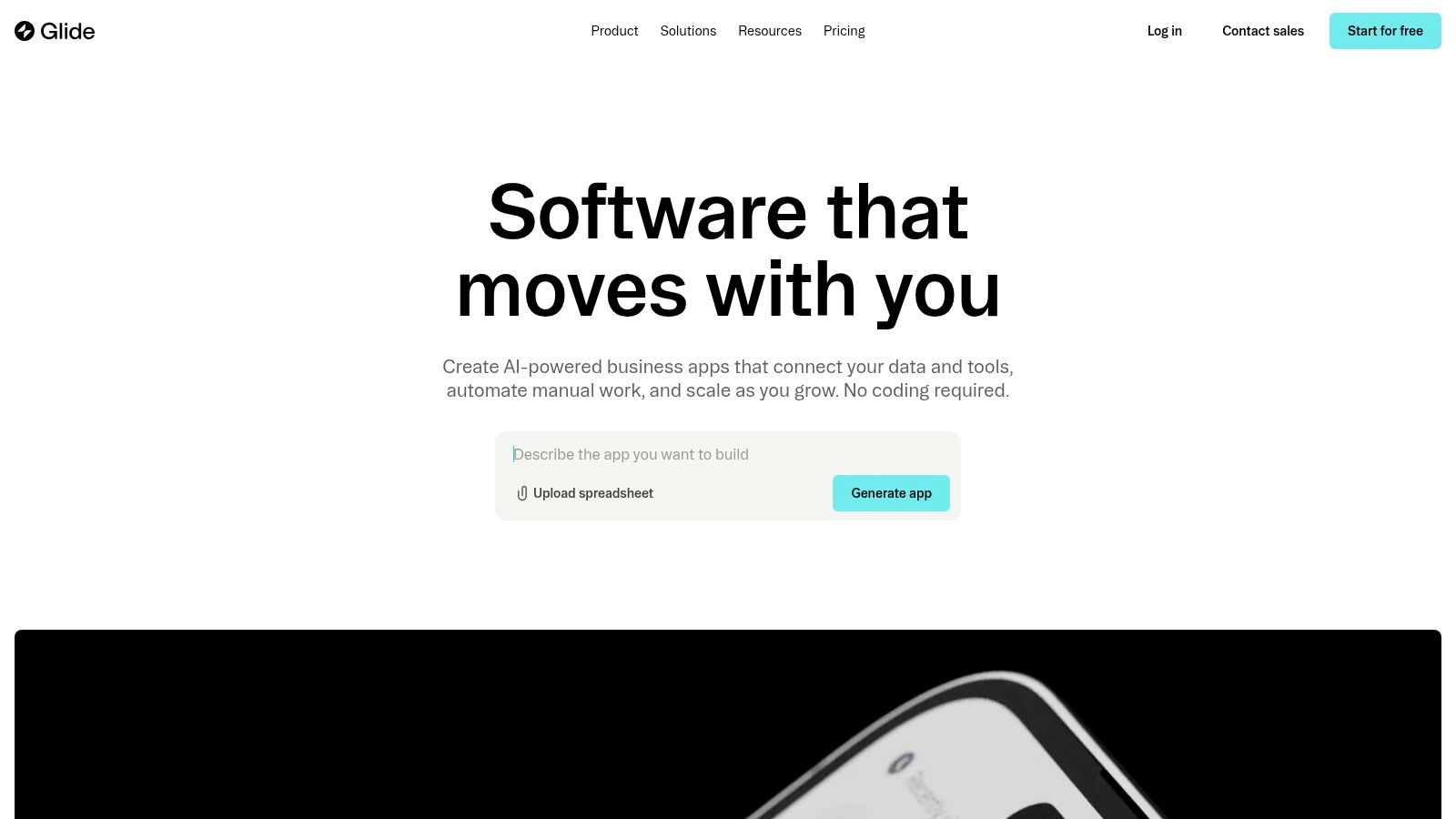
    7. Glide

    Glide turns Google Sheets into powerful mobile apps very quickly. It is designed for users who need functional apps from their data without coding. Glide synchronizes with Google Sheets in real-time. This means your app updates instantly when your data changes.

    Glide

    Key Features & User Experience

    Glide offers a very smooth user experience. You can build a working app in minutes. Its interface is clean and visual, with pre-built templates and layouts. The platform also offers offline functionality. This is a big benefit for teams in areas with poor connectivity.

    Pros:

    • Easy to Use: Perfect for non-developers and spreadsheet users.
    • Rapid App Development: Go from spreadsheet to app in minutes.
    • No Coding Required: Entirely visual build process.

    Cons:

    • Limited Customization: Design and functionality are somewhat constrained.
    • Dependent on Google Sheets: Its core strength is also its main limitation.

    Website: https://www.glideapps.com

    8. Thunkable

    Thunkable is a no-code platform for building native iOS and Android apps. It allows users to create more complex applications with its drag-and-drop interface. The platform supports API integrations and real-time testing. It is a great choice for beginners and educators.

    Thunkable

    Key Features & User Experience

    The user experience on Thunkable uses visual block-based programming. This simplifies adding logic to an app. Users can integrate various APIs to connect their app with external services. Small businesses can discover the potential of automation for small business with tools like this.

    Pros:

    • Native App Support: Builds true iOS and Android applications.
    • Complex Functionality: Supports API integrations and advanced logic.
    • Active Community: Strong community support and extensive resources.

    Cons:

    • Design Limitations: Customization options can be restrictive for designers.
    • Performance: Complex apps may sometimes face performance issues.

    Website: https://www.thunkable.com

    9. Builder.ai

    Builder.ai uses a mix of AI automation and human experts to deliver custom apps. This hybrid model makes it different from pure no-code platforms. The platform’s AI, Natasha, assembles pre-built features. Human developers then refine the app to meet specific needs.

    Key Features & User Experience

    Builder.ai uses a conversational interface to define your app idea. It then gives you a fixed price and timeline. The platform offers a library of customizable features. It also handles development, maintenance, and cloud hosting as a fully managed service.

    Pros:

    • Tailored Solutions: Creates custom apps that fit precise business needs.
    • Rapid Development: Significantly faster than traditional development cycles.
    • Suitable for Complex Apps: Can handle sophisticated functionalities and integrations.

    Cons:

    • Higher Cost: More expensive than standard no-code builders due to customization.
    • Less Direct Control: Users have less hands-on control over the development process.

    Website: https://www.builder.ai

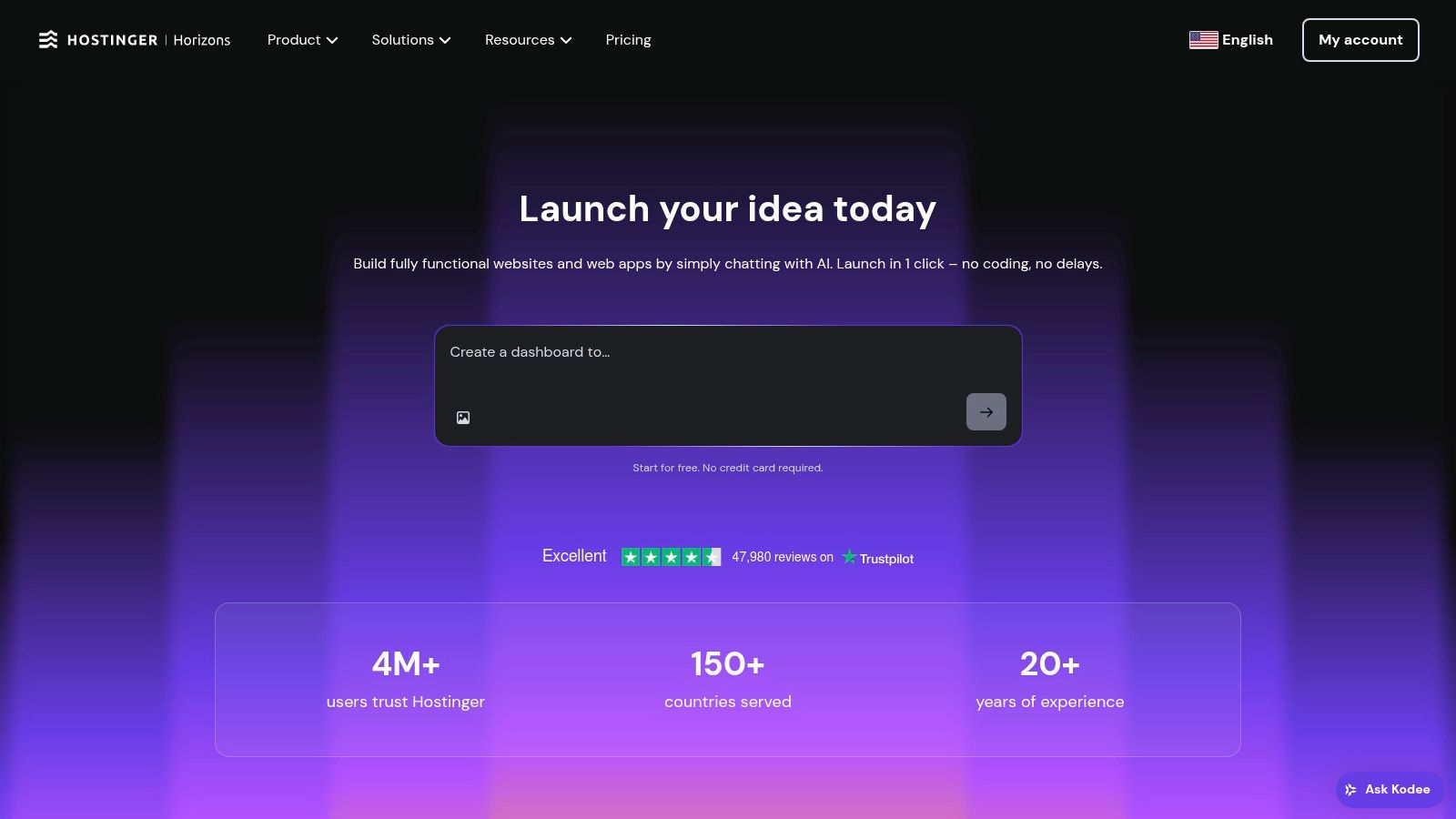
    10. Hostinger Horizons

    Hostinger Horizons is a platform for rapid web application development. It combines no-code AI tools with hosting and domain services. This creates an all-in-one environment. Users can build and launch their apps from a single dashboard.

    Hostinger Horizons

    Key Features & User Experience

    Hostinger Horizons has an AI-powered builder and a real-time editor. It supports voice and image inputs for creating content. The platform's built-in multilingual support helps you create global applications easily.

    Pros:

    • Rapid app development: Go from idea to a live app quickly.
    • Integrated hosting and domain services: Simplifies setup and management.
    • User-friendly interface: Easy for beginners to navigate and use.

    Cons:

    • Limited advanced customization: May not suit complex, highly specific project needs.
    • Some features still under development: The platform is still evolving.

    Website: https://www.hostinger.com/horizons

    11. Microsoft Power Apps

    Microsoft Power Apps is a strong low-code platform for business applications. It is ideal for organizations using the Microsoft ecosystem. Its AI Builder component lets users add AI capabilities like prediction models into their apps. This helps automate and improve business processes.

    Key Features & User Experience

    Power Apps is designed for professional use. It integrates with Microsoft 365, Dynamics 365, and Azure. This allows for powerful workflow automation and data connection. The user experience is more technical but provides great control for building enterprise-grade solutions.

    Pros:

    • Comprehensive Feature Set: Ideal for creating complex business applications.
    • Seamless Integration: Works perfectly with other Microsoft services.
    • Scalable: Suitable for small projects and large enterprise deployments.

    Cons:

    • Steeper Learning Curve: May be challenging for complete beginners.
    • Pricing: Can become costly for larger teams or advanced features.

    Website: https://powerapps.microsoft.com

    12. FlutterFlow

    FlutterFlow uses Google's Flutter framework to build high-performance apps. It combines no-code simplicity with developer-level power. Its visual builder turns drag-and-drop actions into clean Dart code. This low-code environment speeds up development for everyone.

    FlutterFlow

    Key Features & User Experience

    FlutterFlow integrates seamlessly with Firebase for backend services. The user experience is highly visual and intuitive. It allows real-time testing directly within the builder. Users can build complex functions that are not possible with other no-code tools.

    Pros:

    • Powerful Functionality: Supports complex logic and native features.
    • Cross-Platform: Build and deploy to iOS, Android, and web from a single project.
    • Code Export: Provides access to the underlying clean code for full control.

    Cons:

    • Steeper Learning Curve: More complex than purely no-code alternatives.
    • Best with Firebase: Heavily optimized for Firebase, which may not suit all backend needs.

    Website: https://flutterflow.io

    Top 12 AI App Builders Feature Comparison

    PlatformCore FeaturesUser ExperienceTarget AudienceUnique Selling PointsPrice Points
    Appy PieDrag-and-drop builder, AI design, workflow automationBeginner-friendly, affordableSmall businesses, individualsAI-powered design, multilingual supportLow-cost plans
    AdaloDrag-and-drop, real-time updates, external DB integrationIntuitive, rapid prototypingIndividuals, small businessesResponsive design, active communityAffordable
    SoftrAirtable/Google Sheets integration, templates, authenticationQuick setup, no codingClient portals, internal toolsSEO tools, pre-built blocksModerate
    BubbleVisual editor, backend, API integrationHighly customizable, complex appsAdvanced users, startupsFull customization, scalabilityModerate to high
    AppSheet by GoogleGoogle Workspace integration, AI, workflow automationEnterprise-grade, powerful AIEnterprisesAI/ML features, multi-platformHigher pricing
    Zoho CreatorDrag-and-drop, AI integration, automationFeature-rich, complex appsBusinesses, Zoho usersZoho ecosystem integrationMid to high
    GlideGoogle Sheets integration, real-time syncEasy to use, fast developmentBeginners, simple appsOffline mode, templatesLow to moderate
    ThunkableDrag-and-drop, native iOS/Android supportUser-friendly, supports complexityEducators, individualsNative app building, community supportModerate
    Builder.aiAI-assisted development, scalable architectureTailored solutions, fast processBusinesses needing custom appsOngoing supportHigher cost
    Hostinger HorizonsAI-powered no-code, built-in hosting/domainUser-friendly, rapid developmentBeginners, small businessesVoice/image inputs, hosting includedAffordable to moderate
    Microsoft Power AppsMicrosoft 365/Azure integration, AI, workflow automationComprehensive, steep learning curveEnterprises, advanced usersSeamless Microsoft ecosystem integrationHigh
    FlutterFlowDrag-and-drop, Firebase integration, cross-platformUser-friendly, complex functionalityDevelopers, non-developersCross-platform supportModerate

    Final Thoughts

    Your choice from the top 3 AI app builder options depends on your needs. The right tool aligns with your project, skills, and goals. First, define your app's main function. Then, assess your technical comfort level. A simple platform is best for beginners, while advanced users may want more control. Finally, consider the price and how the platform can grow with your app. A good choice now will save you time and money later.


    Ready to move beyond templates and build a truly custom AI solution? If these builders don't quite fit your unique vision, creavoid can help. We specialize in developing bespoke AI applications and platforms, turning your complex ideas into powerful, market-ready realities. Visit creavoid to see how our expert development services can bring your project to life.

  • AI Chatbots for Ecommerce: A Complete Guide

    AI Chatbots for Ecommerce: A Complete Guide

    Using AI chatbots for ecommerce is a popular strategy for online stores. These tools help improve the customer experience and make operations more efficient. They are like automated assistants for your website that are always ready to chat with shoppers. They offer instant help and guide customers through the buying process.

    What Are AI Chatbots for Ecommerce?

    AI chatbots for ecommerce are smart software programs. They are built to have real conversations with customers on your online store. They are much better than old, rule-based bots that only followed a strict script. Today’s chatbots use artificial intelligence (AI) and natural language processing (NLP). This technology helps them understand what a customer is typing. This allows them to give helpful answers right away.

    An AI chatbot is like your best sales associate. It knows everything, is always friendly, and never needs a break. It can handle many tasks that are important for any online business.

    Key Functions of Ecommerce Chatbots

    An AI chatbot is more than just an FAQ machine. Its real power is how it drives sales and improves customer happiness. For example, a shopper might land on your site and not know what they want. A chatbot can ask a few smart questions about their needs or style. Then, it can recommend the right products. This creates a personal shopping experience and helps people feel confident to buy.

    The bot's job does not end at the sale. These bots can also handle common questions after a purchase. They can:

    • Give instant order status updates.
    • Walk customers through returns and exchanges.
    • Answer questions about shipping policies.

    AI chatbots handle these routine questions. This frees up your human support team to solve more complex issues. It creates a smarter and more efficient support system.

    These automated helpers are a key part of a good ecommerce strategy. They improve customer satisfaction by giving instant answers. They also smooth out the buying journey. This often leads to better conversion rates and more repeat customers.

    What Are The Real Benefits of AI Chatbots?

    Many ecommerce stores are adding AI chatbots for good reasons. Putting a chatbot on your site offers serious advantages. These benefits can directly impact your growth and keep your customers happy.

    Image

    The biggest benefit is 24/7 support. Your customers shop at all hours, and their questions do not follow a schedule. A chatbot is always on and ready to help. This means a customer never has to wait for an answer. This constant availability is very important for building satisfaction and loyalty.

    Most people prefer to find answers on their own before calling or emailing. A chatbot meets that need perfectly. It prevents frustration and stops potential buyers from leaving your site because they could not get a quick answer.

    Keeping Customers Happy

    A happy customer is a repeat customer. Chatbots give shoppers quick, accurate answers. This smooths out the bumps in the buying journey.

    A customer who gets an instant response about your shipping policy feels more confident to buy. Each positive interaction builds more trust and loyalty. You will have a customer base that feels supported, which makes them come back.

    A chatbot’s ability to offer consistent, quality support at any hour directly affects customer retention. Shoppers are more likely to choose your store over a competitor's when they know they can get help anytime.

    This shifts your support model from reactive to proactive. Chatbots resolve issues on the spot. This prevents a small question from becoming a big problem. The result is a better shopping experience from start to finish.

    Slashing Operational Costs

    AI chatbots are also a great way to lower operational costs. They can handle a large volume of common questions at once. A human team cannot do that. This frees up your support agents to handle more complex issues that need a human touch.

    Your team answers the same questions over and over every day. These questions include:

    • "Where is my order?"
    • "What's your return policy?"
    • "Do you ship to my country?"

    A single chatbot can answer thousands of these questions easily. This level of automation means you can grow your support without hiring more people. This leads to big savings in salaries and training.

    Driving More Sales and Revenue

    AI chatbots are powerful sales tools. They can guide customers through your sales funnel. They also offer smart product recommendations and can even save a lost sale.

    For instance, a chatbot can engage a shopper who seems unsure. It can ask a few questions to understand their needs. Based on the answers, it can suggest the perfect product, like a personal shopper. That guidance can give a customer the confidence to make a purchase.

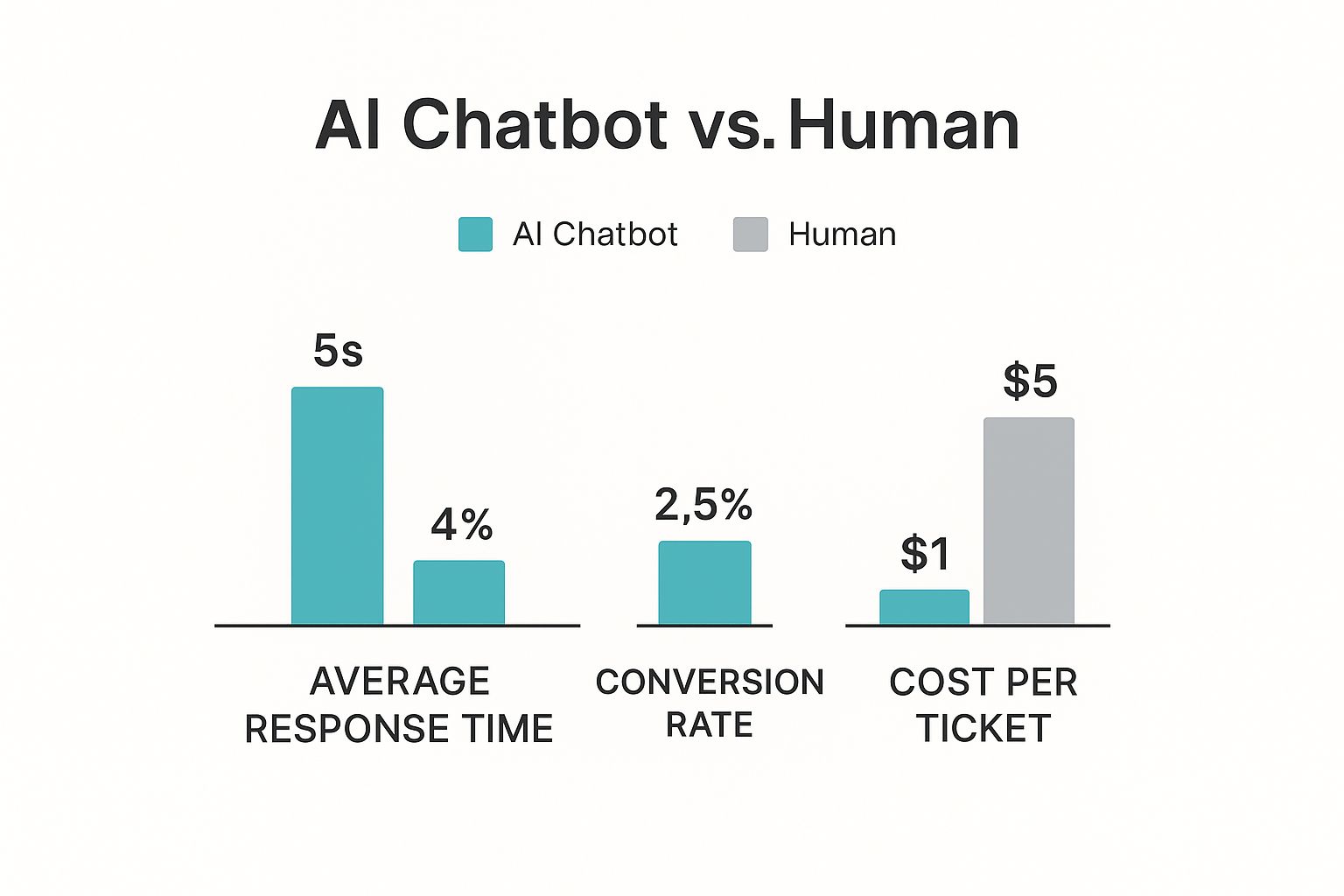
    The numbers show the impact. Data shows that 89% of retail companies are using or testing AI in 2025. Retail chatbots have been shown to increase sales by up to 67%. AI-powered personalization can boost revenue by as much as 40%.

    Chatbots are also very effective at reducing cart abandonment. A chatbot can proactively offer a small discount or answer a final question if a shopper is about to leave your site with items in their cart. Often, that is all it takes to close the sale. A smooth user journey can dramatically improve website conversion rates and turn more visitors into customers.

    Practical Use Cases for Ecommerce Chatbots

    Image

    AI chatbots for ecommerce do more than just say "Hi, how can I help?" These tools are workhorses. They can handle specific, important tasks that shape the customer journey and your bottom line.

    A chatbot can be your most efficient employee. It can be a personal shopper, a logistics coordinator, and a lead generator all at once. It never needs a break.

    Personalize the Shopping Experience

    A chatbot can act as a virtual shopping assistant. It can look at a customer’s browsing history and past purchases. It uses this information to offer product recommendations that make sense.

    This turns a standard online store into a more engaging and helpful experience. The chatbot can ask targeted questions about style or preferences. It then guides the customer to the perfect product.

    Streamline Order Tracking and Management

    The most common question for any ecommerce team is, "Where is my order?" Answering this question repeatedly takes a lot of time. An AI chatbot can handle this task for your team.

    The bot connects to your logistics software. It provides instant, real-time shipping updates in the chat window. A customer just needs their order number, and the bot finds the tracking info immediately. This self-service feature reduces customer anxiety and builds trust.

    An AI-driven chatbot becomes the main spot for any post-purchase questions. This is convenient for customers and great for your support queue. It reduces the number of tickets about order status.

    This automation frees your human agents to handle more complex issues where their skills are truly needed.

    Simplify Returns and Exchanges

    Dealing with returns can be a headache for shoppers. A slow or confusing process can make them dislike your brand. AI chatbots can make this entire process smoother.

    A bot can start the return process and generate a shipping label. It can also answer any policy questions on the spot. It walks the customer through each step, making the experience clear and painless. This puts the customer in control and reduces frustration.

    The bot is also great for exchanges. A bot can check your inventory and help place the new order if someone needs a different size. This happens all in the same conversation. This turns a potentially negative interaction into a positive one.

    Generate High-Quality Leads

    Chatbots are also great lead generation tools. They can proactively talk to visitors on your site. They can turn anonymous traffic into qualified leads for your sales and marketing funnels.

    A visitor might be looking at a product or pricing page. A chatbot can pop up and start a conversation. It can ask smart questions to see how interested they are. It might ask about their budget or what features they need.

    The chatbot can offer a discount code or a helpful guide in exchange for an email address once a visitor shows interest. This captures a valuable lead for your future marketing. Choosing the right tools is important here. You will want to explore your options for the best ecommerce platform for your business.

    AI Chatbot Use Cases and Their Business Impact

    Use CasePrimary Business ImpactExample Interaction
    Personalized RecommendationsIncreased Average Order Value"I see you liked the blue running shoes. We have a new lightweight model in the same color. Want to see it?"
    24/7 Order TrackingReduced Support Tickets"Enter your order number, and I'll give you a real-time shipping update."
    Automated Returns & ExchangesImproved Customer Retention"To start a return, just confirm your order details. I'll email you a shipping label right away."
    Proactive Lead GenerationHigher Conversion Rates"Thinking about our pro plan? I can offer you a 15% discount if you sign up today. Can I get your email?"
    FAQ AnsweringLower Operational Costs"Our standard shipping to the US takes 3-5 business days. You can find our full policy here."

    Chatbots are not just a "nice-to-have" feature. They are powerful tools for driving real business results. They improve the customer experience at every step.

    Deliver Hyper-Personalized Experiences with Generative AI

    Generative AI is making ecommerce chatbots much better. It makes conversations feel incredibly natural and human. Data shows that 74.7% of consumers prefer brands that deliver personalized experiences. These advanced bots are great at this.

    They can analyze customer data in real time. This allows them to offer very relevant recommendations and support. Research shows this level of AI-driven personalization can boost customer retention by 10–15%. For many shoppers, features like live search and automated product suggestions are now top factors in their purchase decisions.

    How to Choose the Right AI Chatbot

    Choosing the right AI chatbot for your store is a big decision. This choice will directly shape your customer's experience and your store's success. There are many options, but it is important to know what to look for.

    The best chatbot should feel like a natural part of your store. It should not be a clunky, robotic add-on. You need to find a solution that matches your specific needs, budget, and goals.

    Assess Your Business Needs and Goals

    First, you need to look at your business. What are you trying to achieve with a chatbot? A clear understanding of your goals will make the selection process easier.

    Do you want to reduce support tickets for your team? Or is your main goal to increase sales with smart product recommendations? Maybe you are focused on stopping shoppers from abandoning their carts. Your top priority will help you focus on the features that matter.

    A clear goal prevents you from paying for fancy features you will never use. For example, a store that wants to cut support costs needs a bot that is great at FAQ automation. A store that wants more sales needs one that is good at product discovery and recommendations.

    Once you have your main goal, be realistic about your budget and your team's technical skills. Some platforms are simple and require no code. Others offer a lot of customization but need more technical skills to set up.

    Rule-Based vs. AI-Powered Chatbots

    You must decide between a simple rule-based chatbot and a smarter AI-powered one. Rule-based bots follow a strict, pre-programmed script. They are great for simple, predictable questions and are usually cheaper.

    AI-powered chatbots use technologies like natural language processing (NLP). They understand what customers are asking, even with unusual phrasing. They get smarter with each conversation and deliver a more natural, human-like experience. They cost more, but they can handle complex situations better.

    This image shows how AI chatbots compare to human agents.

    Image

    The data is clear. AI chatbots can give faster responses, drive higher conversion rates, and solve issues for a lower cost than a human.

    The choice between these two types depends on your needs, customers, and budget. Here is a quick comparison.

    Comparing Chatbot Types: Rule-Based vs. AI-Powered

    FeatureRule-Based ChatbotAI-Powered Chatbot
    Conversation FlowFollows a fixed, decision-tree script.Dynamic, understands intent and context.
    Complexity HandledBest for simple, repetitive FAQs.Can manage complex, multi-part queries.
    Initial CostLowerHigher
    Setup & MaintenanceSimpler to set up, but needs manual script updates.More complex setup, but learns and improves automatically.
    Customer ExperienceCan be frustrating if the query is outside the script.More natural and satisfying for the user.
    Best ForBusinesses with predictable questions and limited budgets.Businesses focused on a great customer experience and lead generation.

    A rule-based bot might be enough if your customers ask the same 10-20 questions repeatedly. You should invest in an AI-powered solution if you want a tool that can truly talk, guide, and sell.

    Essential Features to Look For

    You should look for a few key features when you evaluate different chatbot providers. These features ensure your chatbot will be an asset, not a problem.

    First, integration capabilities are a must. Your chatbot has to work with your ecommerce platform, like Shopify or WooCommerce. It also needs to connect to your CRM, email marketing tools, and help desk software. This keeps your customer data flowing smoothly.

    Next, check the customization options. Your chatbot is part of your brand, so it needs to sound like you. You should be able to change its look, tone, and pre-written responses to match your brand's voice.

    Finally, think about scalability. Your business will grow, and your chatbot must be able to keep up. It needs to handle more conversations without slowing down. Ask potential vendors how their platform supports a growing business.

    Here are a few key questions to ask vendors:

    • Integrations: Can your platform connect with Shopify and our CRM?
    • Customization: How much control do we have over the chatbot’s scripts and appearance?
    • AI Model: Do you use your own AI, or is it built on a service like ChatGPT?
    • Analytics: What kind of reports and performance data can we see?
    • Support: What kind of support do you offer during setup and for ongoing help?
    • Pricing: How does your pricing work? Is it based on conversations, users, or a flat fee?

    Getting clear answers to these questions will help you make the right choice.

    Best Practices for Chatbot Implementation

    Making AI chatbots for ecommerce work well requires a smart approach. A thoughtful launch and ongoing changes separate a frustrating bot from a great one.

    Image

    A great chatbot should feel like a natural part of your brand. It should not be a clunky, added feature. You need to plan its purpose, personality, and conversation flows before it talks to a real customer. Even the smartest bot can fail without this preparation.

    Define Clear Goals and KPIs

    You should first ask: what do I want this chatbot to do? Clear goals provide a roadmap. This guides every design choice and tells you if you have succeeded later.

    Your main goal might be to cut support costs. In that case, you will want to automate answers to your most common questions. Or maybe you want to increase revenue. Then, your priority should be features like proactive product suggestions or saving abandoned carts.

    You need to define key performance indicators (KPIs) to track after setting your goals. These numbers prove your bot is working.

    • Containment Rate: What percentage of chats does the bot handle alone, without a human?
    • Conversion Rate: How many people who chat with the bot make a purchase?
    • Customer Satisfaction (CSAT) Score: Are users finding the bot helpful?
    • Resolution Time: How fast does the chatbot solve customer problems?

    Design an Intuitive Conversation Flow

    Your chatbot’s conversation flow should be a clear path. A bad flow is confusing and leads to dead ends. Your job is to make the journey smooth and logical.

    Start by looking at your help desk data. Find the most common questions and problems your customers have. Use this information to map out the main conversation paths your bot will need.

    A well-designed conversation flow knows what the user wants. For example, if a user asks about "shipping," the chatbot should offer options like "track my order," "view shipping policy," or "calculate shipping costs."

    Always provide clear buttons or quick-reply options. This is especially important at the start of a chat. It avoids the "so, what can you do?" problem and makes the bot feel helpful.

    Give Your Chatbot a Brand Personality

    Your chatbot is often a customer's first contact with your brand. A generic, robotic tone feels cold. Giving your bot a clear character makes the experience more memorable and engaging.

    Think about your audience. Are they young and casual, or do they expect more formal language? The bot’s name, avatar, and tone should all be consistent with your brand. This helps build trust and makes the bot feel like part of the team.

    Ensure a Seamless Human Handover

    No chatbot can handle everything. The handover to a human agent is one of the most important things to get right. A customer should never feel trapped with a bot that cannot help them.

    The transition needs to be seamless. The chatbot should gather key information like the customer's name and order number. It should then pass the entire chat history to the live agent. This simple step prevents the customer from repeating themselves, which is a big source of frustration. You can check out strategies for automated customer support to learn more.

    Monitor Performance and Iterate

    Launching your chatbot is just the start. The real work begins after launch. You have to monitor its performance and use that data to make it better. Look at the conversation logs. See where people get stuck, what questions the bot misses, or what new questions appear.

    Use this feedback to improve your conversation flows and expand the bot's knowledge. The most successful AI chatbots for ecommerce are always learning and evolving. Regular checks and updates will turn a good bot into a vital asset for your business.

    The Future of Conversational Commerce

    The world of AI chatbots for ecommerce is getting smarter. It is moving toward interactions that feel less robotic and more human. Technology is advancing quickly. It is changing how online stores connect with their customers. This is the foundation for a new kind of online shopping that is more personal and interactive.

    Conversational commerce is no longer just about answering simple questions. It is becoming part of the entire customer journey. The goal is to make shopping online feel as natural as talking with an expert in a real store.

    The Rise of Generative AI

    Generative AI is the technology behind this change. This is not your old, script-following bot. This technology allows chatbots to create new, original responses. This leads to conversations that feel dynamic and real.

    A chatbot can now understand not just the words a customer uses, but also the context. For instance, someone might type, "I need a dress for an outdoor wedding next month." A generative AI chatbot can understand the event and location. It can then suggest appropriate styles and fabrics. That is helpful advice, not just an answer.

    Smarter conversations create better customer experiences. Shoppers who feel understood are more likely to trust recommendations and make a purchase. This deepens the bond between them and the brand.

    Voice Commerce and Hands-Free Shopping

    The next big change is the combination of voice commands with ecommerce. We are already used to using voice assistants like Alexa and Siri. Soon we will expect to shop online just by speaking.

    Voice-powered chatbots will let customers search for products and place orders without a keyboard. For example, you could be in the kitchen and realize you need more olive oil. You could just say, "Hey [Brand Name], reorder my last olive oil purchase," and the order is complete.

    This kind of hands-free convenience makes the buying process much smoother. It also makes online shopping available to more people, like those with vision or mobility issues. Voice technology will likely become a standard feature for any serious online store.

    Hyper-personalization is the next step. Future AI chatbots will not just react to customer requests. They will proactively guess their needs and offer solutions before a customer even knows they have a problem.

    Predictive and Proactive Engagement

    The most advanced AI chatbots for ecommerce are becoming predictive. They use data to guess what a shopper might need next. This is where hyper-personalization is important.

    These bots can make very relevant suggestions by analyzing browsing history and past purchases. For example, a chatbot might alert a customer when a new model from their favorite shoe brand is available. This proactive engagement makes the customer feel seen and valued.

    This approach changes the chatbot from a simple tool into a trusted shopping companion. It builds loyalty by showing that your brand understands the customer as an individual. This deep, personalized service will define the next wave of successful online retail.

    As technology advances, chatbots will become even more integrated into online shopping. They will make commerce more conversational, efficient, and tailored to each person.

    Got Questions About AI Chatbots? We've Got Answers.

    Many questions come up when you think about adding an AI chatbot to your business. It is smart to understand the costs, what it takes to set one up, and how you will know if it is working. Here are answers to some common questions.

    What Is the Real Cost to Implement a Chatbot?

    The price for an AI chatbot can vary a lot. A simple, rule-based bot might have a small monthly fee. This is great for smaller stores. A complex AI chatbot that connects to your other systems will cost more. The price is often based on how many chats it handles each month.

    You should keep these costs in mind for your budget:

    • Subscription Fees: Most chatbot platforms have a monthly or yearly fee.
    • Setup Costs: Complex bots might have a one-time setup fee.
    • Maintenance: Your bot might need occasional updates to stay effective.

    How Much Technical Skill Is Needed?

    You do not need to be a coding expert to set up a chatbot. Many modern platforms have no-code, drag-and-drop builders. This means you or your marketing team can design conversations without writing any code.

    You might need some development help for more advanced needs. For example, connecting the chatbot directly to your inventory system may require a developer. However, most platforms are built for business users, not programmers.

    How Do You Measure Chatbot ROI?

    Measuring the return on investment (ROI) for your chatbot is very important. You need to know it is providing value. The best way is to track specific numbers that show its direct impact on your sales and costs.

    One of the clearest metrics for ROI is the chatbot's containment rate. This number tells you what percentage of customer questions the bot handled completely, without a human getting involved. Each of those conversations is a direct cost saving for your support team.

    The conclusion to a blog post about AI chatbots for ecommerce should be a short paragraph. It should summarize the main points without introducing new ideas. The tone should be simple and direct. It should encourage the reader to consider the benefits of using an AI chatbot for their business. The conclusion should be the final part of the article.

    AI chatbots offer many benefits for ecommerce businesses. They provide 24/7 customer support, lower operational costs, and increase sales. By personalizing the shopping experience and handling common questions, they improve customer satisfaction. Choosing the right bot and implementing it carefully can lead to significant growth. As technology improves, chatbots will become an even more essential tool for online stores.


    Ready to see how intelligent automation can transform your business? creavoid builds custom AI solutions that cut costs and drive growth. Discover what's possible.

  • What Is Blackbox AI and How Does It Work?

    What Is Blackbox AI and How Does It Work?

    Blackbox AI is a type of artificial intelligence that is powerful and often very accurate. We can see the data that goes in and the answer that comes out. The decision-making process in the middle, however, is hidden from view.

    Understanding What Blackbox AI Is

    Imagine you have a magic box. You put a complex question in one side, and a correct answer comes out the other. You do not know how it found the answer, but it did. This is how a Blackbox AI works. These systems use complex models like deep learning neural networks. These models have so many layers that even their creators cannot trace a decision’s exact path.

    This simple infographic explains the concept:

    Image

    We control the input data and get a clear output. The middle “processing” stage inside the model remains a mystery. This lack of visibility defines Blackbox AI. It creates both exciting opportunities and real challenges for businesses.

    Blackbox AI vs. Whitebox AI Comparison

    It helps to compare Blackbox models to their transparent counterparts, called “whitebox” AI. Blackbox systems focus on performance. Whitebox models are designed for clarity, so you can easily follow their logic.

    Here is a breakdown of the main differences:

    FeatureBlackbox AI (e.g., Deep Neural Networks)Whitebox AI (e.g., Decision Trees)
    TransparencyOpaque; internal workings are not understandable to humans.Transparent; the decision-making process is clear and easy to follow.
    ComplexityHigh; involves millions or even billions of parameters.Low to moderate; based on simple, explainable rules.
    PerformanceTypically very high accuracy, especially with complex data.Generally lower accuracy, especially on unstructured data like images.
    Use CasesImage recognition, natural language processing, autonomous driving.Credit scoring, fraud detection, medical diagnosis where explainability is crucial.
    InterpretabilityVery difficult; requires specialized techniques to approximate explanations.Very easy; you can literally trace the path from input to output.

    The choice between a Blackbox and a whitebox model involves a trade-off. You must decide if you need the best performance or if you need to understand the AI’s decision. Whitebox models are often the safer choice in high-stakes fields like finance. Blackbox AI is often the best option for tasks where predictive power is most important.

    How Blackbox Models Learn and Make Decisions

    Image

    This learning is often driven by deep learning, which uses structures called neural networks. You can think of these as a digital version of the human brain’s network of neurons. This design helps the AI find subtle patterns in data that a person might miss.

    It all begins with a phase called training. An image recognition model might see millions of labeled pictures. For each image, the AI makes a guess and checks its answer against the label.

    It adjusts its internal wiring every time it is wrong. These “wires,” or parameters, can number in the millions or billions. This cycle of guessing, checking, and adjusting helps the model create its own logic for future decisions.

    The Training Process Unpacked

    The “black box” is built during the training phase. The AI tunes its billions of parameters. It creates a web of calculations so dense that a human cannot follow a single input to its output.

    Here is an analogy: You can teach a toddler what a cat is by showing them many photos. The toddler can then identify a cat they have never seen before. If you ask them to explain how they knew, they would struggle. They just know. A Blackbox model works in a similar but much more complex way.

    A key takeaway is that Blackbox models develop their own problem-solving logic. They do not follow a pre-written script but apply patterns learned from training data.

    This self-developed logic makes them very powerful. They can handle new, unseen information because they have generalized patterns instead of just memorizing examples.

    From Learning to Decision-Making

    The model is ready to work after training. It processes new data through its network of learned parameters. This happens very quickly to provide a prediction, classification, or recommendation. For those curious about creating these systems, learning how to build AI agents for beginners can offer a good foundation.

    The model’s final decision is a highly educated guess. It is based on the statistical probabilities it found during training.

    Here is a simplified look at the flow:

    1. Input Data: The model receives new information, like text, an image, or financial data.
    2. Internal Processing: The data moves through the trained neural network’s layers, causing millions of small calculations.
    3. Output Generation: The model produces an outcome, such as translating text or flagging a transaction.

    This efficiency allows Blackbox AI to power real-time applications. These include moderating online content and guiding autonomous vehicles. Its ability to make fast, accurate judgments comes from its deep, data-driven learning.

    Real-World Examples of Blackbox AI in Action

    Image

    Blackbox AI is already a part of our daily lives. You likely interact with these systems many times a day. They are the invisible engines behind many modern services.

    Consider the recommendation engine on a streaming service. It uses your viewing history and what other people with similar tastes enjoy. The model processes this information and suggests a movie or show. That is a simple example of Blackbox AI.

    In Healthcare and Medical Diagnostics

    The healthcare industry uses Blackbox AI to analyze medical images with high precision. A model can review thousands of X-rays or MRIs to find early signs of disease. The scan is the input, and the output is an area for a radiologist to check.

    These systems can often find very subtle patterns that a human might miss. Their accuracy sometimes meets or exceeds that of human experts. This is a powerful, opaque process that delivers life-saving results.

    The growth in this area is significant. The overall AI market is expected to reach about $243.7 billion by 2025. This growth comes from adoption in key sectors like healthcare. You can see the complete market size statistics for more details.

    In Finance and E-Commerce

    In finance, Blackbox AI is used for fraud detection and high-frequency trading. An AI can monitor millions of transactions in real-time. The transaction data goes in, and an immediate “block this purchase” alert can stop fraud.

    These AI systems protect consumers and financial institutions from large losses. They analyze patterns too complex and fast for human teams. They operate at a speed and scale that is not possible with manual oversight.

    E-commerce uses Blackbox AI for dynamic pricing and inventory management.

    Here are a few ways it is used:

    • Personalized Shopping: Websites create a product feed for you based on what you have viewed and bought.
    • Customer Service Chatbots: AI bots answer common customer questions, which frees up human agents.
    • Supply Chain Optimization: These models predict product demand to help retailers avoid stock shortages.

    Each of these examples shows a similar process. We provide the input and get a valuable output. We trust the model’s hidden logic to connect them. The results are powerful, even if the “how” is a mystery.

    The Key Benefits of Blackbox AI Models

    So, why would anyone use a Blackbox model if we do not know how it works? The simple answer is performance.

    Blackbox AI is often the best tool when you need raw accuracy and power. These models are very good at finding complex patterns in data. These patterns are often invisible to human experts. This ability allows them to make predictions with a high degree of precision.

    An AI can beat a chess grandmaster by recognizing deep strategic patterns. A human player might not even think of these patterns. This superior performance comes from the model’s complex, hidden workings. It can achieve results that simpler, more transparent models cannot.

    Unmatched Speed and Efficiency

    Another major benefit is the speed of Blackbox AI. These systems can process huge datasets and make decisions in real-time. They operate at a scale and speed that humans cannot match. This makes them ideal for tasks where every millisecond is important.

    Online advertising is a classic example. A Blackbox model can analyze millions of user data points instantly. It decides which ad is most relevant to you at that moment. This fast decision-making makes the ad more effective.

    This efficiency leads to business success. Blackbox.ai, a platform for developers, became profitable with a small team. It reached $31.7 million in annual revenue with just 180 employees. This highlights the power of automation. You can read the full usage statistics on wearetenet.com to learn about its global adoption.

    Automation of Complex Tasks

    Blackbox AI also automates tasks that are very complex. You can hand these jobs to an AI. This frees up your team to focus on strategy, creativity, and problem-solving.

    This is happening in many industries today.

    • Customer Support: AI chatbots handle common questions, so human agents can solve harder problems.
    • Manufacturing: AI models monitor production lines to find small defects and improve quality control.
    • Content Creation: Some AI tools for business growth can create reports from large datasets, saving analysts time.

    Blackbox AI takes over these complex tasks. It allows organizations to run more smoothly and use their human talent better. It is a powerful tool for increasing productivity.

    The benefits of Blackbox AI are clear. The combination of accuracy, speed, and automation delivers real results. For many applications, these advantages are too strong to ignore.

    Understanding the Risks and Ethical Concerns

    The main problem with Blackbox AI is that you cannot see how it thinks. This lack of clarity makes it hard to trust a model’s output. It is also difficult to fix mistakes or understand why it works. This creates serious risks when we let these systems make important decisions.

    You can never be sure the model is fair if you cannot see how it works. An AI trained on flawed data can pick up and even increase human biases. This can lead to unfair outcomes in areas like hiring or loan applications. A model might discriminate against someone without anyone knowing why.

    The Problem of Hidden Biases

    Hidden biases are a serious danger of a Blackbox system. A model may seem to perform perfectly in a test environment. In the real world, it could make decisions based on wrong factors. An AI for screening job applicants might favor candidates from certain zip codes. This could happen because the training data had more successful hires from those areas, not because they were more qualified.

    This creates a cycle of unfairness that is hard to spot and fix. The consequences can be severe. They can lead to legal issues and damage a company’s reputation. We see similar issues with other advanced AI. Our guide on the AI image generator explores how these tools also need careful use to avoid biased results.

    Regulatory and Security Challenges

    The secretive nature of Blackbox models also creates problems with regulations. Many industries have rules that require decisions to be explainable. A Blackbox AI cannot do this. This forces companies to choose between a high-performing model and their legal duties.

    These systems can also be vulnerable. Attackers can sometimes change input data in small ways to trick a model. It is a major challenge to identify and defend against these attacks because the model’s logic is a mystery.

    A key problem is that when a Blackbox AI makes a mistake, it is almost impossible to find the root cause. You know the final answer was wrong, but you cannot trace the error back through the model’s complex calculations.

    The growth of Blackbox AI has led to a push for regulation. The European Union’s AI Act now requires explainability for high-risk systems. This is to fight the dangers of these opaque algorithms. U.S. regulators are also concerned about unchecked AI decision-making. You can find more details about these AI risks and breakthroughs in 2025 on ts2.tech.

    The Push for Explainable AI

    Image

    We rely more on Blackbox AI every day. This makes us realize it is unsettling to trust a decision we do not understand. This concern has led to a push for more transparent systems. This new field is called Explainable AI, or XAI.

    XAI aims to look inside these complex models to see what is happening. It is not just about curiosity. It is about building trust and accountability into our tools. Knowing why an AI makes a critical judgment is essential for using it safely.

    How XAI Makes Sense of Complex Models

    Explainable AI does not simplify powerful models. Instead, it provides techniques that act as interpreters. They translate the AI’s complex logic into something we can follow. Two popular methods are LIME (Local Interpretable Model-agnostic Explanations) and SHAP (SHapley Additive exPlanations).

    These tools are like a detective’s magnifying glass. An AI might deny a loan application. LIME or SHAP can show the clues the model used. It might highlight that a “low credit score” and a “high debt-to-income ratio” were the main reasons.

    These tools do not explain the entire model at once. They give you a simple reason for a single decision. This helps you get the “why” without needing a Ph.D. in machine learning.

    This is very important. It helps developers find bugs in their models and spot hidden biases. It also helps them give clear reasons for any AI-driven action. We are now moving from just accepting an AI’s answer to understanding its reasoning.

    The Global Push for Transparency and Regulation

    This is not just a tech trend; it is becoming law. Regulators around the world now see the risks of opaque AI. This is especially true in areas like finance, hiring, and healthcare. They are starting to write rules that require a basic level of transparency.

    The EU’s AI Act is a great example. It places strict rules on systems that make major decisions. If a bank uses an AI to reject a loan, the bank must be able to explain why. This regulatory pressure is forcing companies to be more open.

    This all points to a large industry shift. The conversation is no longer just about performance. Developers and organizations now look for ways to balance the power of Blackbox AI with the need for it to be explainable and trustworthy.

    Got Questions About Blackbox AI?

    We receive many questions about Blackbox AI and its real-world uses. Let’s answer some of the most common ones.

    The main difference is transparency. A whitebox AI, like a simple decision tree, gives you a clear path. You can follow the logic from start to finish. This makes it easy to understand and fix.

    Blackbox models are the opposite. Their inner workings are a mystery. Their results are often very accurate, but a human cannot follow the decision-making process.

    Can You Make a Blackbox AI More Transparent?

    Yes, you can. This is a major focus in the AI community. The field of Explainable AI (XAI) works to open up these complex systems. Tools like LIME and SHAP analyze a model’s outputs. They find which input factors were most important for a single decision.

    These methods do not show the whole process. They give you a good look at the “why” behind a specific result. This is important for building trust and finding hidden biases.

    These tools are like interpreters. They translate the AI’s complex math into something a human can understand. They do this without hurting the model’s performance. It is a way to get high accuracy and some understanding.

    Which Industries Should Be Most Cautious?

    Some fields must be very careful with Blackbox AI. When stakes are high and people’s lives are involved, explaining a decision is a requirement.

    A few industries need to be especially cautious:

    • Finance: For credit scores or loan applications, an unexplained “no” can lead to accusations of discrimination.
    • Healthcare: In diagnostics, every recommendation must be explainable. This is vital for patient safety and for doctors to trust the technology.
    • Hiring and HR: Using an opaque model to screen job candidates is a big risk. It is too easy to create a system that reinforces biases.

    In these sectors, not being able to explain a decision is a major liability, not just an inconvenience.


    Ready to harness the power of AI and automation for your business? creavoid builds intelligent systems and data-driven strategies to fuel your growth. Visit us at https://creavoid.com to see how we can help you scale.

  • 9 Digital Transformation Best Practices for 2025

    9 Digital Transformation Best Practices for 2025

    In a business climate where 'disrupt or be disrupted' is the new mantra, digital transformation is no longer a strategic option. It's a fundamental requirement for survival and growth. For Small and Medium-sized Enterprises (SMEs) and ambitious startups, navigating this complex landscape can feel daunting. The process is far more than simply adopting new technology; it demands a profound shift in culture, strategy, and operations, all aimed at delivering unprecedented value to customers. The primary challenge lies in moving beyond buzzwords to implement concrete, effective strategies that yield tangible results.

    This article cuts through the noise to provide a detailed roadmap. We will explore nine critical digital transformation best practices, offering actionable insights, process frameworks, and real-world examples. These are specifically tailored to help you build a resilient, future-ready organization. From securing C-suite leadership to fostering a data-driven culture and implementing a cloud-first infrastructure, each point is designed to be a practical building block for your evolution.

    You will learn how to:

    • Adopt an agile, iterative approach to development.
    • Prioritize cybersecurity and manage digital risk effectively.
    • Empower your workforce through targeted upskilling and robust change management.
    • Design experiences with a relentless customer-centric focus.

    By understanding and applying these core principles, you can turn the immense pressure of market disruption into your greatest competitive advantage. This guide provides the clear, actionable steps needed to not just participate in the digital future, but to lead it. Let’s dive into the essential practices that will define your success.

    1. CEO and C-Suite Leadership Commitment

    One of the most critical digital transformation best practices isn't a piece of technology; it's the unwavering, visible commitment from the CEO and the entire C-suite. A successful transformation is not an IT project delegated to a single department. It is a fundamental, top-down overhaul of business strategy, culture, and operations. Without executive leadership actively championing the change, initiatives often stall due to internal resistance, resource scarcity, and a lack of clear direction.

    CEO and C-Suite Leadership Commitment

    This commitment goes beyond mere approval. It involves the CEO personally articulating the "why" behind the transformation, connecting it directly to the company's future survival and growth. Leaders must model the desired digital-first behaviors and mindset, demonstrating a willingness to challenge long-standing traditions and embrace new ways of working. This active sponsorship is the engine that powers the entire initiative forward.

    Real-World Example: Microsoft

    Under Satya Nadella, Microsoft shifted from a Windows-centric model to a "cloud-first, mobile-first" powerhouse. Nadella didn't just authorize the change; he spearheaded it. He restructured the company, championed a culture of empathy and learning, and made massive investments in Azure, transforming Microsoft into a leader in cloud computing. This is a prime example of how C-suite vision directly translates into market dominance.

    Actionable Implementation Tips

    • Communicate Relentlessly: Constantly reinforce the vision and benefits of the transformation in company-wide meetings, emails, and internal communications.
    • Allocate Real Resources: Back the vision with a dedicated budget and the best talent. JPMorgan Chase, for example, invests over $12 billion annually in technology, a commitment driven by CEO Jamie Dimon.
    • Establish a Transformation Office: Create a cross-functional committee led by a C-suite executive to govern the initiative, track progress, and remove roadblocks. This ensures accountability.
    • Invest in Leadership Literacy: Ensure the entire leadership team understands key digital concepts. This prevents a disconnect between the vision and the execution. Developing a comprehensive digital transformation roadmap is a key step where leadership's informed input is crucial. Learn more about crafting a digital transformation roadmap on creavoid.com.

    2. Customer-Centric Approach and Experience Design

    True digital transformation is not merely about internal process optimization; it is fundamentally about delivering superior value to the customer. Adopting a customer-centric approach means placing the end-user at the heart of every decision, from product design to operational workflow. This practice involves deeply understanding customer needs, pain points, and digital behaviors, and then re-engineering the business to create seamless, intuitive, and highly satisfying experiences across all touchpoints.

    Customer-Centric Approach and Experience Design

    This philosophy, championed by leaders like Jeff Bezos at Amazon, shifts the focus from "what can we sell?" to "what does our customer need?". By prioritizing the customer experience, companies can build loyalty, increase retention, and create powerful brand advocates. It requires using data-driven insights not just for marketing, but for a continuous cycle of improvement, ensuring the digital solutions you build are the ones your customers actually want and will use.

    Real-World Example: Sephora

    Sephora excels at using technology to enhance the customer journey. Its mobile app integrates a powerful loyalty program with features like the Virtual Artist, which uses augmented reality to let customers "try on" makeup. This digital tool doesn't just sell products; it solves a real customer problem: the uncertainty of buying cosmetics online. By blending the digital and in-store experience so effectively, Sephora has created a highly personalized and engaging ecosystem that keeps customers coming back.

    Actionable Implementation Tips

    • Map the Customer Journey: Conduct workshops to visually map out every interaction a customer has with your brand. This reveals pain points and opportunities for digital enhancement.
    • Implement Continuous Feedback Loops: Use tools like surveys, user testing sessions, and social media listening to constantly gather customer input and integrate it into your development cycle.
    • Use A/B Testing for Optimization: Don't guess what works best. Systematically test variations of your website, app features, and digital communications to make data-driven decisions that improve the user experience.
    • Invest in a Customer Data Platform (CDP): A CDP unifies customer data from all sources into a single, coherent profile. This 360-degree view is essential for delivering the personalized experiences modern consumers expect.

    3. Data-Driven Decision Making and Analytics

    Transitioning from intuition-based choices to data-driven decision making is a cornerstone of modern digital transformation best practices. This shift involves more than just collecting data; it's about building a robust infrastructure to process it, implementing advanced analytics tools, and fostering a culture where evidence and insights guide strategic direction. In a digital economy, companies that harness their data effectively can anticipate market shifts, understand customer behavior, and optimize operations with unprecedented precision.

    Data-Driven Decision Making and Analytics

    This approach embeds analytics, artificial intelligence (AI), and machine learning (ML) into the core of the business. Instead of relying on gut feelings or historical anecdotes, leaders use predictive models and real-time dashboards to make informed, strategic moves. This data-centric mindset empowers teams at every level to test hypotheses, measure outcomes, and continuously iterate, creating a powerful engine for innovation and competitive advantage.

    Real-World Example: Netflix

    Netflix is a masterclass in data-driven strategy. The streaming giant meticulously analyzes viewing data, including what users watch, when they pause, and what they search for, to make critical content decisions. This analytical rigor informed the creation of hit series like "House of Cards," which was greenlit based on data showing a crossover audience for director David Fincher, actor Kevin Spacey, and the original British version of the show. This practice minimizes risk and maximizes return on content investment.

    Actionable Implementation Tips

    • Start with Business Questions: Don't collect data for its own sake. Define clear business questions and key performance indicators (KPIs) you want to address, such as "What is our customer churn rate?" or "Which marketing channel has the highest ROI?"
    • Invest in Data Quality and Governance: Ensure your data is accurate, consistent, and secure. A successful analytics program is built on a foundation of trustworthy data, so establishing clear governance policies from the start is crucial.
    • Democratize Data with Tools and Training: Equip business users, not just data scientists, with user-friendly analytics and visualization tools like Tableau or Power BI. Provide training to help them interpret data and derive actionable insights for their specific roles.
    • Create Cross-Functional Data Teams: Assemble teams with a mix of data analysts, business domain experts, and IT professionals. This collaboration ensures that the insights generated are not only statistically sound but also relevant and applicable to real-world business challenges.

    4. Agile and Iterative Development Methodology

    A core tenet of modern digital transformation best practices involves abandoning rigid, slow-moving project management in favor of agility. Adopting an agile and iterative development methodology allows organizations to be more responsive, flexible, and customer-centric. Instead of long, linear "waterfall" cycles, agile breaks down large projects into small, manageable increments called sprints. This enables continuous improvement, rapid feedback loops, and the ability to pivot quickly based on market changes or user data.

    Agile and Iterative Development Methodology

    This approach is not just for software development; it's a business mindset. It fosters collaboration between self-organizing, cross-functional teams and prioritizes delivering tangible value to the customer at regular intervals. By building, measuring, and learning in rapid cycles, companies can reduce risk, accelerate time-to-market, and ensure the final product truly meets user needs, which is a cornerstone of a successful digital transformation.

    Real-World Example: Spotify

    Spotify is famous for its "squad" model, an at-scale implementation of agile principles. The company organizes its teams into small, autonomous units (squads) that own specific features from end to end. This structure promotes ownership, speeds up decision-making, and has allowed Spotify to continuously innovate and deploy new features, keeping it ahead in the competitive music streaming industry. This organizational design is a powerful demonstration of how agile philosophy can shape an entire company's culture and operational effectiveness.

    Actionable Implementation Tips

    • Start with a Pilot: Don't try to transform the entire organization overnight. Select a single, high-impact project to pilot the agile methodology, learn from the experience, and then scale gradually.
    • Invest in Training and Coaching: Agile requires a significant mindset shift. Provide formal training on frameworks like Scrum or Kanban and consider hiring an agile coach to guide teams through the initial transition.
    • Form Cross-Functional Teams: Break down departmental silos. Create teams with all the skills needed (e.g., design, development, marketing, QA) to complete a project increment independently.
    • Establish a Clear "Definition of Done": To ensure quality and alignment, every team must agree on a specific set of criteria that a task must meet before it can be considered complete. This prevents ambiguity and rework.

    5. Employee Upskilling and Change Management

    Technology is only one part of the digital equation; the human element is equally, if not more, critical. A core digital transformation best practice is to proactively invest in employee upskilling and manage the cultural shift that accompanies new processes. Simply deploying new software without preparing your team is a recipe for low adoption, frustration, and failure. Effective transformation requires building the digital capabilities and mindsets of the people who will use the new tools and systems every day.

    This means moving beyond one-off training sessions to create a continuous learning culture. It involves a strategic approach to identifying future skill needs, providing accessible and relevant training, and managing the human side of change with empathy and clear communication. Supporting employees through this transition ensures they feel valued and empowered rather than threatened by new technology.

    Real-World Example: Amazon

    Amazon's "Career Choice" program is a powerful example of upskilling at scale. The company pre-pays 95% of tuition for employees to take courses in high-demand fields, even if those fields are not directly related to their current roles at Amazon. By investing heavily in its workforce's future skills, Amazon not only facilitates its own digital evolution but also fosters immense employee loyalty and prepares its team for the economy of tomorrow.

    Actionable Implementation Tips

    • Conduct a Skill Gap Analysis: Before launching any training, assess your team's current digital literacy and identify the specific skills needed to support your transformation goals. This ensures your investment is targeted and effective.
    • Offer Diverse Learning Formats: Cater to different learning styles by providing a mix of online courses, hands-on workshops, peer mentoring, and self-paced modules.
    • Appoint Digital Champions: Identify and empower enthusiastic employees to act as internal advocates. These champions can provide peer support, share success stories, and help drive adoption from the ground up.
    • Link Training to Career Growth: Clearly demonstrate how acquiring new digital skills can lead to promotions, new responsibilities, and career advancement. This provides a powerful incentive for employees to engage with training initiatives.

    6. Cloud-First Infrastructure and Architecture

    A foundational digital transformation best practice is the strategic adoption of a cloud-first infrastructure. This approach prioritizes cloud computing for all new technology deployments and gradually migrates existing on-premise systems. It is not just about moving servers to a data center; it's a fundamental shift in how businesses procure, manage, and leverage technology to gain agility, scalability, and a competitive edge. By treating cloud as the default choice, companies unlock the ability to innovate faster and respond to market changes with unprecedented speed.

    Embracing a cloud-first architecture means moving away from rigid, capital-intensive hardware cycles. Instead, businesses can access virtually limitless computing power on a flexible, pay-as-you-go basis. This allows for rapid experimentation, cost-effective scaling during peak demand, and access to advanced services like AI and machine learning without massive upfront investment. It transforms IT from a cost center into a strategic enabler of business growth and innovation.

    Real-World Example: Netflix

    Netflix is a quintessential example of a successful cloud-first strategy. Early in its streaming journey, the company made the bold decision to migrate its entire infrastructure from its own data centers to Amazon Web Services (AWS). This move gave Netflix the massive scalability needed to support its global expansion and the flexibility to continuously deploy new features. Its cloud-native architecture is a key reason it can handle immense traffic and maintain a high-quality user experience worldwide.

    Actionable Implementation Tips

    • Start with Non-Critical Applications: Begin your cloud journey by migrating less complex, non-critical workloads. This helps your team build skills and confidence while minimizing risk.
    • Invest in Cloud Security and Governance: Proactively implement robust security protocols and governance frameworks specifically for the cloud. This includes identity management, data encryption, and compliance monitoring.
    • Train Teams on Cloud-Native Development: Equip your developers with the skills to build applications designed for the cloud (e.g., using microservices and containers). This maximizes the benefits of cloud infrastructure.
    • Monitor and Optimize Cloud Costs: Regularly use cloud cost management tools to analyze spending and eliminate waste. Without careful oversight, cloud bills can quickly escalate. Learn more about choosing the right cloud platforms and solutions on creavoid.com.

    7. API-First and Microservices Architecture

    Another foundational digital transformation best practice involves a shift in how you build and structure your technology. Adopting an API-first approach and a microservices architecture moves you away from rigid, monolithic systems. Instead, you design systems with Application Programming Interfaces (APIs) as the primary interface and break down large applications into smaller, independently deployable services. This architectural choice is crucial for building resilient, scalable, and adaptable digital platforms.

    This modern approach enables faster development cycles, as teams can work on different microservices simultaneously without disrupting the entire system. It also allows for easier integration with third-party tools and fosters innovation by making data and functionality accessible through well-defined APIs. Ultimately, it creates a flexible technology backbone that can evolve with your business needs, rather than constraining them.

    Real-World Example: Netflix

    Netflix's transition from a monolithic DVD rental service to a global streaming giant is a textbook case of leveraging microservices. Faced with scaling challenges, Netflix re-architected its entire platform into hundreds of fine-grained microservices, each handling a specific function like user authentication, billing, or video streaming. This allowed them to innovate rapidly, maintain high availability, and scale to serve millions of concurrent users, a feat impossible with their old architecture.

    Actionable Implementation Tips

    • Start with Domain-Driven Design (DDD): Organize your services around business capabilities, not technical layers. This ensures your architecture directly supports and reflects business processes.
    • Implement Comprehensive API Documentation: Use standards like OpenAPI (Swagger) to create clear, interactive documentation. This is essential for both internal developers and external partners who will consume your APIs.
    • Use Containerization: Deploy services using technologies like Docker and orchestrate them with Kubernetes. Containers make your microservices portable and simplify deployment, scaling, and management across different environments.
    • Invest in an API Gateway: An API gateway acts as a single entry point for all clients, handling tasks like routing, security, and rate limiting. This simplifies the client-side and secures your backend services.

    8. Cybersecurity and Digital Risk Management

    As businesses digitize their operations, they inherently expand their attack surface, making robust cybersecurity a non-negotiable component of any transformation strategy. This digital transformation best practice involves embedding security into every facet of the initiative, rather than treating it as an afterthought. It means shifting from a traditional perimeter-based defense to a more dynamic, proactive approach that protects digital assets, sensitive customer data, and core business functions from an evolving threat landscape.

    This proactive stance requires implementing comprehensive security measures from the ground up. Adopting frameworks like zero-trust security, which assumes no user or device is inherently trustworthy, is crucial. This model enforces strict verification for every person and device trying to access resources on the network, significantly reducing the risk of unauthorized access and lateral movement by attackers.

    Real-World Example: Maersk

    The 2017 NotPetya cyberattack on global shipping giant Maersk serves as a powerful lesson. The attack crippled their entire global IT infrastructure in hours, costing the company an estimated $300 million. Their recovery, however, demonstrated resilience built from a renewed focus on cybersecurity. They rebuilt their entire network with security-by-design principles, segmenting systems and implementing stronger access controls, transforming a catastrophic event into a catalyst for a more secure and resilient digital foundation.

    Actionable Implementation Tips

    • Implement Security by Design: Embed security controls and reviews into the earliest stages of any new project or system development lifecycle, not just before launch.
    • Conduct Regular Security Audits: Proactively identify vulnerabilities by performing regular penetration testing and security assessments on your critical systems and applications.
    • Train Your Entire Team: The human element is often the weakest link. Provide continuous security awareness training to all employees to help them recognize phishing attempts and follow best practices.
    • Establish a Clear Incident Response Plan: Develop, document, and practice a detailed plan for how your organization will respond to a security breach to minimize damage and ensure business continuity. Explore more about cybersecurity and data protection on creavoid.com.

    9. Strategic Partnerships and Ecosystem Building

    Digital transformation is not a solo journey. One of the most powerful digital transformation best practices is to look beyond your organization's walls and build a robust ecosystem of strategic partnerships. This means collaborating with technology providers, innovative startups, and even competitors to access new capabilities, accelerate innovation, and create shared value. Instead of trying to build every new technology or skill internally, smart companies leverage external expertise to move faster and more efficiently.

    This approach transforms the traditional, linear value chain into a dynamic, interconnected network. By forming alliances, you can tap into specialized knowledge, co-develop new products, and gain access to new markets or customer segments. These partnerships act as accelerators, allowing you to integrate cutting-edge solutions, from cloud infrastructure to AI algorithms, without the time and expense of developing them from scratch.

    Real-World Example: Ford & Google

    Ford's alliance with Google is a prime example of ecosystem building in action. Rather than attempting to create a competing infotainment and connectivity platform, Ford partnered with Google to integrate Android Automotive OS directly into millions of its vehicles. This gives Ford access to Google's best-in-class apps like Google Maps and Google Assistant, while allowing Ford to focus on its core competency: building vehicles. The partnership accelerates Ford's connected car strategy and improves the customer experience instantly.

    Actionable Implementation Tips

    • Define Clear Partnership Goals: Before seeking partners, clearly articulate what you want to achieve. Is it access to technology, a new market, or a specific customer base? Success metrics must be defined upfront.
    • Establish Strong Governance: Create a clear framework for managing the partnership, including roles, responsibilities, communication protocols, and decision-making processes. This prevents misunderstandings and keeps the collaboration on track.
    • Create Win-Win Value Propositions: A successful partnership must benefit all parties. Ensure your proposal clearly outlines the value your partner will receive, whether it's revenue, data insights, or access to your customer base.
    • Conduct Thorough Due Diligence: Vet potential partners carefully. Assess their technological capabilities, financial stability, and, most importantly, their cultural fit with your organization to ensure a smooth collaboration.

    Digital Transformation Best Practices Comparison

    InitiativeImplementation ComplexityResource RequirementsExpected OutcomesIdeal Use CasesKey Advantages
    CEO and C-Suite Leadership CommitmentModerate to HighHigh (leadership time, budget)Strong alignment, faster decisions, cultural changeLarge-scale transformations needing strategic directionEnsures buy-in, accountability, resource allocation
    Customer-Centric Approach and Experience DesignHighHigh (tech, talent investment)Increased satisfaction, loyalty, competitive edgeCustomer-focused digital product/service redesignsEnhances customer loyalty and revenue growth
    Data-Driven Decision Making and AnalyticsHighHigh (data infrastructure, skills)Better decisions, predictive insights, efficiencyData-intensive operations, innovation through analyticsIncreases accuracy, opportunity identification
    Agile and Iterative Development MethodologyModerateModerate (training, tools)Faster delivery, adaptability, continuous valueSoftware development, projects needing flexibilityAccelerates time-to-market, improves team collaboration
    Employee Upskilling and Change ManagementModerateHigh (training programs, time)Reduced resistance, improved skills, faster adoptionOrganizations undergoing cultural/skill transformationsBuilds capabilities, enhances engagement
    Cloud-First Infrastructure and ArchitectureHighHigh (cloud migration, expertise)Scalability, cost savings, agilityIT infrastructure modernization and scalabilityReduces costs, improves flexibility and innovation
    API-First and Microservices ArchitectureHighHigh (development, monitoring)Scalability, resilience, faster deploymentComplex systems requiring modularity and integrationEnables faster releases, system flexibility
    Cybersecurity and Digital Risk ManagementHighHigh (security tools, expertise)Protection from threats, compliance, trustAll digital operations, especially regulated industriesSafeguards assets, ensures compliance
    Strategic Partnerships and Ecosystem BuildingModerateModerate to High (partner management)Accelerated innovation, risk-sharing, market expansionCompanies leveraging external innovation and networksAccess to expertise, faster innovation cycles

    Your Next Move: Activating Your Transformation Journey

    Embarking on a digital transformation journey is a marathon, not a sprint. The nine best practices outlined in this guide are not independent items on a checklist; they are deeply interconnected pillars that form the foundation of a holistic, successful strategy. From securing unwavering C-suite leadership to fostering a robust ecosystem of strategic partners, each element reinforces the others, creating a powerful synergy that drives meaningful change.

    Success hinges on weaving these principles into the very fabric of your organization's culture, processes, and technology stack. It requires a fundamental shift towards a customer-obsessed mindset, where every decision is validated against the value it delivers to the end-user. It demands a culture of data-driven agility, replacing gut feelings with empirical evidence and embracing iterative development to adapt to market shifts with speed and precision.

    Synthesizing the Core Pillars

    Let's distill the journey into its most critical components. True transformation is built upon three core areas of focus:

    • Leadership and People: It all starts at the top. Without committed leadership championing the vision and a proactive change management strategy to upskill and empower your employees, even the most brilliant technology will fail to gain traction. Your people are not just part of the transformation; they are the engine that powers it.
    • Process and Agility: Moving from rigid, siloed operations to a dynamic, agile methodology is non-negotiable. This process-level change, supported by a data-first approach, allows your organization to learn, pivot, and innovate faster than the competition. It's about building a system that thrives on feedback and continuous improvement.
    • Technology and Architecture: Your technology choices must enable, not hinder, this new way of working. A cloud-first infrastructure, an API-first architecture, and a vigilant approach to cybersecurity are the technical cornerstones. This modern stack provides the scalability, flexibility, and security needed to build exceptional customer experiences and operate efficiently.

    From Theory to Action: Your Immediate Next Steps

    Reading about digital transformation best practices is the first step, but action is what creates momentum. The path forward can feel overwhelming, especially for resource-conscious SMEs and startups. The key is to start small, build momentum, and scale your successes.

    Here is a practical, three-step plan to activate your journey today:

    1. Conduct a Self-Assessment: Use the nine practices in this article as a scorecard. Honestly evaluate where your organization currently stands on each one. Where are your most significant gaps? Where do you have surprising strengths? This initial audit will provide a clear, data-informed starting point.
    2. Identify Your "Keystone" Initiative: You cannot tackle everything at once. Based on your assessment, choose one or two high-impact areas for immediate focus. Perhaps it’s establishing a formal data analytics workflow or migrating a single, critical application to the cloud. A "keystone" win builds confidence and secures buy-in for future initiatives.
    3. Create a Cross-Functional "Tiger Team": Assemble a small, dedicated team of passionate individuals from different departments (e.g., marketing, operations, tech). Empower this team to own your first initiative. This cross-functional approach breaks down silos and ensures the solution addresses a genuine, organization-wide need.

    While the path is complex, the rewards are truly transformative: unparalleled operational efficiency, deeply loyal customers, and a sustainable competitive advantage in an increasingly digital world. Mastering these digital transformation best practices is not just about updating technology; it's about future-proofing your entire business.


    Ready to translate these best practices into tangible results? The expert team at creavoid specializes in building the AI-powered automations and scalable SaaS platforms that accelerate your transformation. Partner with us to turn your strategic vision into a market-leading reality. Learn more at creavoid.

  • Mastering Web Development Project Management Strategies

    Mastering Web Development Project Management Strategies

    When someone asks what web development project management is, it’s easy to give a textbook answer: it's the process of planning, executing, and launching web projects on time and within budget. But that barely scratches the surface.

    In reality, it's the critical, often chaotic, bridge between a brilliant idea and a website that actually works for a business. It's about making sure every single piece, from the first design sketch to the final server deployment, is handled with purpose and precision.

    The Foundation of Successful Web Projects

    Image

    Let's be real—turning a concept into a polished, high-performing website is never a straight line. I’ve seen enough projects go sideways to know that modern web development project management is so much more than just tracking timelines and ticking off tasks in a spreadsheet. It's a dynamic discipline that's all about sharp strategic planning, proactive risk management, and fostering genuinely seamless collaboration.

    The old days of rigid, top-down project plans that completely shattered at the first sign of change are long gone. Those outdated methods were a recipe for blown budgets, missed deadlines, and a final product that nobody was happy with. Today's projects demand a framework that is both structured and adaptable.

    Embracing Structure and Flexibility

    The real challenge is building a process that gives the team clear direction without killing creativity or the ability to pivot when needed. This means setting rock-solid goals and milestones while using a methodology that actually welcomes feedback and iteration throughout the development cycle. It’s about creating a predictable workflow, not a restrictive cage.

    A great project manager creates a system where the team knows exactly what to do next, why it's important, and how it connects to the big picture. This clarity is what separates the chaotic, stressful projects from the successful ones.

    This blend of structure and flexibility is what allows you to handle the inevitable curveballs, like a last-minute scope change or a technical hurdle you didn't see coming. Instead of derailing the entire project, these challenges get managed within the framework you’ve already built.

    The Role of Technology in Modern Management

    Of course, trying to manage this process manually is a fast track to burnout. Technology plays a huge part in bringing these principles to life. The right tools give you the visibility, communication channels, and automated tracking you need to make smart, informed decisions on the fly.

    The data backs this up. High-performing projects almost always have good software behind them. In fact, a staggering 77% of successful projects use project management tools. Yet, shockingly, only 23% of organizations use them overall, and 54% of those can't even track KPIs in real-time, which completely ties their hands when it's time to adapt. If you're curious, you can dig into more project management statistics to see the trends for yourself.

    To put it simply, every solid project management foundation rests on a few core pillars. These aren't just buzzwords; they are the fundamental components you need in place to give your project a fighting chance.

    Core Pillars of Web Project Management

    PillarKey FocusImpact on Success
    Clear Scope DefinitionEnsuring everyone—team and stakeholders—shares a precise understanding of project goals, features, and limits.Prevents "scope creep" and ensures the final product aligns with the original vision.
    Realistic TimelinesBasing milestones and deadlines on actual team capacity and complexity, not just wishful thinking.Builds trust, reduces team burnout, and leads to more predictable delivery dates.
    Open CommunicationCreating a central hub for all discussions, feedback, and updates to prevent information silos.Fosters collaboration, speeds up problem-solving, and keeps everyone on the same page.
    Proactive Risk PlanningIdentifying potential issues early and creating contingency plans before they turn into full-blown emergencies.Minimizes disruptions, protects the budget and timeline, and reduces project stress.

    Getting these four elements right from the very beginning sets the stage for a smoother process and, ultimately, a much better final product.

    Assembling Your High-Performing Web Team

    Image

    A project is only ever as good as the people behind it. When we talk about managing a web development project, it’s easy to get lost in Gantt charts and deadlines. But the real core of success isn't just about processes; it’s about putting together a team where everyone’s skills click into place to build something great.

    Think of it less like filling seats on a bus and more like casting for a blockbuster. You need the right person for each specific role.

    The Core Cast of Your Web Project

    Every web project, big or small, leans on a few key players. These aren't just job titles; they’re critical functions that need to work in sync.

    • The Project Manager (PM): This is your director. The PM isn't the one writing code or designing mockups, but they're the person making sure everyone else can do their job without hitting roadblocks. They are the central hub for communication, the lead on managing risks, and the chief problem-solver.
    • The UI/UX Designer: This is the person who lives and breathes the end-user's perspective. The UX (User Experience) side focuses on mapping out how a user will navigate the site, creating wireframes and user flows. The UI (User Interface) side then brings that to life, crafting the visual look and feel.
    • The Developers: These are the builders, the ones who turn the vision into a functioning product. You’ll typically have front-end developers, who build everything a user sees and interacts with, and back-end developers, who handle the server-side logic, databases, and all the "under the hood" magic.
    • The QA Tester: Your guardian of quality. This person's job is to hunt down bugs, test every feature on different browsers and devices, and make sure the final product is solid, secure, and ready for the world.

    A huge mistake I see teams make is keeping these roles completely separate. The real magic happens when a developer feels comfortable challenging a UI choice, or a designer truly understands the technical hurdles the back-end team is facing. It's that cross-functional teamwork that sets a project up for success.

    Fostering True Collaboration

    Putting a group of talented people in a room is one thing; turning them into a high-performing team is something else entirely. It all comes down to breaking down communication silos and creating a genuine sense of shared ownership. This starts by setting up clear and open channels, whether it's a dedicated Slack channel or daily stand-up meetings where information flows freely.

    For example, when a developer runs into an unexpected technical problem, they need to feel empowered to flag it to the PM and designer right away. That kind of transparency prevents hours of wasted work on a feature that might need a complete rethink. It’s this proactive, open communication that separates the efficient teams from the ones constantly bogged down in rework.

    Team size matters, too. Most studies show that the sweet spot for a project team is 6 to 10 members. This size is large enough for a diverse skillset but small enough to keep communication from becoming a logistical nightmare. In fact, despite all our modern tools, poor project performance still wastes nearly 10% of every dollar spent, which really underscores how critical strong team dynamics are.

    Of course, skill gaps are a reality, especially on more complex projects. You might need to bring in a freelancer for a niche task. The key is to integrate them completely. Get them on your team's Slack, invite them to the stand-ups, and treat them like part of the core team, not an outsider. For companies looking at this model, getting familiar with the ins and outs of outsourcing software development can give you a major strategic edge and help you sidestep common issues.

    Choosing Your Project Management Methodology

    Picking a project management methodology isn't just a box to check—it's a decision that will define your project's entire rhythm. It dictates how your team communicates, how you handle curveballs, and ultimately, how you deliver the final product. Trust me, one size does not fit all in web development. The framework you land on has to sync up with your project's unique needs, what the client is expecting, and how your team actually works best.

    Forget the textbook definitions for a moment. What really matters is how these methodologies play out in the real world. For instance, a scrappy startup racing to launch its first SaaS product would be right at home with an Agile approach. Why? Because their requirements are almost guaranteed to change as they get that first wave of user feedback. Agile’s built-in flexibility is what makes it a powerhouse in situations like that.

    Now, picture a completely different scenario: a government agency needs a new public information portal. The scope is locked down, the features are set in stone, and every single compliance box must be ticked. Here, the rigid, step-by-step nature of the Waterfall methodology is a perfect fit. It provides the predictability and rock-solid documentation they need. Each phase gets completed and signed off before the next one can even start, which means no last-minute surprises.

    This visual breakdown really highlights the core differences between these two foundational approaches.

    Image

    As you can see, Agile is all about speed and adapting on the fly, using shorter cycles and constant feedback. Waterfall, on the other hand, is built for the long haul on stable projects where change is the exception, not the rule.

    Agile In Action: Scrum and Kanban

    When people talk about Agile, they're usually referring to one of its two most popular flavors: Scrum and Kanban. Both champion flexibility, but they get there in slightly different ways.

    Scrum is all about structure within that flexibility. Work is organized into fixed-length iterations called "sprints," which usually last about two weeks. Before each sprint kicks off, the team pulls a set amount of work from a prioritized list (the backlog) and commits to getting it done. This creates a predictable rhythm of delivery and review, with daily stand-up meetings to keep everyone on the same page.

    Kanban, in contrast, is more of a continuous flow. You visualize your work on a Kanban board with columns like "To Do," "In Progress," and "Done." The main goal is to limit the amount of work in progress (WIP) at any given time. This simple rule is surprisingly powerful—it prevents bottlenecks and keeps the work moving smoothly. It’s a fantastic fit for teams that handle a steady stream of tasks, like a support team crushing bug reports or a content team pushing out articles.


    Agile vs Waterfall: Which Is Right for Your Web Project?

    So, how do you decide? This table breaks down the key differences to help you figure out which methodology—or which flavor of Agile—is the best match for the project you have in front of you.

    FactorAgile (Scrum/Kanban)Waterfall
    FlexibilityHigh. Changes are welcomed and expected throughout the project.Low. The scope is fixed upfront; changes are difficult and costly.
    Project StructureIterative and incremental. Work is done in short cycles (sprints).Linear and sequential. One phase must be completed before the next begins.
    Client InvolvementContinuous. Frequent feedback and collaboration are essential.Minimal. Involvement is high at the start (requirements) and end (testing).
    Best ForProjects with evolving requirements, startups, and product development.Projects with clear, fixed requirements, like government or construction.
    DocumentationMinimal and focused on user stories; working software is the priority.Extensive. Every phase is thoroughly documented and signed off.
    RiskLower risk of project failure due to early and frequent testing.Higher risk if requirements were misunderstood at the beginning.

    Ultimately, Agile offers the adaptability needed for most modern web projects where user feedback is key, while Waterfall provides the structure and predictability required for projects with rigid constraints.


    Making the Right Choice

    At the end of the day, the best methodology is the one your team will actually stick with and that truly fits the soul of the project. Don't be afraid to mix and match. I’ve seen countless successful teams blend the upfront planning of Waterfall for discovery and design with the nimble execution of Agile sprints for the development phase.

    This kind of practical, hybrid thinking is a huge part of building a successful digital transformation roadmap that gets real results. Once you understand the core principles of each approach, you can make a smart, informed choice that sets your project up for a win from day one.

    Selecting the Right Project Management Tools

    Image

    The right software can feel like a superpower for your team, transforming tangled workflows into a clear path forward. But choose the wrong one, and you’ll spend more time fighting the tool than managing the project. Navigating the crowded market of web development project management software requires a strategy, not just a list of popular names.

    Your first move isn't to look at features, but to look at your team. How do they actually work? Are they a small, visual-thinking group that just needs to see tasks move from "To Do" to "Done"? A simple Kanban-style board like Trello or the basic view in Asana might be perfect. These tools excel at providing at-a-glance clarity without burying users in complexity.

    On the other hand, if you're juggling multiple complex web projects with overlapping dependencies, you'll need something with more muscle. This is where all-in-one powerhouses like Jira or ClickUp really shine. They are built from the ground up for intricate sprints, detailed bug tracking, and generating the kind of in-depth reports that are essential for larger, more formal development cycles.

    Key Features to Evaluate

    Once you have a handle on your team's style, you can start assessing specific features. It's easy to get distracted by every shiny object; instead, focus on what will genuinely solve your problems.

    • Task Management & Visualization: How does the tool display work? Look for options like Kanban boards, lists, and calendar views. The ability to switch between these is a huge plus, as different team members often prefer different ways of seeing their tasks.
    • Collaboration Hub: You need real-time comments, file attachments, and @mentions. The whole point is to keep every project-related conversation in one place, ending the frustrating hunt through emails or Slack threads for a critical piece of feedback.
    • Reporting & Analytics: Can you easily track progress against your milestones? Look for features like burndown charts, velocity reports, and customizable dashboards. These should give you a high-level view of project health without forcing you to manually crunch numbers.
    • Integrations: Your project management tool doesn't live in a bubble. It needs to play nice with the other software your team relies on, like GitHub for code repositories, Slack for daily communication, and Figma for design files.

    The best tool is the one your team will actually use consistently. A feature-rich platform that sits empty is far less valuable than a simple tool that the entire team embraces and integrates into their daily routine.

    The market for these tools is absolutely booming. It's on track to be worth $7.24 billion by 2025, and a staggering 82% of companies are already using project management software to get more done. Interestingly, smaller businesses are 13% more likely to adopt these tools than large enterprises. But complexity is rising for everyone—57% of employees report they're using more tools year-over-year. You can discover more insights about project management statistics on monday.com to see the full picture.

    Ultimately, your choice should empower your specific web development project management style. Start with a free trial, get your team involved in the evaluation process, and pick the software that makes their work simpler, clearer, and more efficient.

    Your Blueprint for Project Execution

    You’ve got your team, your tools, and your methodology picked out. Now for the fun part: actually building the thing. This is where all that planning pays off and you start turning ideas into a real, live website.

    To keep things from descending into chaos, you need a repeatable blueprint. Think of it less as a rigid set of rules and more like a flexible framework that guides your project from a vague concept to a successful launch. Each phase has its own goals, deliverables, and—let's be honest—potential landmines to watch out for.

    Discovery and Planning: Laying the Foundation

    Let me be blunt: this is the most critical part of the entire process. If you nail this phase, you'll save yourself a world of hurt later. Rushing the discovery and planning stage is the number one reason I see projects go off the rails, leading to expensive rework and frustrated stakeholders.

    The goal here is simple but crucial: get everyone on the same page about what you’re building, who it's for, and why it matters. This goes way beyond a simple feature list. It's about digging deep into the business goals, understanding the end-user's needs, and getting real about technical limitations.

    Here’s what you should be doing:

    • Stakeholder Interviews: Talk to everyone who has a stake in the project. You need to understand their expectations and what they consider a "win."
    • Requirements Gathering: Meticulously document every single functional and non-functional requirement. This document becomes the project’s single source of truth.
    • Scope Definition: Create a detailed project scope document. This should clearly outline deliverables, timelines, and the budget. This isn't just paperwork; it’s your best defense against scope creep.

    I'll say it again for the people in the back: never, ever start a project without a signed-off scope document. It’s your North Star. When disagreements pop up later (and they will), this document is what you'll turn to. It protects your team, your budget, and the project's integrity.

    Design: Weaving the User Experience

    With a solid plan in hand, it’s time to bring in the designers. This phase is about so much more than making things look pretty. It's about strategically crafting the user's journey from the moment they land on the site. You're translating all those requirements from the discovery phase into a visual and interactive blueprint.

    The process typically moves from basic sketches to fully realized designs.

    1. Wireframes: These are the bare-bones skeletons of your site. They’re simple, black-and-white layouts that focus entirely on structure, content hierarchy, and user flow, without any distracting colors or fonts.
    2. Mockups: Next, you flesh out the wireframes into static, high-fidelity designs. This is where you introduce the color palette, typography, and imagery to show stakeholders exactly what the final site will look like.
    3. Prototypes: Finally, you create interactive mockups. These allow stakeholders to actually click through the site and get a tangible feel for the user experience long before any code gets written.

    Getting feedback at each of these sub-stages is non-negotiable. Why? Because changing a wireframe is fast and cheap. Changing a fully coded page is a nightmare.

    Development: Sprints and Bringing Code to Life

    Now it's time for your developers to roll up their sleeves and turn those beautiful designs into a functional website. If you’re following an Agile approach, this work will be broken down into sprints—short, focused work cycles, usually lasting two weeks.

    The development team will pull tasks from the project backlog, code them, and aim to have a potentially shippable piece of the product ready at the end of each sprint. For the project manager, this phase is all about running interference—clearing roadblocks, facilitating communication, and keeping a close eye on progress. Daily stand-up meetings are your best friend here, ensuring everyone is aligned and that problems are tackled immediately.

    This part of the web design and development process is often the most intense and requires tight coordination.

    Testing and Deployment: The Final Hurdles

    Just because a feature is built doesn't mean it's done. Now it enters the crucial Testing and Quality Assurance (QA) phase. Your testers are the gatekeepers of quality, and their job is to try and break everything.

    They’ll rigorously check for bugs, ensure cross-browser compatibility, and test for responsiveness on a whole zoo of different devices. The goal is simple: find and fix problems before your users do.

    Once the site has been thoroughly prodded, poked, and approved, it’s time for deployment. This is more than just flipping a switch. A go-live checklist is essential, covering everything from the final code push and database migrations to server configurations and last-minute security scans. Launching is the grand finale of your project management efforts, but remember, it’s not the end. The real journey begins with post-launch maintenance and monitoring, which is where you secure the long-term value of all your hard work.

    Frequently Asked Questions

    Even the best-laid plans can hit a snag. In web development, projects are living things—they evolve, they face roadblocks, and they always, always generate questions. Here are some of the most common ones I've run into, along with some hard-won advice on how to handle them.

    How Do I Handle Scope Creep Without Damaging Client Relationships?

    Ah, the age-old project management dilemma. Scope creep—that slow, steady expansion of features beyond what everyone initially agreed on—is practically a given. The trick isn't stopping it cold, but managing it so everyone feels heard and respected.

    When a client asks for something new, your gut reaction might be to say "no," but that just creates friction. A much better approach is to say, "Absolutely, we can do that. Let's talk about what it means for our timeline and budget." This simple shift turns a potential conflict into a collaborative decision.

    Always, always bring the conversation back to the signed scope document. It’s your friendly, objective third party. You can politely point out that the new request is outside the current plan and will need a formal change order. This isn't about being difficult; it's about educating the client on the real-world impact of their ideas and making sure your team gets paid for their work.

    What’s the Best Way to Keep Non-Technical Stakeholders Updated?

    This is all about translation. Your stakeholders don't care about API integrations or database migrations; they care about business results. Your job is to connect your team's technical progress to the outcomes that matter to them.

    Instead of getting bogged down in jargon like "sprint velocity" or "bug backlogs," frame your updates around milestones and what the user can now see or do. Visuals are your best friend here—use interactive prototypes or simple, high-level dashboards to show what’s done, what’s in the works, and what’s next.

    A quick weekly or bi-weekly summary email can work wonders. Keep it short and sweet, focusing on three things:

    • What we got done: Be specific and tangible. "The user login and registration pages are now fully designed and functional."
    • What's on deck for next week: This sets clear, manageable expectations.
    • Any potential roadblocks: Flag issues early. Mentioning a potential delay and your plan to tackle it builds far more trust than letting it become a surprise crisis.

    My Project Is Falling Behind Schedule. What Should I Do?

    First, take a breath. It happens. Second, be honest and transparent—immediately. Trying to hide a delay is like trying to hide a fire; it only gets worse and more destructive.

    The second you realize the timeline is in jeopardy, you need to play detective. What’s the root cause? Is it unchecked scope creep? Did you hit an unexpected technical wall? Or were the initial estimates just a bit too rosy?

    Once you've pinpointed the problem, bring a clear recovery plan to your team and the stakeholders. This isn't about pointing fingers; it's about presenting solutions. Your plan might involve re-shuffling priorities, adding resources, or—most commonly—adjusting the scope. For instance, you could propose launching with the core, must-have features and rolling out the "nice-to-haves" in a second phase. It shows you're in control and managing the situation responsibly, which builds trust even when you have to deliver bad news.


    Ready to stop fighting fires and start building exceptional web platforms? The team at creavoid specializes in scalable, user-focused web and SaaS development, powered by intelligent automation and data-driven strategy. We build platforms designed to convert visitors into loyal customers. Discover how our agile approach can bring predictability and success to your next project at https://creavoid.com.

  • 9 Saas growth strategies You Should Know

    9 Saas growth strategies You Should Know

    Navigating the path to sustainable growth in the competitive Software-as-a-Service (SaaS) market requires more than just a great product. It demands a deliberate, multi-faceted approach to acquiring, retaining, and expanding your customer base. While the fundamentals of business remain, the SaaS model introduces unique challenges and opportunities, from managing churn to capitalizing on recurring revenue streams. The right combination of SaaS growth strategies can be the difference between stagnation and exponential scaling.

    This guide moves beyond generic advice to provide a comprehensive and actionable roundup of proven tactics. We will dissect nine powerful strategies that successful SaaS companies use to fuel their expansion. Each section is designed to be a practical playbook, offering not just the "what" but the "how" and "why." You will find specific implementation steps, real-world examples from industry leaders, and the key metrics you need to track to measure your success accurately.

    Whether you are a startup founder looking for your first hundred customers or a marketing manager at an established company aiming to accelerate momentum, this article will equip you with the insights needed to build a robust growth engine. We will explore everything from leveraging your product as the primary driver of acquisition with Product-Led Growth (PLG) to fostering a loyal user base through community building and maximizing customer lifetime value. Prepare to discover tangible strategies you can adapt and implement to drive meaningful, long-term growth for your SaaS business.

    1. Product-Led Growth (PLG)

    Product-Led Growth (PLG) is a go-to-market strategy that relies on the product itself as the primary driver of customer acquisition, conversion, and expansion. Instead of traditional, sales-led motions, PLG allows users to experience the product’s value firsthand through freemium tiers, free trials, or interactive demos before ever speaking to a salesperson. This hands-on approach is one of the most powerful SaaS growth strategies because it creates a direct, value-driven path to purchase.

    Product-Led Growth (PLG)

    This model builds trust and demonstrates utility, letting the product do the selling. Companies like Slack and Calendly became household names by perfecting this approach. Slack’s viral loop is triggered when a user invites colleagues, while Calendly grows each time a user shares their scheduling link. In both cases, the core functionality promotes adoption organically.

    How to Implement a PLG Strategy

    Implementing PLG requires shifting focus from selling to helping users succeed. The goal is to minimize friction and maximize the user's time-to-value (TTV), the time it takes for a new user to realize your product's benefit.

    • Focus on the "Aha!" Moment: Identify the key action that makes users understand your product's core value. Design your onboarding to guide every new user to this moment as quickly as possible.
    • Build Viral Loops: Embed features that encourage sharing and collaboration directly into the user experience. This could be inviting team members, sharing a report, or co-editing a document.
    • Implement Self-Service Onboarding: Create intuitive, guided onboarding flows with checklists, tooltips, and progress bars. This empowers users to learn independently and reduces reliance on support teams.
    • Track Activation Metrics: Monitor user activation rates, feature adoption, and conversion funnels closely. Use this data to identify friction points and continuously optimize the user journey.

    For a deeper dive into the principles of PLG, watch this insightful talk from Wes Bush, a leading authority on the topic.

    2. Freemium Model

    The Freemium Model is a popular pricing strategy where a company offers a basic, feature-limited version of its product for free, with no time limit. Users can access more advanced features, increased capacity, or premium support by upgrading to a paid subscription. This approach lowers the barrier to entry, allowing for widespread adoption and creating a large user base that can be nurtured toward paid plans. As one of the most effective SaaS growth strategies, freemium excels at generating leads and demonstrating product value upfront.

    Freemium Model

    This model allows the product's core utility to attract and retain users. Companies like Mailchimp and Dropbox have scaled massively using this strategy. Mailchimp offers a generous free tier for new businesses with a small email list, creating a natural upgrade path as they grow. Similarly, Dropbox provides a base level of free storage, prompting users to pay for more space once they hit their limit. The key is that the free version is genuinely useful, not just a crippled demo.

    How to Implement a Freemium Model

    Successfully implementing a freemium model requires a delicate balance. The free tier must be valuable enough to attract and retain users, while the paid tiers must offer compelling reasons to upgrade. The goal is to make upgrading feel like a natural and necessary step in the user's journey.

    • Define Clear Value-Based Limitations: Instead of random feature-gating, limit access based on usage that correlates with business growth. This could be the number of contacts (Mailchimp), storage space (Dropbox), or advanced features needed by power users (Canva).
    • Create Obvious Upgrade Paths: Ensure users know exactly what they gain by upgrading. Use in-app prompts, comparison tables, and targeted email campaigns to highlight the benefits of paid features when a user hits a limitation.
    • Ensure the Free Tier is Sustainable: Your free plan must be valuable enough to drive adoption but not so feature-rich that it cannibalizes paid conversions. Calculate the cost of serving free users and ensure your conversion rate to paid plans can support it.
    • Monitor User Behavior and Conversion Funnels: Track which features free users engage with most and identify the triggers that lead to an upgrade. Use this data to refine your offering and optimize your upgrade prompts for maximum effectiveness.

    3. Content Marketing & SEO

    Content Marketing & SEO is a strategic, long-term approach focused on creating and distributing valuable, relevant, and consistent content to attract and retain a clearly defined audience. When combined with Search Engine Optimization (SEO), it becomes one of the most sustainable SaaS growth strategies, driving qualified organic traffic and building brand authority over time. Instead of interrupting potential customers with ads, this strategy pulls them in by answering their questions and solving their problems.

    Content Marketing & SEO

    This inbound method builds trust and establishes your company as a thought leader in its niche. HubSpot, for example, built its empire on the back of a comprehensive marketing blog and educational resources that attract millions of visitors. Similarly, Ahrefs dominates SEO-related search results by providing unparalleled educational content about the very problems its tool solves, creating a powerful, self-sustaining growth engine.

    How to Implement a Content & SEO Strategy

    A successful content and SEO strategy requires a deep understanding of your ideal customer profile (ICP) and the challenges they face. The goal is to create a resource hub that meets their needs at every stage of their journey, from awareness to decision.

    • Create Content Clusters: Build your content around core "pillar" topics relevant to your ICP. Create a comprehensive pillar page for each core topic, then support it with shorter "cluster" posts that cover specific subtopics and link back to the main pillar.
    • Focus on Search Intent: Understand what users are looking for when they type a query. Create content that directly addresses their intent, whether it's informational (blog posts), navigational (pricing page), or transactional (demo request page).
    • Repurpose Content Aggressively: Maximize the value of each content piece by repurposing it into different formats. A blog post can become a video, a series of social media updates, an infographic, or a webinar presentation.
    • Build a Strong Internal Linking Structure: Use internal links to connect related pages on your site. This helps search engines understand your site's structure, distributes page authority, and guides users to relevant content, keeping them engaged longer.

    For a more in-depth look at how these two disciplines work together, you can learn more about SEO content marketing on creavoid.com.

    4. Referral Programs

    Referral programs are a systematic way to incentivize existing, happy customers to bring in new users. This strategy turns your user base into a motivated, word-of-mouth marketing engine by offering rewards, such as credits or discounts, to both the referrer and the new customer. It’s one of the most cost-effective SaaS growth strategies because it leverages trust; a recommendation from a friend is far more powerful than a traditional advertisement.

    Referral Programs

    This approach creates a powerful, self-perpetuating growth loop. Dropbox famously used this model, offering free storage space to users who referred friends, a strategy that fueled its explosive early growth. Similarly, PayPal offered cash bonuses for referrals, while Typeform provides account credits, demonstrating that the reward should align with what your customers value most.

    How to Implement a Referral Program

    A successful referral program is built on simplicity and value. The goal is to make sharing effortless for your advocates and the reward compelling enough to motivate them.

    • Make Sharing Frictionless: Integrate one-click sharing options directly within your app or customer dashboard. Provide pre-written messages and unique referral links that are easy to copy and share across email, social media, or messaging apps.
    • Offer Valuable, Two-Sided Rewards: Motivate both parties by giving a reward to the referrer and a special offer to the new user. This could be service credits, feature unlocks, or account discounts that enhance their product experience.
    • Time Your Ask Perfectly: Prompt users to refer others when their satisfaction is at its peak. This could be right after they’ve achieved a key milestone, received great customer support, or given you a high NPS score.
    • Track Quality Over Quantity: Monitor the lifetime value (LTV) and churn rate of referred customers. This helps you understand which advocates bring in the most valuable users, allowing you to optimize your program for long-term growth, not just sign-ups.

    5. Strategic Partnerships & Integrations

    Strategic Partnerships and Integrations involve forming collaborative relationships with complementary businesses to create mutual value. This strategy expands your market reach and enhances your product's functionality by connecting it with other tools your customers already use. Instead of building every feature from scratch, you leverage existing ecosystems, turning potential competitors or adjacent software into powerful allies. This is one of the most effective SaaS growth strategies for tapping into established customer bases and adding immediate value.

    This approach creates a win-win scenario where both partners benefit. Salesforce pioneered this with its AppExchange, creating a massive marketplace that makes its core CRM platform stickier. Similarly, Shopify’s extensive app ecosystem allows merchants to customize their stores endlessly, driving growth for both Shopify and its app partners. The core idea is to embed your product into your customers' existing workflows, making it indispensable.

    How to Implement a Partnership & Integration Strategy

    A successful partnership strategy is built on identifying and nurturing relationships that align with your customers' needs. The goal is to make your product more powerful and accessible by connecting it to the tools they love.

    • Identify High-Value Partners: Start by analyzing your customer data. Which tools do they use most often alongside yours? Prioritize integrations with these high-demand platforms to deliver immediate value and align with your Ideal Customer Profile (ICP).
    • Build a Robust Integration Framework: Create a well-documented API and provide clear guidelines for partners. A seamless development and onboarding experience encourages more companies to build integrations with your platform, expanding your ecosystem.
    • Develop Co-Marketing Initiatives: A technical integration is only half the battle. Work with partners on joint webinars, blog posts, and marketing campaigns to promote the integration to both audiences, driving adoption and new leads.
    • Measure Partnership ROI: Track key metrics like the number of leads generated from partner referrals, the adoption rate of new integrations, and the impact on customer retention. Use this data to optimize your partnership efforts and focus on the most fruitful relationships.

    Developing a strong partnership and integration ecosystem is crucial for modern SaaS success. To see how these connections form the backbone of modern business technology, explore these insights on cloud platforms solutions from Creavoid.com.

    6. Customer Success & Expansion Revenue

    Customer Success & Expansion Revenue focuses on proactively ensuring customers achieve their desired outcomes while using your product. This goes beyond reactive support; it’s a strategic function designed to maximize customer value, which in turn drives retention and unlocks new revenue through upselling and cross-selling. As one of the most sustainable SaaS growth strategies, it treats customer relationships as an engine for growth, not just a cost center.

    This strategy transforms the post-sale journey into a continuous growth loop. Companies like Gainsight and Zendesk have built their entire models around this philosophy, creating dedicated customer success teams to guide users, monitor health, and identify expansion opportunities. Similarly, usage-based platforms like Snowflake and Datadog pair proactive customer success management with their consumption models, ensuring clients not only stay but also increase their spending as they find more value.

    How to Implement a Customer Success & Expansion Strategy

    Implementing this strategy requires a shift from a reactive to a proactive mindset. The goal is to anticipate customer needs, mitigate churn risk, and systematically grow account value by aligning your success with theirs.

    • Implement Customer Health Scoring: Develop a scoring system based on key metrics like product usage, feature adoption, support tickets, and NPS scores. This allows you to identify at-risk accounts and happy, high-potential accounts proactively.
    • Establish Clear Success Milestones: Work with customers to define and track key milestones in their journey. Celebrating these achievements reinforces value and strengthens the partnership, creating a foundation for future growth.
    • Segment Customers for Targeted Engagement: Not all customers need the same level of attention. Segment your user base by size, potential, or health score to create tailored communication cadences, from high-touch one-on-one reviews to low-touch automated check-ins.
    • Use Data to Identify Expansion Opportunities: Analyze usage data to pinpoint customers who are hitting usage limits or could benefit from premium features. A customer success manager can then reach out with a relevant upsell or cross-sell offer that solves a real, observed need.

    For more on building a world-class customer success engine, explore the content from Gainsight's CEO, Nick Mehta, a leading voice in the field.

    7. Account-Based Marketing (ABM)

    Account-Based Marketing (ABM) flips the traditional marketing funnel on its head. Instead of casting a wide net to capture as many leads as possible, ABM is a strategic B2B approach that concentrates sales and marketing resources on a defined set of high-value target accounts. This focus allows for highly personalized campaigns designed to resonate with the specific needs and pain points of key decision-makers within those organizations.

    This hyper-targeted method is one of the most effective SaaS growth strategies for companies with a high average contract value (ACV). By treating each target account as a market of one, you can create deeply personalized experiences that cut through the noise. Companies like Snowflake and Terminus have mastered this by tailoring their entire go-to-market motion around specific enterprise accounts, leading to significant deals and long-term partnerships.

    How to Implement an ABM Strategy

    Effective ABM requires tight alignment between sales and marketing teams and a commitment to personalization at scale. The goal is to surround key stakeholders within a target account with relevant, valuable content across multiple channels, demonstrating a clear understanding of their business challenges.

    • Align Sales and Marketing: Begin by creating a shared list of target accounts. Both teams must agree on the criteria for an ideal customer profile (ICP) and the specific companies that fit it. This alignment is the foundation of any successful ABM program.
    • Create Account-Specific Value Propositions: Research each target account to understand its unique goals, challenges, and internal structure. Craft messaging and content that speaks directly to these points, showing exactly how your solution provides value for their specific situation.
    • Use Intent Data: Leverage third-party intent data to identify which of your target accounts are actively researching solutions like yours. This allows you to time your outreach for maximum impact, engaging prospects when they are most receptive.
    • Measure Account Engagement: Shift from traditional lead-based metrics (like MQLs) to account-based metrics. Track engagement levels across the entire account, including website visits, content downloads, and ad clicks from multiple contacts within the organization. For more insights into creating effective campaigns, you can explore some of the best online marketing strategies on creavoid.com.

    8. Community Building

    Community Building is the strategy of creating and nurturing an ecosystem where users, prospects, and industry enthusiasts can connect, share knowledge, and support one another. More than just a support forum, a thriving community becomes a powerful asset, fostering brand loyalty, generating user-generated content, and providing invaluable product feedback. This approach turns passive users into active advocates, making it one of the most sustainable SaaS growth strategies for long-term engagement and retention.

    A strong community acts as a moat, differentiating your brand beyond features and pricing. Companies like Figma and Notion have excelled at this. Figma’s community is a hub where designers share plugins and files, while Notion’s user base creates and distributes countless templates, effectively demonstrating the product's versatility and driving adoption organically through peer-to-peer value exchange.

    How to Implement a Community Building Strategy

    Building a successful community requires a genuine commitment to providing value beyond your product. It’s about facilitating connections and empowering members to lead, not just follow.

    • Start with Your Superusers: Identify and engage your most passionate users first. These champions can become your founding members and co-creators, helping set the tone and culture of the community.
    • Provide Exclusive Value: Offer more than just product discussions. Share exclusive content, host expert AMAs (Ask Me Anything), provide early access to features, or create a space for professional networking.
    • Hire Dedicated Community Managers: A community won't run itself. Invest in skilled community managers who can facilitate conversations, enforce guidelines, create engagement initiatives, and act as a bridge between the members and your company.
    • Establish Clear Guidelines: Create and clearly communicate moderation policies and a code of conduct to ensure the space remains safe, respectful, and constructive for everyone.
    • Engage Authentically: Encourage your internal team, from engineers to executives, to participate in the community. Authentic, transparent interactions build trust and show members they are truly being heard.

    9. Viral Marketing & Network Effects

    Viral Marketing leverages network effects, a phenomenon where a product becomes more valuable as more people use it. This strategy focuses on designing product features and marketing campaigns that naturally encourage users to share, invite others, or create content that spreads organically. Instead of paying for every new user, this approach turns your existing user base into a powerful acquisition engine, making it one of the most scalable and cost-effective SaaS growth strategies.

    This model was pioneered by early platforms like Hotmail, which famously added a promotional signature to every outgoing email. Today, SaaS companies like Loom and Miro exemplify this strategy. Every time a user shares a Loom video recording or invites a colleague to collaborate on a Miro board, they are organically marketing the product. The core use of the product itself drives growth.

    How to Implement a Viral Marketing Strategy

    Implementing a viral strategy requires integrating sharing mechanisms directly into the core user workflow, making it a natural and valuable action rather than a tacked-on feature. The goal is to create a self-perpetuating loop of user growth.

    • Embed Sharing into Core Workflows: Build sharing directly into the product’s primary function. Calendly does this perfectly, as sharing a scheduling link is essential to its use, exposing new people to the tool with every interaction.
    • Create Share-Worthy Content: Encourage users to create content that they will naturally want to share publicly. This could be a beautifully designed report, a finished project, or a performance dashboard.
    • Leverage Social Proof: Display usage statistics, popular templates, or testimonials to show new users that others are actively using and loving the product. This builds trust and encourages adoption.
    • Optimize the Invitation Process: Make inviting others seamless and rewarding. Track key metrics like the viral coefficient (the number of new users generated by an existing user) to continuously refine your sharing mechanics.

    For a classic read on how network effects create defensibility and drive growth, check out this foundational essay from a16z.

    SaaS Growth Strategies Comparison Matrix

    MethodologyImplementation ComplexityResource RequirementsExpected OutcomesIdeal Use CasesKey Advantages
    Product-Led Growth (PLG)High – demands strong product design and analyticsModerate – product & analytics teamsScalable growth, higher conversion, better product-market fitSaaS with self-service products, viral potentialLower acquisition cost, faster sales cycle, scalable
    Freemium ModelModerate – needs tier design and usage trackingModerate to high – infrastructure for free usersLarge user base growth, low barrier to entryConsumer apps, SaaS with clear upgrade pathsBuilds user base, creates network effects, feedback loop
    Content Marketing & SEOModerate to high – ongoing content creationModerate – content, SEO specialistsLong-term organic traffic, brand authorityB2B/B2C inbound marketingBuilds thought leadership, lowers acquisition cost
    Referral ProgramsLow to moderate – tracking & reward systemsLow to moderate – rewards and managementHigh-quality leads, viral growth potentialBusinesses with existing satisfied usersLow acquisition cost, builds loyalty, leverages trust
    Strategic Partnerships & IntegrationsHigh – complex integrations and relationship managementModerate – partner management teamsAccess to new markets, increased product valueB2B, platform businessesShared costs, faster market reach, credibility boost
    Customer Success & Expansion RevenueHigh – dedicated teams and tracking systemsHigh – customer success managersReduced churn, increased lifetime valueSaaS, enterprise, subscription businessesDrives retention, expansion revenue, customer advocacy
    Account-Based Marketing (ABM)High – personalized campaigns and tech stackHigh – sales & marketing alignmentHigher conversion on high-value accountsEnterprise B2B salesImproved ROI, stronger relationships, shorter sales cycles
    Community BuildingHigh – continuous engagement and moderationModerate to high – community managersStrong loyalty, organic growth via advocacyProducts with passionate user baseBuilds advocacy, reduces support costs, network effects
    Viral Marketing & Network EffectsVery high – product & marketing tightly integratedModerate – product & marketing teamsExponential growth, low acquisition costSocial apps, collaboration toolsExponential growth, strong competitive moats

    Final Thoughts

    Navigating the landscape of SaaS growth is a complex but exhilarating journey. We've explored a comprehensive arsenal of nine powerful SaaS growth strategies, moving from the user-centric pull of Product-Led Growth and viral marketing to the targeted precision of Account-Based Marketing. Each strategy represents not just a tactic, but a fundamental philosophy on how to attract, engage, and retain customers in a competitive digital ecosystem. The key takeaway is that there is no single "magic bullet" for sustainable growth. Instead, the most successful SaaS companies build a resilient, adaptable growth engine by strategically blending several of these approaches.

    The path from a promising startup to a market leader is paved with strategic experimentation and a deep understanding of your ideal customer. Your initial growth might be sparked by a clever freemium model that lowers the barrier to entry, but long-term success will likely depend on nurturing those free users into advocates through exceptional customer success and a vibrant community. Similarly, a robust content marketing and SEO strategy can create a steady stream of inbound leads, which can then be accelerated through strategic partnerships and high-value integrations that embed your product into your customers' daily workflows.

    Synthesizing Your Growth Strategy

    The true power of these concepts is realized when they are integrated into a cohesive, multi-faceted plan. Think of these strategies not as isolated options on a menu, but as interconnected gears in a larger machine.

    • Connect Your Flywheels: How can your Product-Led Growth model feed your Referral Program? When a user discovers a key feature on their own, that "aha!" moment is the perfect time to prompt them to share. How can your Community Building efforts provide insights for your Content Marketing? The questions asked and solutions shared within your community are a goldmine for relevant blog posts, tutorials, and case studies.
    • Align Strategy with Stage: Early-stage startups might lean heavily on freemium models and content marketing to build initial awareness and user base with limited capital. A more mature SaaS business, on the other hand, might focus on expanding revenue from its existing customer base through dedicated Customer Success initiatives and launching sophisticated Account-Based Marketing campaigns to capture high-value enterprise clients.
    • Measure, Iterate, and Evolve: None of these strategies are "set it and forget it." Success requires a relentless focus on data. Track your Customer Acquisition Cost (CAC), Lifetime Value (LTV), Net Revenue Retention (NRR), and viral coefficient (K-factor). Use these metrics to validate your hypotheses, understand what's working, and pivot away from what isn't. The SaaS market is dynamic; your growth strategy must be as well.

    Your Path Forward

    Ultimately, mastering these SaaS growth strategies is about more than just boosting metrics on a dashboard. It’s about building a durable business that delivers genuine value and creates a loyal following. It’s about transforming your product from a simple tool into an indispensable part of your customers' success story. The journey requires patience, creativity, and a willingness to learn from both your wins and your losses. By thoughtfully selecting, combining, and refining the strategies we've discussed, you can build a powerful and sustainable engine for growth that will propel your SaaS business to new heights.


    Ready to put these strategies into action with powerful, data-driven content? creavoid offers an AI-powered platform to help you scale your content marketing and SEO efforts, generating high-quality articles and marketing copy designed to attract and convert your ideal customers. Visit creavoid to see how we can help you build the foundational content engine for your SaaS growth.