
The Evolving Landscape of Software Development Outsourcing

Software development outsourcing has undergone a significant transformation. It’s evolved from a primarily cost-focused strategy to a vital tool for business growth and innovation. Several key factors have fueled this change, including the growing complexity of software projects, the demand for specialized tech skills, and the increasingly global nature of the tech talent pool. Businesses are adapting to the ever-changing demands of technology, and outsourcing is a key part of that adaptation.
From Cost-Cutting to Strategic Partnerships
In the early days, outsourcing was often seen as a way to cut expenses by taking advantage of lower labor costs overseas. Today, it’s less about simply saving money and more about accessing a worldwide network of talent and achieving specific business objectives.
For instance, a company might outsource the development of a mobile app to a team specializing in mobile development, allowing their internal team to concentrate on other core projects. This strategic use of outsourcing allows businesses to tap into niche skills and accelerate their development timelines. The growth of the outsourcing market itself emphasizes this shift.
The global market for outsourced services reached $620.381 billion in 2020. This underscores the strategic importance of outsourcing in today’s business world. Companies are using it to improve efficiency, control costs, and access specialized skills. Projections show a 5.54% CAGR in the coming years, demonstrating the growing reliance on this model. You can find more detailed statistics at Invedus. As software needs increase across industries, businesses are turning to outsourcing to stay competitive and adapt to rapid technological changes.
The Maturation of the Global Talent Ecosystem
The global talent pool for software development has matured considerably. This maturation is characterized by increased specialization, better communication infrastructure, and the rise of Agile development methodologies. Businesses can now find highly skilled developers worldwide who can integrate seamlessly with their in-house teams. The adoption of cloud-based collaboration tools like Slack and Microsoft Teams has made communication and project management in outsourced projects even easier.
Key Drivers of Modern Outsourcing
Several key factors are driving the current trend of outsourcing software development:
Access to Specialized Skills: Finding and hiring in-house experts in areas like AI, machine learning, and blockchain can be challenging and costly. Outsourcing offers a way to access this expertise without the expense of full-time employees.
Faster Time to Market: Outsourcing allows businesses to quickly build development teams and accelerate project timelines, giving them a competitive advantage.
Increased Flexibility and Scalability: Outsourcing provides the flexibility to scale development resources up or down depending on project needs and market conditions.
Focus on Core Competencies: By outsourcing non-core development tasks, businesses can free up internal resources to focus on their core strengths and strategic initiatives.
To illustrate how software development outsourcing has evolved, let’s take a look at the following table:
The table below, “Evolution of Software Development Outsourcing”, showcases the transition of software development outsourcing over time, moving from a simple cost-reduction tactic to a strategic partnership model.
| Era | Primary Motivation | Relationship Type | Common Services | Expected Outcomes |
|---|---|---|---|---|
| 1990s – 2000s | Cost Reduction | Vendor | Basic programming, testing | Lower expenses |
| 2000s – 2010s | Access to skills, Time to Market | Client-Vendor | Application development, web development | Improved efficiency, faster project delivery |
| 2010s – Present | Strategic Partnership | Partner | Specialized development (AI, Cloud, Mobile), Product development | Innovation, business growth, competitive advantage |
This table highlights the key shifts in outsourcing motivations, relationship dynamics, and the types of services commonly outsourced. The evolution demonstrates a clear progression towards strategic collaboration and a focus on achieving core business goals.
This evolving landscape presents significant opportunities for businesses of all sizes. By taking a strategic approach to software development outsourcing, companies can not only reduce costs but also gain access to a global talent pool, accelerate innovation, and achieve their business objectives more efficiently.
Unlocking the Real Benefits Beyond Cost Savings
While cost reduction is a major motivator, the perks of outsourcing software development go far beyond simply trimming expenses. Smart businesses are using outsourcing to access specialized expertise, often lacking in their local talent pool. This access can be a true difference-maker, empowering companies to take on complex projects they might otherwise find difficult to staff internally.
Accessing Specialized Expertise and Talent
One of the most compelling reasons to outsource is the opportunity to connect with a global network of specialists. Imagine a company wanting to integrate AI into its operations. They might struggle to find local data scientists with the right experience. Outsourcing offers a solution, linking them with qualified AI professionals worldwide. This targeted approach ensures projects are managed by individuals with the most relevant skills, resulting in higher quality outcomes. Plus, outsourcing helps overcome recruitment challenges, especially in competitive tech sectors.
Accelerating Time-to-Market and Enhancing Flexibility
Speed and adaptability are essential in today’s dynamic business world. Outsourcing lets companies quickly build development teams and launch products faster. This speed can be a significant competitive edge, helping businesses capitalize on emerging opportunities and capture market share. Furthermore, outsourcing provides operational flexibility, allowing companies to scale teams up or down as needed. This adaptability is especially valuable in fluctuating markets, enabling businesses to remain agile and responsive to changes in demand.
Quantifying the Benefits for Executive Buy-In
Savvy CTOs know that building a solid business case requires more than just comparing hourly rates. They quantify the benefits of outsourcing by looking at factors like faster time-to-market, access to specialized skills, and increased operational agility. For example, some companies have cut their time-to-market by a remarkable 40-60% with strategic outsourcing. The global IT outsourcing market is expected to reach $682.3 billion this year, with IT services representing 72% of all global outsourcing contract values. This trend reflects a fundamental shift in how companies approach business operations, particularly in software development.
With ongoing software engineer shortages, businesses are increasingly turning to outsourced talent, especially from regions like the Philippines, India, and Eastern Europe. These areas offer skilled engineers at a lower cost than local hiring, allowing companies to save up to 40% by tapping into a global talent pool. Learn more at Kinetic Staff. By presenting a complete view of the potential return on investment, CTOs can make persuasive arguments that resonate with executive decision-makers and secure approval for outsourcing initiatives. This approach goes beyond simple cost analysis, emphasizing the strategic advantages outsourcing provides.
Selecting the Right Outsourcing Model That Actually Works
Outsourcing software development isn’t a one-size-fits-all approach. Different models cater to varying needs and priorities. Choosing wisely is crucial for project success, depending on factors like scope, budget, and required communication. Let’s explore the common models and determine the best fit for your business.
Understanding the Core Models
Several outsourcing models exist, each with unique characteristics. Understanding these nuances is key to making an informed decision.
Offshore Outsourcing: Partnering with a team in a distant country often offers significant cost advantages. However, communication and time zone differences can present hurdles.
Nearshore Outsourcing: Working with a team in a neighboring country or similar time zone simplifies communication. Potentially more expensive than offshoring, it balances cost and accessibility.
Onshore Outsourcing: Collaborating with a team within your own country simplifies communication and project management. This often comes at a higher cost.
Project-Based Outsourcing: Outsourcing an entire project to an external team who manages it from beginning to end. Ideal for well-defined projects with clear deliverables.
Dedicated Teams: Building a dedicated external team that works solely on your projects, acting as an extension of your in-house team. This offers greater control and flexibility.
Staff Augmentation: Supplementing your existing team with specialized external experts to address skill gaps. Useful for short-term needs or specific project phases.
To help visualize the differences between these models, let’s examine a comparison table:
Introduction to Table: The following table compares different outsourcing models to help businesses choose the right approach. It highlights key factors like cost-efficiency, communication ease, and more.
| Outsourcing Model | Cost Efficiency | Communication Ease | Time Zone Overlap | Cultural Alignment | Best For |
|---|---|---|---|---|---|
| Offshore Outsourcing | High | Can be challenging | Limited | Potential differences | Budget-sensitive projects |
| Nearshore Outsourcing | Moderate | Easier than offshore | Moderate | More likely alignment | Balancing cost and communication |
| Onshore Outsourcing | Lower | Easiest | High | Strong alignment | Seamless collaboration |
| Project-Based Outsourcing | Moderate | Varies by vendor | Varies by vendor | Varies by vendor | Well-defined projects |
| Dedicated Teams | Moderate | Typically strong | Can be tailored | Can be tailored | Long-term projects & flexibility |
| Staff Augmentation | Moderate to High | Typically strong | Can be tailored | Can be tailored | Filling specific skill gaps |
Conclusion of Table: As the table demonstrates, each model has its pros and cons. Consider your priorities and project requirements when making your decision.
Choosing the Best Fit
The optimal outsourcing model depends on your specific needs and goals. Consider these factors:
Project Complexity and Scope: Complex projects benefit from dedicated teams or staff augmentation. Simpler projects might suit project-based outsourcing.
Budget Constraints: Offshore outsourcing offers the lowest cost, while onshore is the highest. Nearshore represents a middle ground.
Communication Requirements: For crucial real-time communication, onshore or nearshore models are often preferable.
Control and Management Preferences: Dedicated teams offer more control than project-based outsourcing.
Cultural Alignment and Language: Cultural similarities can improve collaboration and understanding.
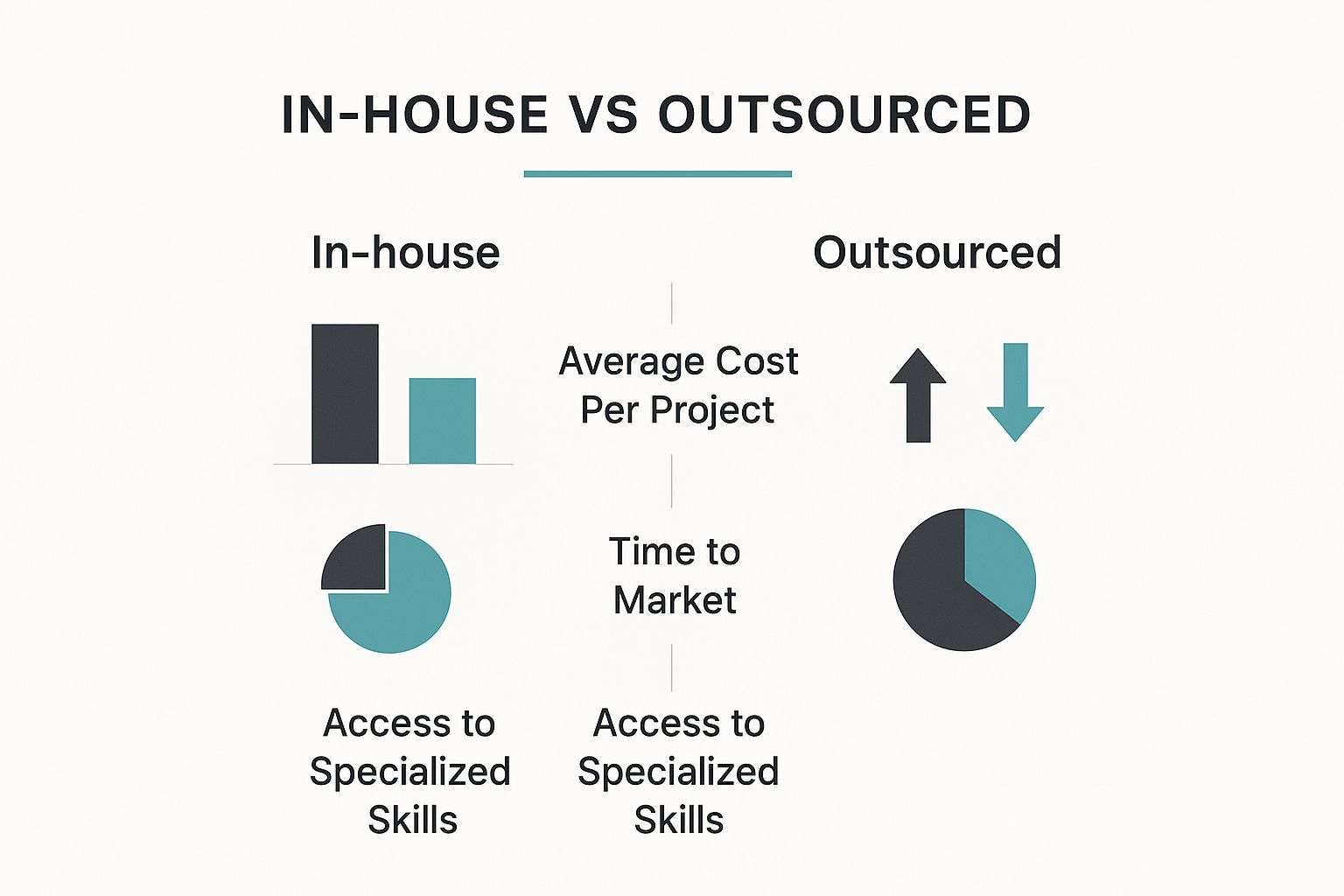
This infographic illustrates the differences between in-house and outsourced software development regarding average cost, time to market, and access to specialized skills. Outsourced development generally offers cost savings and faster access to specialized skills, leading to a quicker time to market.
Decision Frameworks for Success
Successful companies use decision frameworks to guide their outsourcing model selection. These frameworks consider:
Cost-benefit analysis: Weighing the costs of different models against potential benefits.
Risk assessment: Identifying potential risks, like communication issues or quality concerns.
Communication plan: Defining how communication will be managed across different locations.
Service Level Agreements (SLAs): Establishing clear expectations for service quality and delivery timelines.
By carefully evaluating these factors and using a structured decision framework, businesses can confidently select the outsourcing model that best aligns with their unique needs, setting them up for success. This strategic approach maximizes the benefits of outsourcing to achieve business objectives.
Global Talent Hotspots: Where Smart Companies Are Looking

Finding the right people for your projects is crucial, especially when you need creative talent. For insightful guidance on this, creative staffing solutions offers valuable resources. Many companies recognize that top software development talent isn’t always found locally. This understanding has fueled a significant rise in outsourcing, with businesses actively seeking talent in global hotspots. But where are these hotspots located, and what makes them so attractive?
Beyond Traditional Outsourcing Destinations
While India remains a significant player in outsourcing, companies are increasingly exploring emerging tech hubs. These new hubs offer a variety of benefits, from specialized tech skills to more favorable costs. Diversifying talent sources helps mitigate risk and provides access to a larger pool of skilled professionals. This allows businesses to strategically select the location that best fits their project needs.
Eastern Europe: A Rising Tech Powerhouse
Eastern Europe has become a major force in software development. Countries like Ukraine and Poland have robust technical education systems, producing highly skilled developers. These developers are proficient in a wide range of programming languages and technologies. Ukraine has particularly become a hub for AI development. Poland, with its strong IT infrastructure and burgeoning startup scene, attracts businesses seeking expertise in web and mobile development. The proximity to Western Europe and strong English language skills in these regions further facilitate smooth communication and collaboration.
Latin America: Bridging the Gap
Latin America offers nearshore advantages for North American businesses. Argentina, for instance, boasts a thriving mobile development community. Brazil’s expanding tech sector provides expertise in areas like cloud computing and cybersecurity. Countries such as Colombia and Mexico are also becoming increasingly popular for outsourcing software development due to their attractive cost structures and minimal time zone differences with the U.S. This allows for efficient real-time communication and streamlined project management.
Southeast Asia: A Growing Force
Southeast Asia is another region gaining traction in software development outsourcing. Vietnam, in particular, is known for providing high-quality software development at competitive prices. The region’s growing number of tech universities and increasing English proficiency are making it a compelling alternative to more established outsourcing locations. This trend also extends to nearby countries like the Philippines. The expansion of available talent pools greatly benefits businesses looking to diversify their outsourcing strategies. North America remains a highly lucrative market for software outsourcing, with its value projected to reach $227.40 billion by 2027. This growth is fueled by factors such as rising labor costs, talent shortages, and the increasing complexity of software projects. Many U.S. companies are outsourcing to nearshore and offshore teams in regions like Latin America, Europe, and Asia to address the skills gap. The increasing demand for cloud solutions, AI-powered applications, and cybersecurity expertise further encourages businesses to partner with outsourcing firms that can deliver effective and affordable solutions. Learn more about North American Software Outsourcing Statistics.
Evaluating Potential Locations
When choosing an outsourcing location, consider these key factors:
Technical Expertise: Does the region have a proven track record in the technologies your project requires?
Cost of Labor: Does the location offer a cost advantage compared to your local market?
Communication and Collaboration: How easy is it to communicate with teams in that location? Are there language barriers or significant time zone differences?
Business Culture: Does the region’s business culture align with your company’s values and work style?
By carefully evaluating these factors, businesses can select the optimal location for their software development outsourcing needs. This strategic approach enables companies to access top-tier talent and maximize the return on their outsourcing investment.
Avoiding the Painful Pitfalls of Outsourcing
Outsourcing software development offers a wealth of benefits, but it’s not a magic bullet. It comes with its own set of potential challenges that, if left unchecked, can lead to frustration and even project failure. This section explores some common pitfalls and, importantly, offers strategies to navigate them successfully.
Communication Breakdowns: Bridging the Distance
One of the most frequent hurdles in outsourcing software development is miscommunication. This can arise from language barriers, cultural differences, or simply a lack of well-defined communication processes. Imagine, for instance, a simple misinterpretation of a key project requirement. This seemingly small issue can snowball into significant delays and expensive rework.
To prevent this, establish crystal-clear communication channels and expectations right from the start. Regular video conferences, comprehensive project documentation, and using collaborative project management tools like Asana can dramatically improve communication flow and keep everyone aligned.
Quality Control: Maintaining High Standards
Another significant concern is maintaining consistent quality. Variations in coding standards and testing practices can result in software bugs and performance problems. How can you avoid this? Implement rigorous quality assurance processes.
This means defining specific quality metrics, conducting regular code reviews, and implementing thorough testing procedures at every stage of development. Think of it as building quality into the product from the ground up.
Security Risks: Protecting Your Assets
Outsourcing inherently involves sharing confidential information with external teams. This naturally raises concerns about protecting your intellectual property and securing sensitive data. A well-drafted contract, with explicit clauses on intellectual property rights and confidentiality, is absolutely essential.
In addition, ensure your outsourcing partner follows stringent security protocols and adheres to all relevant data privacy regulations, like GDPR. Protecting your assets should be a top priority.
Contractual Disputes: Clarity from the Start
Ambiguous contracts can easily lead to disputes later on. Clearly define the project scope, deliverables, payment terms, and intellectual property ownership within the contract. This clarity helps prevent misunderstandings and ensures everyone is on the same page regarding expectations. Choosing the right vendor is also crucial; carefully evaluate your options, including whether to Outsource SEO Services.
Managing Expectations: Realistic Goals and Timelines
Unrealistic expectations about project timelines and deliverables can create unnecessary stress and disappointment. Work collaboratively with your outsourcing partner to establish realistic goals and timelines. Account for potential delays and incorporate buffer time to handle unforeseen issues. A pragmatic approach is key.
Building a Governance Framework: Maintaining Oversight
Staying informed about the project’s progress without micromanaging is a delicate balance. Establish a clear governance framework that outlines roles, responsibilities, and reporting procedures. Regular progress reports, using key performance indicators (KPIs), and maintaining open communication channels allow for effective oversight without hindering the outsourcing team’s autonomy.
Contingency Planning: Preparing for the Unexpected
Even with the most meticulous planning, unexpected issues can arise. Develop a contingency plan to address potential problems such as unforeseen delays, team member turnover, or changes in project requirements. This proactive approach minimizes disruptions and keeps the project moving forward.
By addressing these potential pitfalls proactively, businesses can dramatically improve the chances of a successful outsourcing experience. This approach not only mitigates risks but also cultivates a stronger, more productive working relationship with the outsourcing partner. The result? Better outcomes and a more positive experience for everyone involved. Effective communication, clearly defined contracts, robust quality control, and consistent oversight are essential ingredients for achieving your software development goals through outsourcing.
Building Genuine Partnerships (Not Just Vendor Relationships)

The success of outsourced software development often depends on the relationship you build with your outsourcing partner. Simply viewing them as a vendor often leads to subpar results. A true partnership, however, can unlock exceptional outcomes.
This involves a shift in perspective, moving from transactional interactions toward a collaborative and mutually beneficial relationship. It’s about seeing your outsourcing partner as an extension of your team, not just a service provider.
Onboarding and Knowledge Transfer: Setting the Stage for Success
Effective onboarding and knowledge transfer are essential. This involves clearly communicating project goals, sharing necessary documentation, and providing access to relevant systems. Think of it as integrating a new member into your internal team.
The smoother the integration, the faster they can contribute meaningfully. This lays the groundwork for open communication and effective collaboration throughout the project’s life cycle. A well-onboarded team is a productive team.
Cultural Integration: Bridging the Gaps
When collaborating with teams across geographical and cultural boundaries, understanding and respecting those differences is key. Acknowledging different communication styles, work ethics, and holidays fosters respect and understanding.
This cultural sensitivity builds trust and strengthens the partnership. For instance, adjusting communication schedules to accommodate different time zones shows consideration and facilitates smoother interactions. This might involve scheduling meetings at times convenient for both parties, requiring some flexibility.
Communication Protocols and Collaboration Tools: Staying Connected
Clear communication protocols are the backbone of successful outsourcing. Establishing preferred communication channels, setting clear expectations for response times, and utilizing collaborative tools streamlines interactions.
Tools like Slack, Microsoft Teams, or dedicated project management platforms keep everyone connected and informed, regardless of location. These platforms create a central hub for communication, document sharing, and progress tracking, promoting transparency and accountability.
Regular video conferences enable face-to-face interaction, essential for building rapport and tackling complex issues. This personal touch can significantly improve communication and collaboration.
Management Techniques for Distributed Teams: Fostering Ownership
Managing a distributed team requires a different approach than managing an in-house team. Emphasize clear goals, provide consistent feedback, and encourage autonomy. Empowering outsourced teams to take ownership of their work builds a sense of responsibility and pride.
This involves clearly defining roles and responsibilities, providing the necessary resources, and trusting the team to manage their workload. Regular check-ins and progress reviews help keep the project on track and allow for adjustments as needed.
Inspiring Excellence: Going Beyond Requirements
Forward-thinking companies encourage their outsourced teams to contribute ideas and go the extra mile. This means fostering a collaborative environment where ideas are welcomed and valued. Recognizing and rewarding outstanding performance cultivates a culture of excellence.
This can be as simple as acknowledging a team member’s creative solution or celebrating milestones. When outsourced teams feel valued, they become more invested in the project’s success and contribute beyond the minimum requirements. A common pitfall is improper vendor selection; carefully consider whether to Outsource SEO Services. Building genuine partnerships can transform outsourcing arrangements into engines for innovation and growth, delivering exceptional results.
Future-Proofing Your Outsourcing Software Development Strategy
The outsourcing world is always evolving. To keep up, your software development outsourcing approach needs to be just as adaptable. This section dives into the latest trends and how innovative companies are maximizing the value of their external development partners.
Embracing Emerging Trends
Several key trends are shaping the future of outsourcing software development:
AI-Augmented Programming: AI tools like GitHub Copilot are becoming increasingly common for developers, improving both productivity and the quality of code. This translates to outsourced teams potentially delivering better work, faster.
Blockchain-Based Contracting: Blockchain technology is gaining traction for secure and transparent contract management. This has the potential to minimize disputes and simplify payment processing.
Microservice Specialization: Outsourcing specific microservices gives companies access to specialized expertise and facilitates building more adaptable and scalable applications. For instance, a company could outsource the creation of a payment processing microservice to a team with deep experience in financial technology.
These trends are just a snapshot of the changing software development outsourcing landscape. Keeping current on these advancements is key for businesses that want to remain competitive.
Innovative Strategies for Competitive Advantage
Forward-thinking companies are exploring new ways to enhance their outsourcing strategies:
Outcome-Based Pricing: Moving away from hourly rates and toward measurable outcomes better aligns incentives and promotes improved performance. This model prioritizes specific results over simply paying for time.
Hybrid Team Structures: Combining internal and outsourced teams lets companies capitalize on the strengths of both, leading to a more flexible and budget-friendly workforce. This approach gives businesses greater control over core project elements while still utilizing external expertise for specialized tasks.
Advanced Collaboration Platforms: Investing in cutting-edge collaboration tools like Slack or Microsoft Teams improves communication, project management, and knowledge sharing across geographically dispersed teams, ultimately improving efficiency and productivity.
By using these strategies, companies can break free from traditional outsourcing models and forge more dynamic, efficient, and results-oriented partnerships.
From Obsolete Practices to Future Capabilities
Some traditional outsourcing practices are becoming less effective. For example, depending solely on fixed-price contracts for involved projects can stifle innovation and lead to disagreements. Similarly, prioritizing only cost reduction can limit access to top talent.
To thrive in the future of outsourcing, companies need to develop these capabilities:
Agile Project Management: Adopting agile methodologies enables greater flexibility and responsiveness to evolving project requirements. This adaptability is crucial in today’s dynamic development environment.
Strong Communication and Collaboration Skills: Clear communication and collaboration are essential for effectively managing distributed teams and achieving shared goals.
Data-Driven Decision Making: Using data analytics to track performance and pinpoint areas for improvement helps refine outsourcing strategies and maximize return on investment.
By moving past outdated practices and fostering these key capabilities, businesses can position themselves to take advantage of emerging opportunities in the outsourcing arena and maintain a competitive edge.
Ready to elevate your software development? creavoid offers specialized AI solutions, custom software development, and performance-driven online marketing to help your business succeed. Visit creavoid today to find out more.